Appearance
Child Protective Services (CPS) Genogram Template
A CPS genogram template helps you map a child’s household, placement history, system involvement, and family risk factors in one view. Use it when a child welfare assessment, court report, or case review depends on seeing both the caregiving structure and the protective relationships around the child.
Child Protective Services (CPS) Genogram Template
What This Template Shows
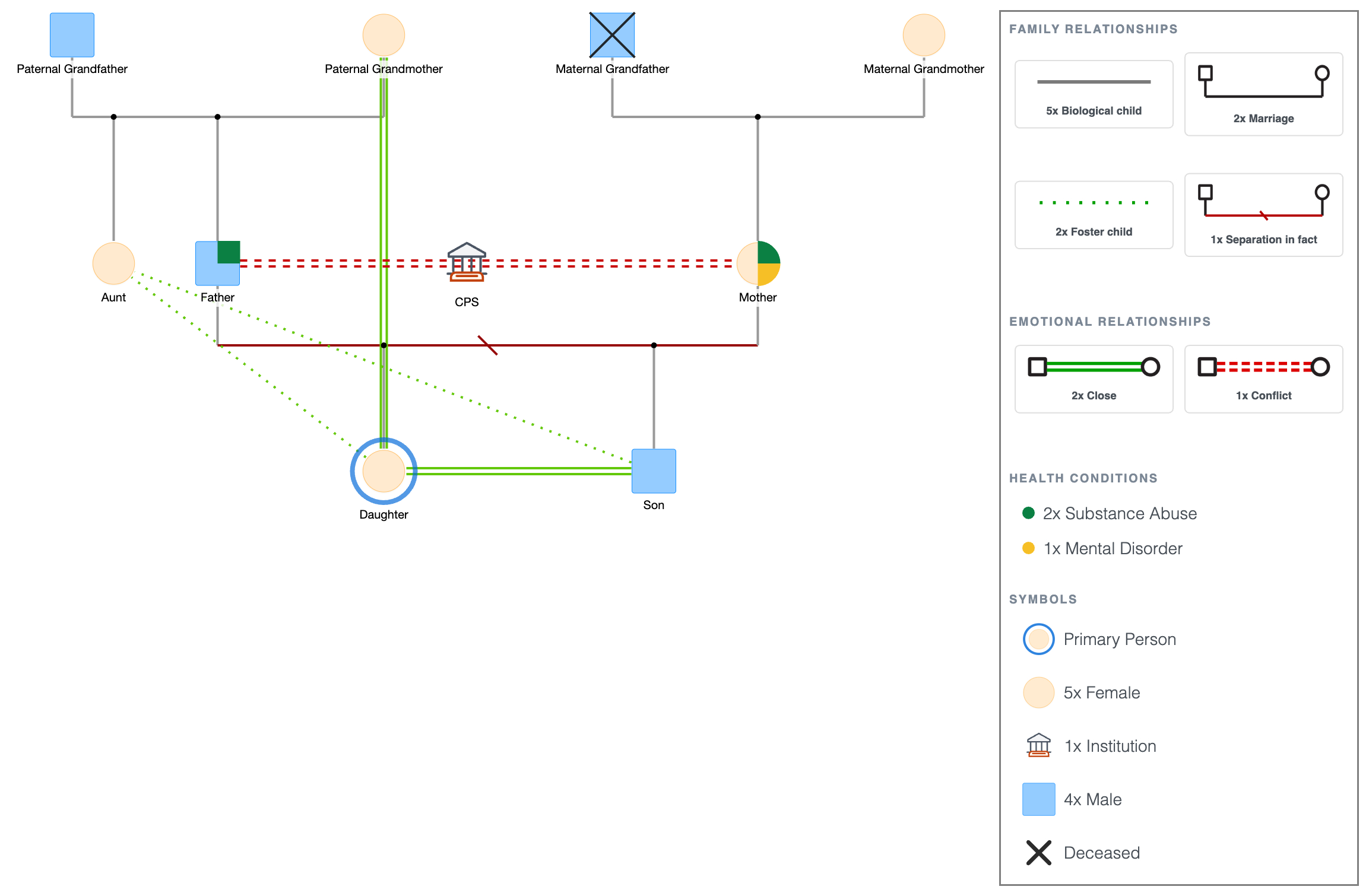
Three generations with a child protection structure.
The parents are separated; both carry substance use markers, and the mother also carries a mental disorder marker.
The child (the primary person) and her sibling are placed with a paternal aunt via foster child lines.
A CPS institution node connects to the child's household.
The child has a close relationship with her paternal grandmother and with her sibling. The parents are in conflict.
The child protection picture is visible in the diagram: parental risk factors in the middle generation, the child's placement with a kinship caregiver documented through the foster child line, CPS involvement shown through the institution node, and the sibling bond and grandmother relationship as the protective factors in an otherwise high-risk picture.
The symbol legend is displayed below the diagram. For full definitions and clinical usage, see Genogram Symbols Explained.
When to Use This Template
- CPS intake and safety assessment: map the child's household composition, parental risk factors, and extended family network at the point of referral or initial contact.
- Kinship placement identification and documentation: use the extended family structure to identify potential kinship caregivers and document placement arrangements and relationship lines.
- Court report preparation: provide a clear visual summary of the child's family structure, placement history, and the rationale for the agency's care plan or permanency recommendation.
- Child welfare and MSW field placement coursework: meets standard documentation requirements for child welfare tracks within BSW and MSW programs.
How to Use This Template
1. Download as-is
Click the PDF or PNG button under the embed to download immediately. Use as a case reference, supervision document, or teaching example.
2. Customize before downloading
Click "Use this genogram" to open the template in EasyGenogram. Replace the generic labels with real or fictional names, adjust the household configuration, and update the risk markers, placement lines, and institution nodes to reflect the actual case.
Export as PDF or PNG when done, or share via link with a supervisor or case team.
Child Protective Services (CPS) Genogram Template
Explore this genogram and adapt it to your needs.
FAQ
What is a CPS genogram template?
A CPS genogram template is a family diagram used in child protective services to map a child's household composition, family structure, system involvement, and risk and protective factors. It gives caseworkers a visual record of the full family network alongside CPS and court involvement.
How is a CPS genogram different from a standard social work genogram?
A standard social work genogram covers family structure, household markers, and system involvement broadly. A CPS genogram focuses specifically on child protection; the child is the primary person, abuse and neglect risk factors are documented on relevant family members, foster and kinship placement lines are used to show where the child is living, and institution nodes document CPS and court involvement directly in the diagram.
What does a child welfare genogram include?
A child welfare genogram covers at least three generations and includes household composition and living arrangements, parental risk factors such as substance use and mental health markers, foster and kinship placement lines, CPS and court institution nodes, sibling relationships, and the protective factors in the family network such as close relationships with extended family members who may support the child or serve as kinship caregivers.
Is this template free?
Yes. Open and customize it in EasyGenogram at no cost. Export requires a subscription for most users; students with a valid school email can export free.
Can I use this for a child welfare or MSW field placement assignment?
Yes. The template follows McGoldrick-Gerson-Petry standard notation and includes the placement lines, institution nodes, and risk markers required for child welfare documentation. Open it in EasyGenogram, adjust the family structure to match your assignment or case, and export as PDF for submission.