Appearance
Genogram for Foster Care
A genogram in foster care isn't a one-time diagram. As a child's contact arrangements and placement status change over the life of a case, the same genogram gets updated to reflect it, rather than rebuilt from scratch at every review.
Why the Genogram Doesn't Stay Static
A foster placement rarely looks the same at month one as it does at month twelve.
Contact with a biological parent might start suspended and become supervised, then unsupervised, then overnight.
A placement might shift from full-time to transitional as reunification gets closer.
If the genogram only reflects the day it was drawn, it stops being useful the moment anything changes, which for most cases is within weeks.
The Sherwood Family Example
Genogram for Foster Care (Intake)
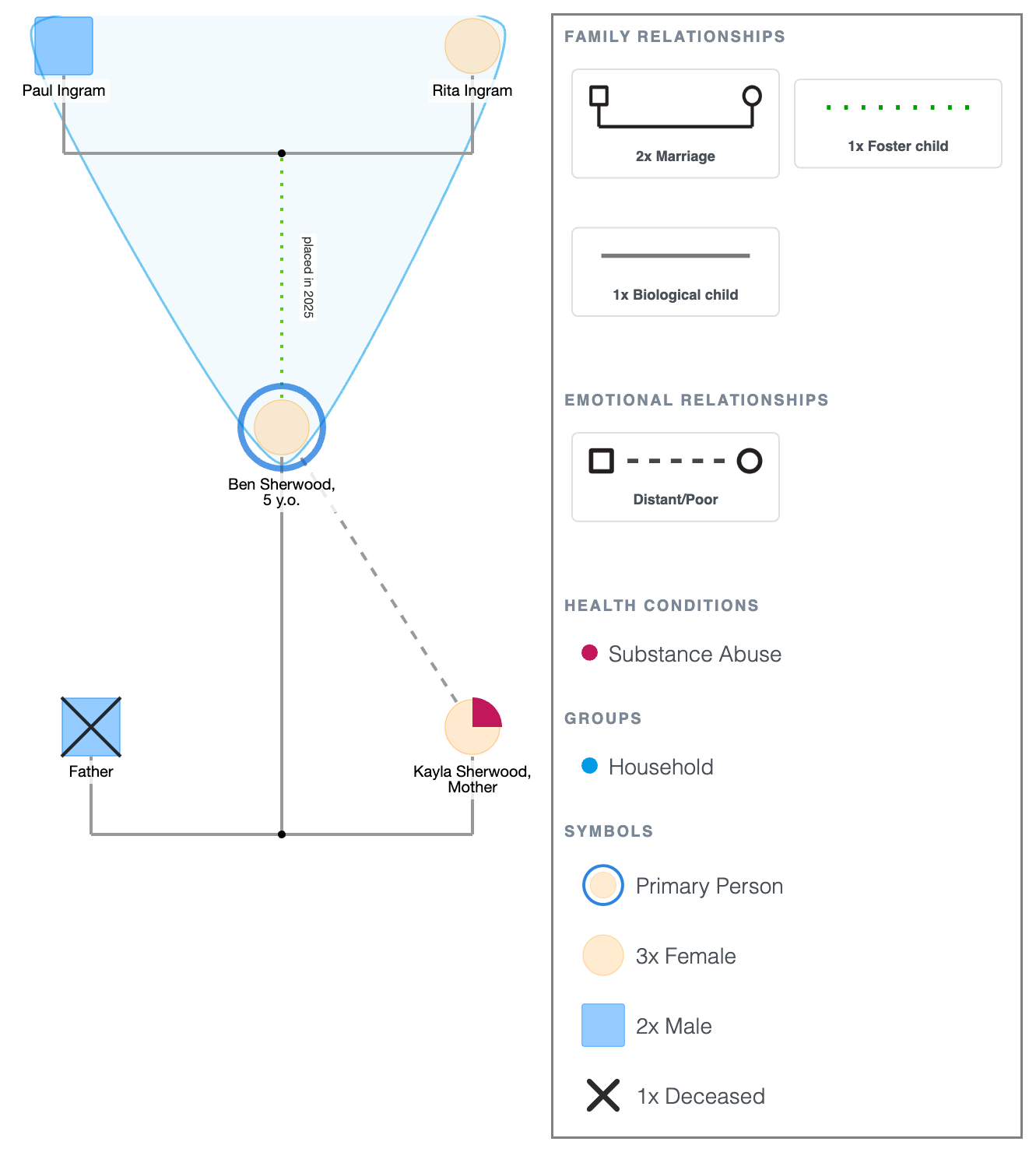
- Ben Sherwood, 5, primary person, removed at intake due to his mother's substance use.
- Foster carers: Paul and Rita Ingram - green dotted foster child line to Ben, placement date noted.
- Mother: Kayla Sherwood - Distant/Poor line to Ben at intake, later updated.
Ben Sherwood was removed from his mother Kayla's care at age five following a substantiated finding related to her substance use.
He was placed with foster carers Paul and Rita Ingram, and his caseworker built a genogram at intake showing the placement and a Distant/Poor line to Kayla, reflecting suspended contact while she began treatment.
How the Diagram Changed Over the Case
At month one, the diagram showed exactly what was true then: Ben with the Ingrams, Kayla's line marked Distant/Poor, contact suspended pending her entry into treatment. Nothing about that line was permanent, it recorded the case's status at that point.
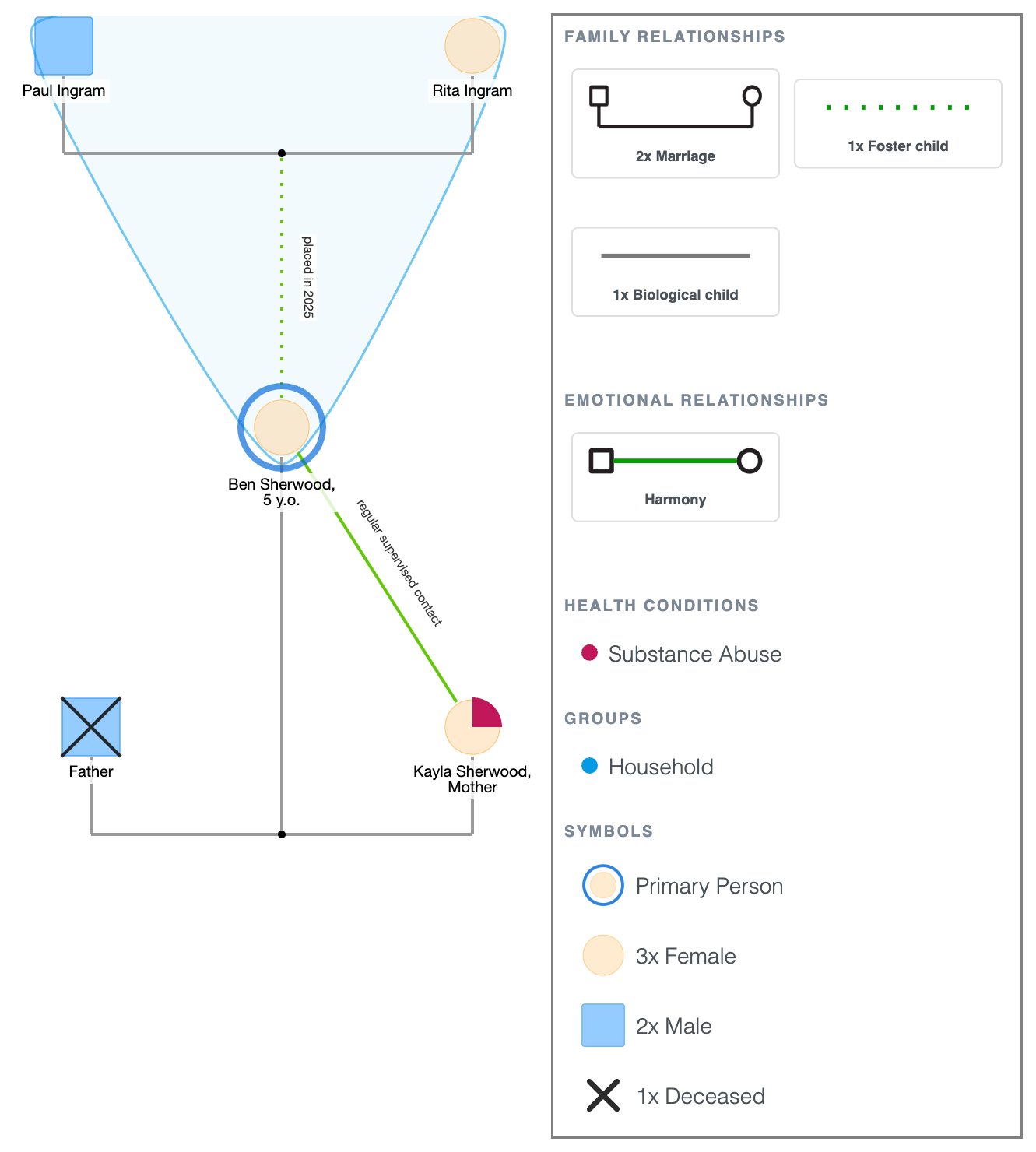
By month four, Kayla had completed her treatment program, and her line to Ben was updated to reflect regular supervised contact, a meaningfully different relationship than the one recorded four months earlier, shown on the same diagram rather than a new one.
Genogram for Foster Care (4 Months)
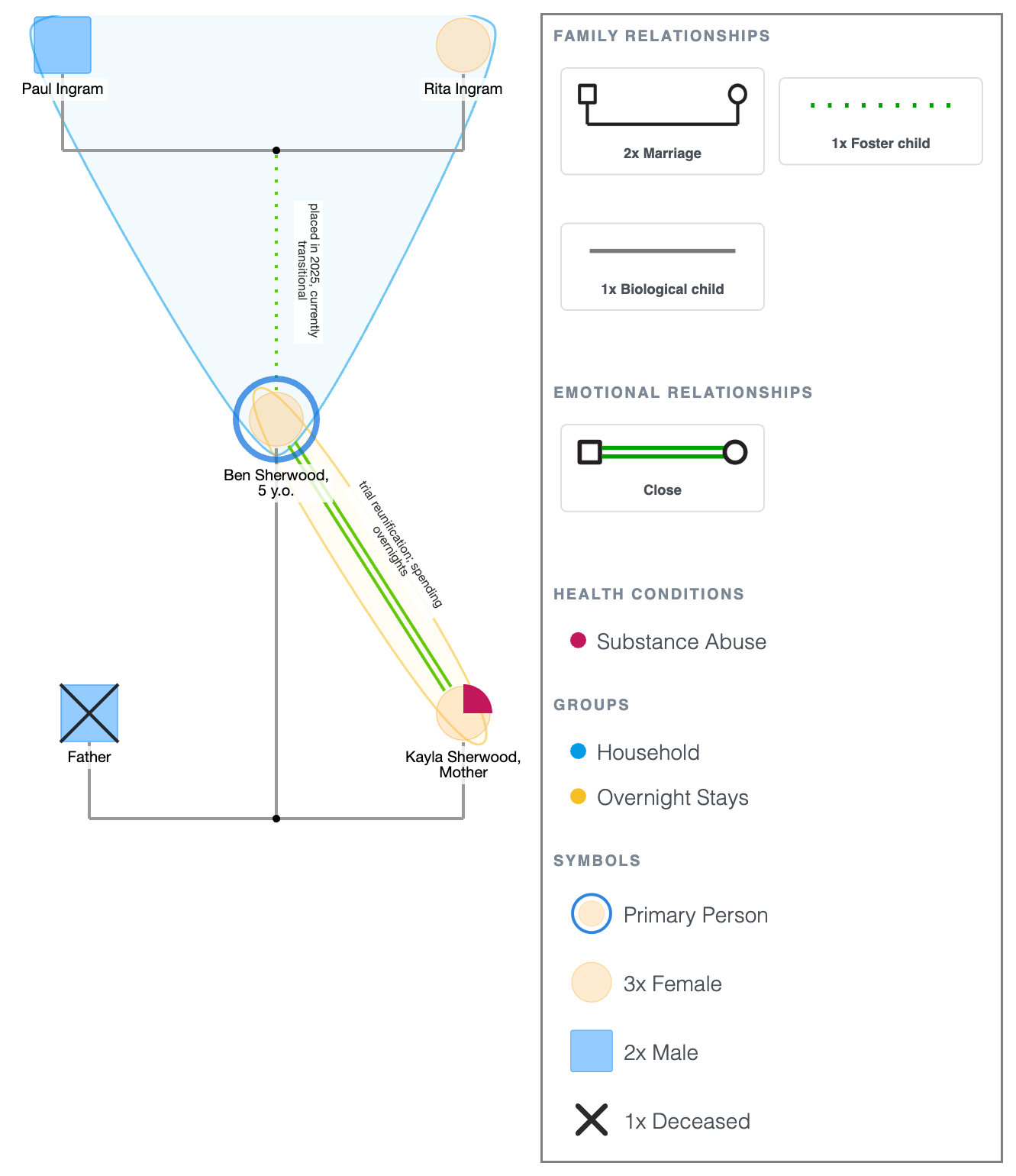
At month nine, trial reunification began. Ben started spending overnights with Kayla, and the foster placement line to the Ingrams was annotated as transitional, still active but no longer the sole placement. Two relationships were live on the diagram at once, which is exactly what was happening in Ben's actual life at that point.
Genogram for Foster Care (9 Months)
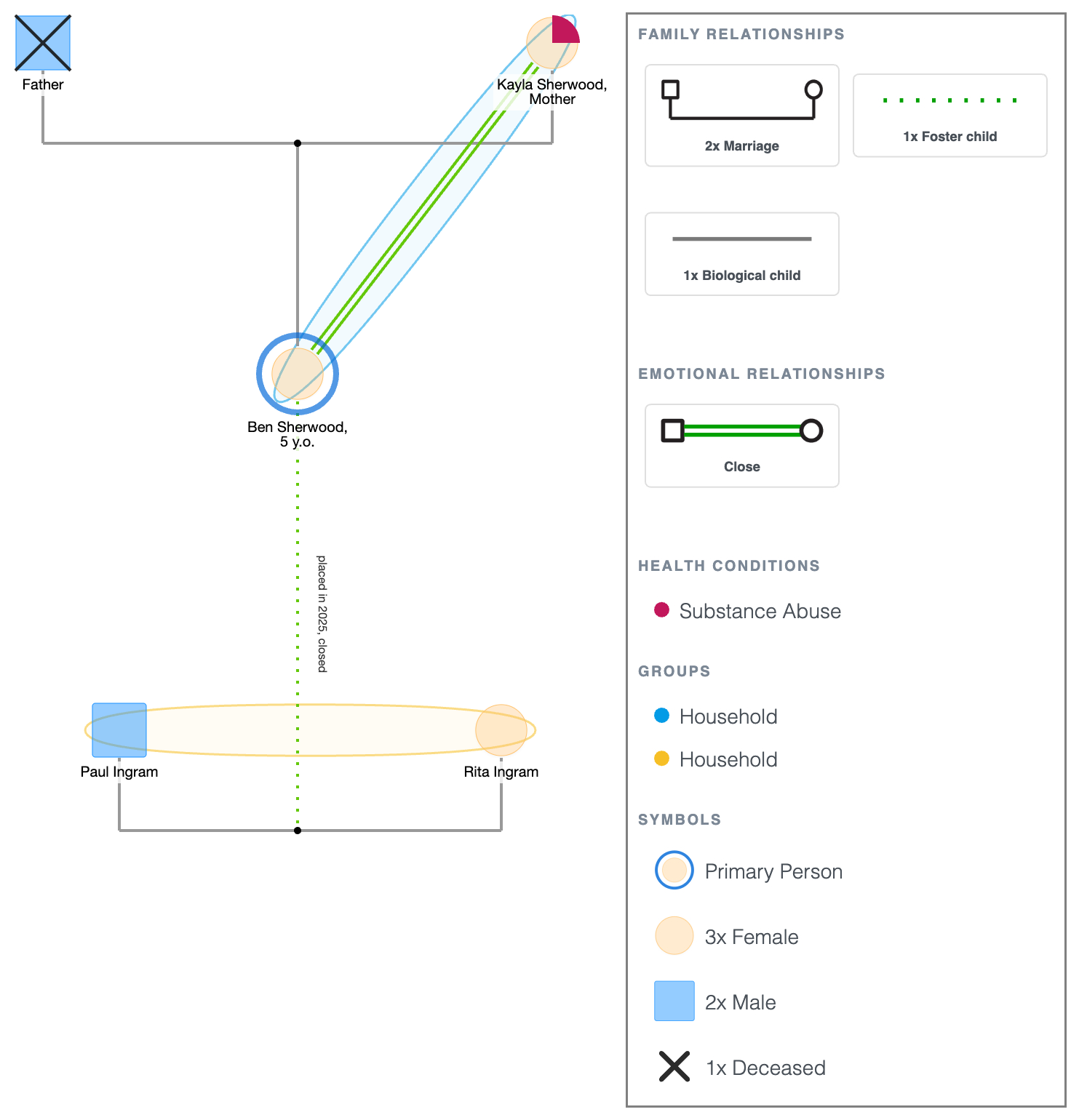
By month twelve, the case closed. Ben was fully reunited with Kayla, the foster line to the Ingrams got a closing date, and Kayla's line became the primary household connection again. The diagram at closure looks nothing like the diagram at intake, but it's the same diagram, updated four times rather than replaced.
Genogram for Foster Care (12 Months)
Why This Matters for the Case Record
A caseworker reviewing Ben's file at month nine doesn't need to read four separate narrative updates to understand where the case stands.
The genogram shows it directly: a transitional foster placement, a strengthening maternal relationship, and the specific time period each change occurred.
At a permanency hearing, that same diagram gives the court a visual case history instead of a purely verbal summary of what changed and when.
This matters just as much when a case doesn't move toward reunification.
A genogram that's been honestly updated at every stage, including stalled progress or a contact arrangement that had to be scaled back, is a more accurate record than one that only shows the most recent snapshot.
Build and Update One Across a Case
Start the genogram at intake with the placement and biological family connections as they stand.
At each significant case event, a change in contact arrangement, a new placement, a step toward reunification, update the relevant line rather than creating a new diagram.
Note the date of each change directly on the line so the diagram itself becomes a timeline.
Export a copy at each major review point for the case file, so the diagram's history is preserved alongside its current state.
For the full guide, see How to Make a Genogram.
Genogram for Foster Care (12 Months)
Explore this genogram and adapt it to your needs.
FAQ
Should I keep old versions of the genogram or just update the current one?
Keep both. Update the working diagram so it reflects the current case status, but export and save a copy at each major review point. That gives you both an accurate current picture and a record of how the case has progressed.
How do you show a placement that's transitioning toward reunification?
Annotate the foster placement line as transitional rather than removing it outright, since the placement is often still active alongside increasing contact with the biological parent. Both relationships exist at once during this period, and the diagram should show that.
What happens to the foster placement line once a child is reunified?
Add a closing date to the foster child line rather than deleting it. The placement is part of the child's history even after it ends, and removing it entirely loses information a future reviewer might need.
Does every foster care case move toward reunification the way Ben's did?
No. Some cases move toward adoption or long-term kinship care instead. The same principle applies regardless of the outcome; update the genogram to reflect the case's actual trajectory rather than assuming reunification is the default direction.
How often should a foster care genogram actually be updated?
At every significant change, such as a shift in contact arrangement, a new placement, a step toward or away from reunification, or a court hearing. Waiting until a scheduled review to update it risks the diagram falling out of sync with what's actually happening in the case.
Sources
- Child Welfare: A Unified Model of Practice
- Genograms: Assessment and Intervention (4th ed.)