Appearance
Foster Care Genogram
Social work and child welfare assignments that involve looked-after children require accurate notation for the foster placement, the biological family, and any contact arrangements. This guide covers each one and includes a completed example to adapt.
How Foster Care Appears in a Genogram
The foster child connection
In EasyGenogram, foster children are connected to their foster parents with a green dotted line.
This runs from the foster parent down to the child's symbol, in the same structural position as a biological or adopted child.
The line type is what identifies the placement as foster rather than biological or adoptive.
Biological parents
Biological parents remain legally the child's parents during a foster placement and appear in the diagram.
They are placed separately from the foster family and connected to the child through a biological child line.
Their relationship lines to the child reflect the current contact arrangement, which could be a thin solid line for regular supervised contact, or a dashed line for infrequent or suspended contact.
Placement dates
Placement start dates are noted alongside the foster child line to anchor the diagram to a specific point in the case history.
When a placement has ended, the end date is added. This allows multiple placements to be shown as a chronological record.
Multiple placements
A child with a history of multiple placements can have prior foster families shown in the diagram with dated lines, each labeled with the placement period.
This makes the placement history visible without requiring a separate case note.
Kinship care
When the foster placement is with a relative; such as a grandparent, aunt, or uncle, the same green dotted foster line applies.
The relative's structural relationship to the child (through the biological parent) is also shown, so the diagram records both the kinship connection and the formal foster placement simultaneously.
For the full symbol reference, see the genogram symbols guide.
Foster Care vs Adoption in a Genogram
The line types are similar but carry different meanings:
- Foster child: green dotted line. The placement is temporary. Biological parents remain legally connected and appear in the diagram with their own lines to the child.
- Adopted child: dashed blue line. The placement is permanent and legally finalized. Biological parents may or may not appear depending on the adoption type and contact arrangements.
For the adoption-specific notation, see the adoption genogram article.
A Completed Foster Care Genogram Example: The Murray Family
Rob Murray (46) and Helen Murray (43) are experienced foster carers.
They have one biological son, Oliver (17), and are currently fostering two children: Liam (9), placed 8 months ago, and Ella (7), placed 3 months ago.
Liam's biological mother, Jane (28), has monthly supervised contact.
His biological father's whereabouts are unknown.
Ella's biological parents, Claire (25) and Mark (27), are subject to ongoing care proceedings.
Foster Care Genogram Example
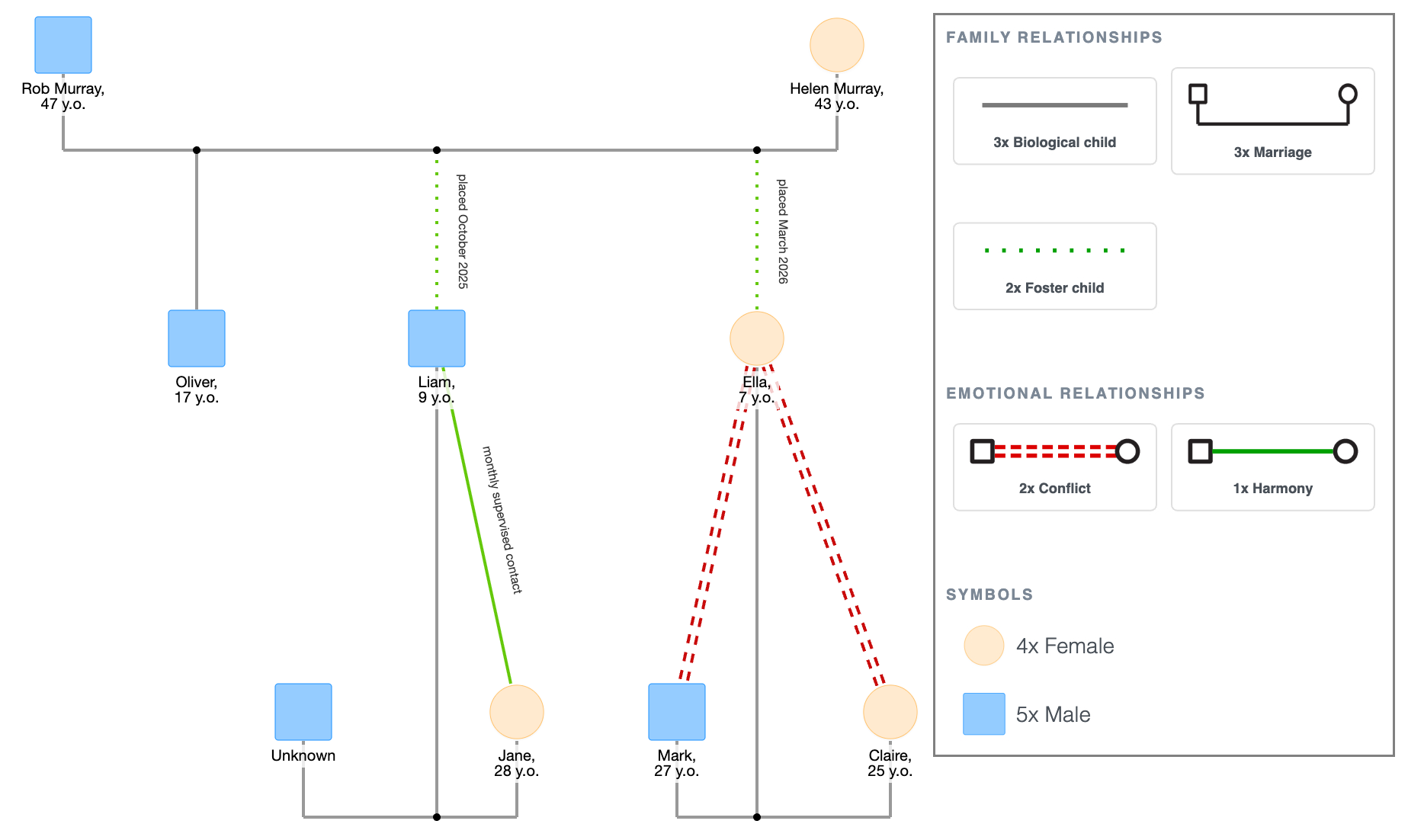
The family:
- Rob Murray, 46, and Helen Murray, 43 - married.
- Oliver Murray, 17 - biological son, connected by a solid line.
- Liam, 9 - foster child, connected to Rob and Helen by a green dotted line. Placement date noted: October 2025.
- Ella, 7 - foster child, connected to Rob and Helen by a green dotted line. Placement date noted: March 2026.
- Jane, 28 - Liam's biological mother. Shown separately with a biological child line to Liam. Relationship line: thin solid, toward Liam; monthly supervised contact taking place.
- Liam's biological father - unknown. Symbol placed in correct position, labeled unknown.
- Claire, 25, and Mark, 27 - Ella's biological parents. Shown separately, each with a biological child line to Ella.
- Stressful lines from both to Ella - conflict lines indicate the stress associated with ongoing care proceedings.
What this genogram shows:
- Oliver, Liam, and Ella sit on the same sibship line below Rob and Helen. Their different connection lines (one solid, two dotted) show their different relationships to the foster family.
- Liam has been placed longer than Ella. The placement dates on each dotted line make that visible. A caseworker reviewing the diagram at the 12-month point can see at a glance which placement is more established.
- Jane appears with a biological line to Liam and an active relationship line. She is not in the household; her position in the diagram shows that. She is, however, present in Liam's life; the contact line shows that too.
- Liam's father is unknown but his position is not empty. The symbol is there, labeled unknown. Removing it would imply he doesn't exist.
- Claire and Mark both carry stressful lines to Ella, reflecting the proceedings. They appear in the diagram because they are still Ella's legal parents. The nature of the proceedings is shown in the line type (conflict).
Foster Care Genogram Example
Explore this genogram and adapt it to your needs.
When to Use a Foster Care Genogram
- Placement assessment - mapping the child's full system at the point of referral or placement.
- Care review - updating the diagram to reflect changes in contact arrangements, new siblings, or placement history.
- Court documentation - a dated genogram provides a visual record of the child's family connections and placement history.
- Social work intake - establishing the full picture of the child's family before case planning begins.
- Academic assignments - social work and counseling courses that require genograms involving non-standard family structures.
How to Build a Foster Care Genogram
- Place the foster family: standard couple line with a double border or marker identifying them as the current household.
- Add biological children: solid line from the couple line.
- Add foster children: green dotted line from the couple line, with placement date noted on the line.
- Add biological parents: place them separately with a biological child line connecting to the child.
- Show contact arrangements: draw a relationship line between the biological parent and the child reflecting the current nature of contact.
For a full step-by-step guide, see how to make a genogram.
FAQ
How do you show foster care in a genogram?
Foster children are connected to their foster parents with a dotted line, and in EasyGenogram, this appears as a green dotted line. The child's symbol is the same as any other child; it is the line type that identifies the placement as a foster arrangement. Biological parents are shown separately in the diagram with their own connection lines to the child, reflecting that they remain legally connected during the placement.
What is the symbol for a foster child in a genogram?
In standard genogram notation, the foster child connection is a dotted vertical line from the foster family's couple line down to the child's symbol. In EasyGenogram, this is a green dotted line. The child's own symbol (a square for male, a circle for female) is standard. The line type is what distinguishes a foster placement from a biological or adoptive relationship.
How is a foster care genogram different from an adoption genogram?
The main difference is the line type and what it means. A foster child connection (dotted green line) indicates a temporary placement; biological parents remain legally connected and appear in the diagram. An adopted child connection (dashed blue line) indicates a permanent legal relationship; the child has been legally transferred to the adoptive family. In both cases, biological parents may appear on the diagram, but their role and connection differs.
How do you show biological parents in a foster care genogram?
Biological parents are placed separately from the foster family and connected to the child through a biological child line. Their relationship line to the child reflects the current contact arrangement; a solid line for regular contact, a dashed line for infrequent or suspended contact, a zigzag if the relationship is stressful or conflictual. If a biological parent's whereabouts are unknown, a symbol is placed in the correct position and labeled unknown.
Is there a foster care genogram template?
Open the Murray family genogram above in EasyGenogram and replace the family details with your own case. It includes the correct notation for a foster placement with biological parent connections and placement dates. For a blank starting point, see the genogram template page in Qwoach.
Sources
- Genograms: Assessment and Intervention (3rd ed.). W.W. Norton & Company.