Appearance
Adoption Genogram
Social work and counseling assignments that involve adoptive families require accurate notation for adopted children, biological parents, and any ongoing contact arrangements. This guide covers each one and includes a completed example to adapt.
How Adoption Appears in a Genogram
The adopted child connection
In EasyGenogram, adopted children are connected to their adoptive parents with a dashed blue line.
This is drawn from the couple's (or individual’s) line down to the child's symbol, the same position as a biological child but with a different line style.
The position in birth order is maintained; adopted children appear in chronological order of joining the family alongside biological siblings.
The adoptive parents
The adoptive parents appear as the primary parenting connection. Their couple line and parent-child connection are drawn in the same way as any other parental relationship.
The dashed blue line connecting them to the adopted child is what identifies the adoption.
Biological parents, when known
When biological parents are known, they can appear on the diagram outside the main household.
They connect to the child through a separate biological child line rather than the adoptive parent couple line.
Their position on the diagram makes clear they are the birth parents, not the raising parents.
Biological parents, when unknown
When one or both biological parents are unknown, a symbol is placed in the correct position with a label noting unknown.
The position is not left empty, an unknown parent is still part of the child's biological history.
Open adoption contact
In open adoption arrangements where the birth parent has ongoing contact with the child, that contact can be shown as a relationship line between the birth parent and the child.
The line type reflects the quality of the contact; a positive, consistent relationship carries a solid line; infrequent or complicated contact carries a dashed or stressful line.
For the full symbol reference, see the genogram symbols guide.
A Completed Adoption Genogram Example: The Lawson Family
Tom Lawson (42) and Karen Lawson (39) have been married for twelve years.
They have one biological daughter, Emma (8), and one adopted son, Ben (6).
Ben was adopted domestically through an open adoption two years ago.
His birth mother, Sarah (26), has agreed to contact twice a year. His birth father is not known.
Adoption Genogram Example
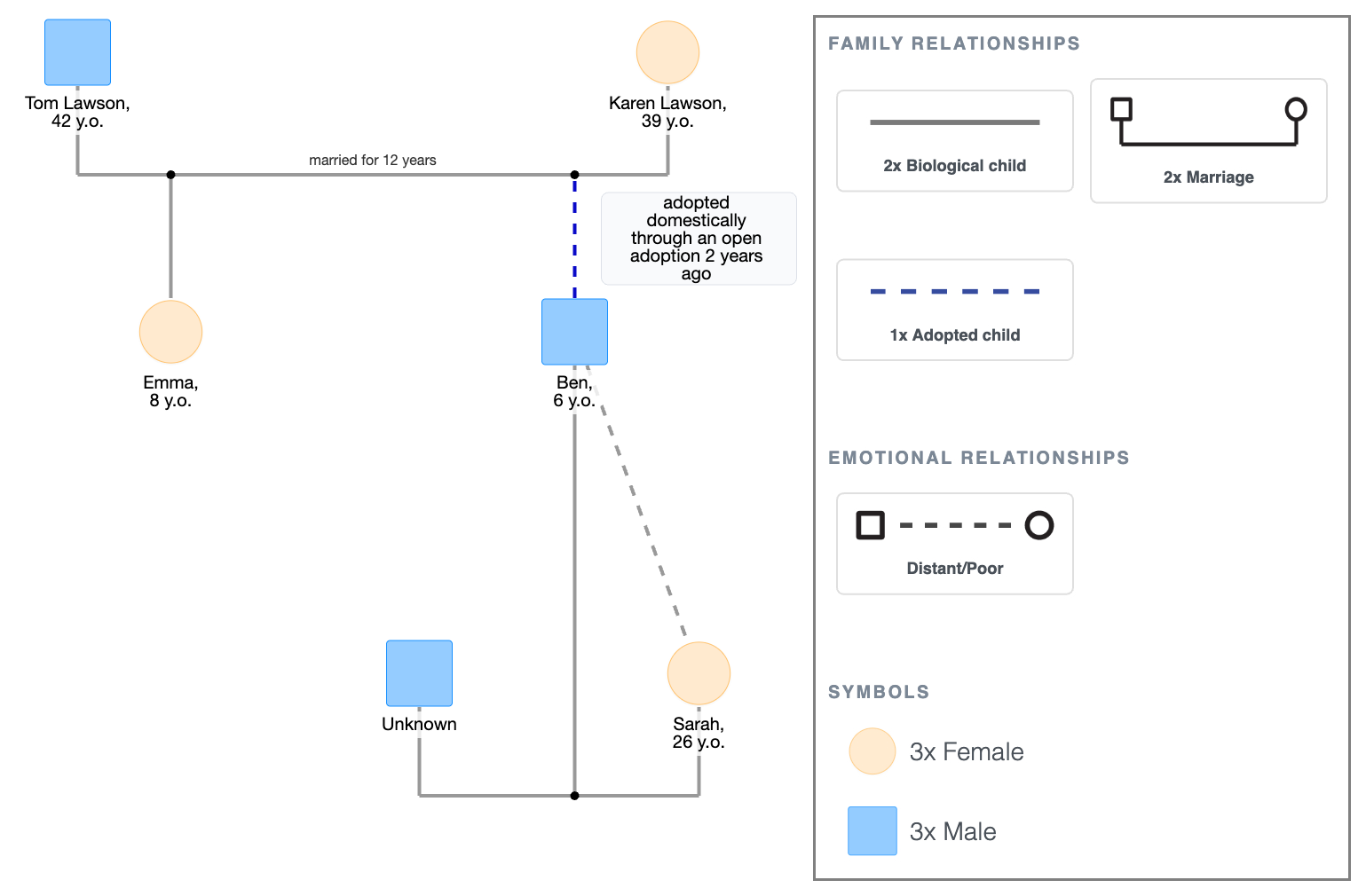
The family:
- Tom Lawson, 42, and Karen Lawson, 39; married, connected by a solid horizontal line.
- Emma Lawson, 8; biological child, connected to Tom and Karen by a solid line.
- Ben Lawson, 6; adopted child, connected to Tom and Karen by a dashed blue line.
- Sarah, 26; Ben's birth mother, connected to Ben by a biological child line outside the main household. The relationship between Sarah and Ben shows the open adoption contact; a thin solid line reflecting twice-yearly contact that is still forming.
- Ben’s birth father; unknown. Symbol placed in correct position, labeled unknown. No connection line.
What this genogram shows:
- Emma and Ben sit on the same sibship line in birth order. Their different connection lines (one solid, one dashed) mark the distinction between biological and adopted. The diagram holds both children in the same structural position while recording how each joined the family.
- Sarah appears outside the main household with a biological connection to Ben and a thin relationship line showing the open adoption contact. She is not a parent in the household; her position in the diagram shows that. She is, however, a present (albeit distant) connection in Ben's life; the relationship line shows that too.
- Ben's birth father appears as an unknown symbol. His position acknowledges that a biological father exists even where no information is available. Leaving the position empty would suggest no biological father, so marking it unknown is more accurate.
Adoption Genogram Example
Explore this genogram and adapt it to your needs.
When to Use an Adoption Genogram
- Adoption assessment — mapping the child's full family system including biological parents and adoptive family for pre-adoption and post-placement reports.
- Family therapy — helping adoptive families and adopted individuals explore identity, attachment, and family belonging.
- Social work intake — documenting the household structure and any ongoing biological family connections.
- Academic assignments — social work, counseling, and psychology courses that require students to map non-standard family structures.
- Personal use — adopted individuals mapping their own family history across both biological and adoptive lines.
How to Build an Adoption Genogram
- Place the adoptive parents: standard couple line at the top of the diagram.
- Add biological children: solid line from the couple line down to each biological child.
- Add adopted children: dashed blue line from the couple line down to each adopted child, in birth order position.
- Add biological parents where known: place them outside the main household with a biological connection line to the child.
- Mark unknown biological parents: place a symbol in the correct position and label it unknown rather than leaving the space empty.
For a full step-by-step guide, see how to make a genogram.
FAQ
How do you show adoption in a genogram?
Adopted children are connected to their adoptive parents with a dashed line rather than the solid line used for biological children. In EasyGenogram, the adopted child connection is a dashed blue line. The adopted child appears in the same position on the sibship line as biological siblings, in chronological order of joining the family. Biological parents can be shown separately outside the main household with their own connection line to the child.
What is the symbol for adopted children in a genogram?
The adopted child connection is a dashed blue line from the adoptive parent down to the child's symbol.
How do you show biological parents in an adoption genogram?
Biological parents are placed outside the main adoptive household with a biological child connection line running to the adopted child. If a biological parent is unknown, a symbol is placed in the correct position and labeled unknown; the position is not left empty. In open adoption arrangements, an additional relationship line can be drawn between the birth parent and the child to show the nature and quality of ongoing contact.
What is an adoption genogram used for?
Adoption genograms are used in pre-adoption and post-placement assessments, family therapy with adoptive families, social work intake for children in care, and academic assignments in social work and counseling programs. They are also used by adopted individuals mapping their own family history across both biological and adoptive lines.
Is there an adoption genogram template?
Open the Lawson family genogram above in EasyGenogram and replace the family details with your own. It is set up with the correct notation for an adoptive family including an open adoption contact. For a blank starting point, see the genogram template page on Qwoach.
Sources
- Genograms: Assessment and Intervention (3rd ed.). W.W. Norton & Company.