Appearance
Genogram for Foster Families
Foster carers documenting their household need a genogram that shows their own family background, their children, and the current placements. This article covers the household-centered version.
What a Foster Family Genogram Maps
- The foster carers' family background: their own parents, siblings, and relevant health history across three generations.
- Biological children: placed on the sibship line with standard solid connection lines.
- Current foster placements: shown with green dotted lines and placement dates.
- Prior placements: where relevant to the case, shown with dated lines and closed dates.
- The household boundary: a dashed line drawn around all current household members makes it immediately clear who is living under the same roof.
What to Include
The foster carers
Place the foster carers in the middle row as the primary couple.
Their own parents go in the top row; names, ages, any significant health conditions. This three-generation structure gives a complete picture of the foster household's background.
Biological children
Biological children appear on the sibship line below the couple, connected by solid lines, in chronological birth order.
Foster children
Foster children appear on the same sibship line as biological children, connected by green dotted lines.
Placement start dates are noted alongside each dotted line. Where a placement has ended, the end date is added. This builds a placement history into the diagram without requiring a separate record.
The household boundary
A dashed boundary line drawn around all current household members; the foster carers, their biological children, and any current placements, marks who is living in the household at the point the genogram is drawn.
This is particularly useful in court documentation and case reviews where the current household composition needs to be immediately clear.
Relationship lines
Where significant relationships have formed between foster carers and foster children; or between foster children and biological children in the household; these can be shown as relationship lines.
A close bond between a biological child and a foster child is worth noting if it is clinically relevant.
A Completed Example: The Murray Family
Rob Murray (46) and Helen Murray (née Burns, 43) have been registered foster carers for six years.
Rob's parents are Alan Murray (deceased, 2018, heart attack, age 68) and Margaret Murray (72, hypertension). Helen's parents are Frank Burns (70, type 2 diabetes) and Joan Burns (67).
Rob and Helen have one biological son, Oliver (17), and are currently fostering two children: Liam (9), placed with them in October 2025, and Ella (7), placed in March 2026.
Genogram Example for Foster Families
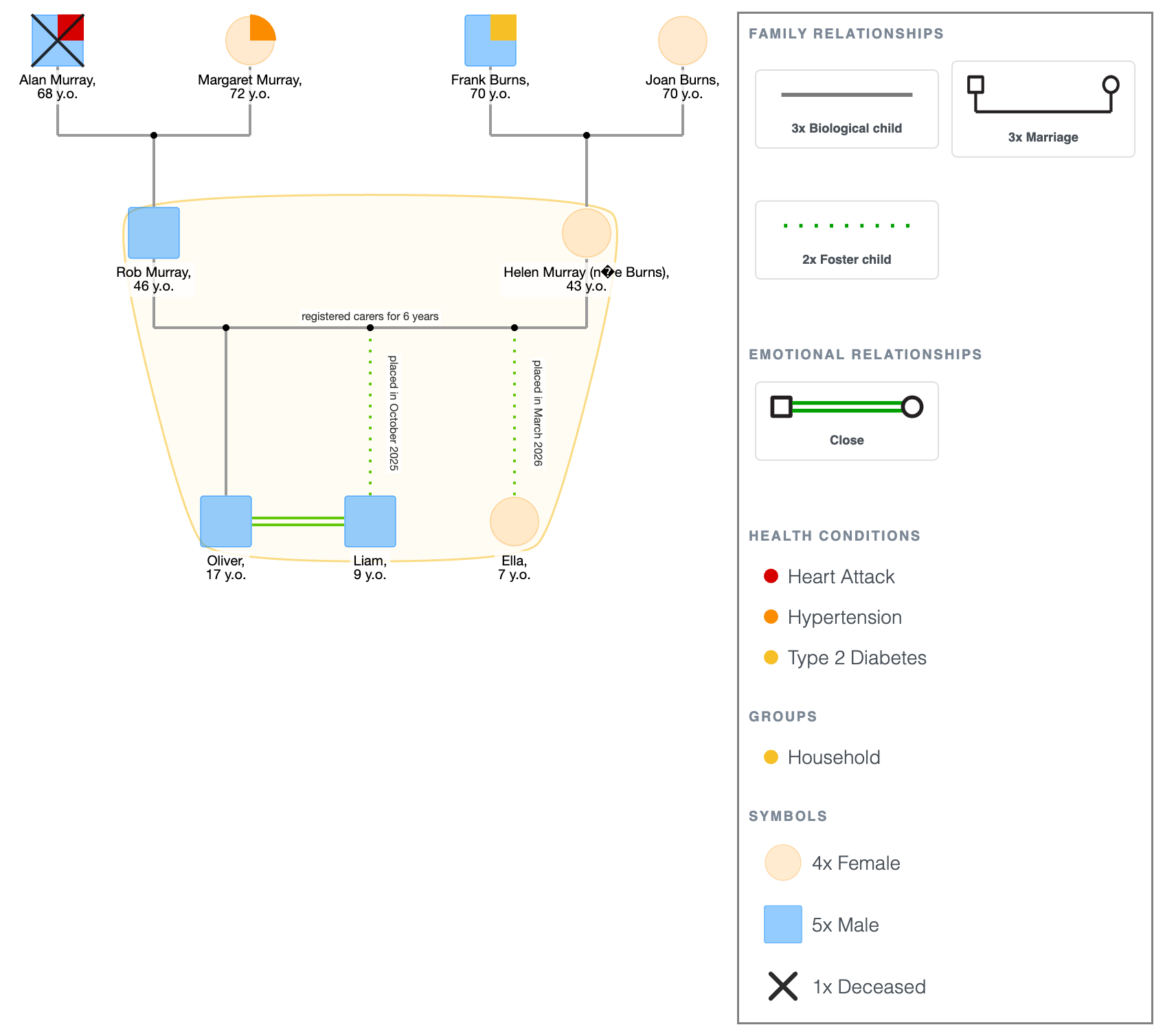
The family:
- Alan Murray; deceased 2018, heart attack, age 68. Margaret Murray, 72, hypertension. Rob below them, connected by a solid biological child line.
- Frank Burns, 70, type 2 diabetes. Joan Burns, 67. Helen below them, connected by a solid biological child line.
- Rob Murray and Helen Murray; married. Household boundary drawn around the current household.
- Oliver Murray, 17; biological son, solid line.
- Liam, 9; foster child, green dotted line. Placement date: October 2025 noted on line.
- Ella, 7; foster child, green dotted line. Placement date: March 2026 noted on line.
- Close relationship line between Oliver and Liam; the two have formed a significant bond over eight months together.
What this genogram shows:
- Oliver, Liam, and Ella sit on the same sibship line. The solid and dotted lines distinguish their relationships to Rob and Helen. The household boundary drawn around all five current household members makes the composition of the household visible at a glance.
- Alan's heart attack sits in the row above Rob, who is 46. Margaret's hypertension sits in the same row. Frank's type 2 diabetes sits in Helen's family line. This health history is part of the foster family's record; relevant both for the family and for any assessment of the household environment.
- The placement dates on Liam's and Ella's lines show that Liam has been in placement twice as long as Ella. A case reviewer reading the diagram can see that without a verbal briefing.
- Oliver and Liam's close relationship line sits alongside the structural lines. One is a 17-year-old biological son; one is a 9-year-old foster child who has been in the household for eight months.
Genogram Example for Foster Families
Explore this genogram and adapt it to your needs.
How to Build a Genogram for a Foster Family
- Place the foster carers in the middle row: standard couple line.
- Add the foster carers' parents: top row, both sides, with names, ages, and health conditions where relevant.
- Add biological children: solid lines in birth order.
- Add foster children: green dotted lines in order of placement date, with start dates noted on each line.
- Draw the household boundary: a dashed line around all current household members.
For a full step-by-step guide, see how to make a genogram. For foster-specific notation, see the foster care genogram article.
FAQ
What is a genogram for a foster family?
A genogram for a foster family maps the foster household from the carers' perspective; their own three-generation family background, their biological children, and the children currently placed with them. It is used in foster carer assessments, case reviews, and court documentation to give a complete picture of the household's composition and background. It differs from a foster care genogram, which centers on a specific foster child rather than the household as a whole.
How do you show foster children in a foster family genogram?
Foster children appear on the sibship line alongside the foster family's biological children, connected by a green dotted line from the couple's line. Placement dates are noted alongside each dotted line. Current placements are included inside the household boundary. Prior placements can be shown with their start and end dates if the history is relevant to the case.
Should you show the foster child's biological family in a foster family genogram?
It depends on the purpose of the genogram. In a household-centered document, the foster child's biological family may be noted briefly or linked to a separate genogram centered on that child. For clinical or court purposes where both pictures are needed, the biological connections can be shown separately outside the household boundary.
How is a foster family genogram different from a foster care genogram?
A foster care genogram centers on the child; mapping the biological family, the foster placement, contact arrangements, and placement history from the child's position. A foster family genogram centers on the foster household; mapping the carers' own family background, their biological children, and all current placements together. Same notation, but with different starting points.
Is there a genogram template for foster families?
Open the Murray family genogram above in EasyGenogram and replace the family details with your own. It includes the correct notation for a three-generation foster household with biological children, current placements, placement dates, and a household boundary. For a blank starting point, see the genogram template page in Qwoach.
Sources
- Genograms: Assessment and Intervention (3rd ed.). W.W. Norton & Company.