Appearance
Genogram for Adoptive Families
Social work and counseling assignments involving adoptive families require accurate notation for adopted children, biological parents, and any ongoing contact arrangements; across three generations rather than just the immediate household. This guide covers the structure and includes a completed three-generation example to adapt.
What a Genogram for an Adoptive Family Shows
- The adoptive family structure: parents, siblings, grandparents on both sides across three or more generations.
- Biological parent connections: where known, shown separately with their own lines to the adopted child.
- Health history from both sides: adoptive family health history is fully documented; biological family health history is documented where available and marked unknown where it is not.
- Relationship quality: close connections, distance, and contact arrangements across both family systems.
Mapping Both Lineages
The adoptive family
The adoptive family is mapped in the standard genogram structure; grandparents at the top, parents in the middle row, children at the bottom.
Adopted children appear on the sibship line in chronological order of joining the family, connected to their adoptive parents with a dashed blue line.
Biological children appear with a solid line on the same row.
Biological parents in open adoption
When biological parents are known and contact is ongoing, they appear separately from the main household.
A biological child line connects them to the child.
An additional relationship line shows the nature of the contact.
Biological parents in closed adoption
When the adoption is closed and biological parent information is not available, a symbol is placed in the correct position and labeled unknown.
The position is not left empty; acknowledging that biological parents exist, even without information about them, is more accurate than omitting them entirely.
International adoption
Where a child is adopted internationally, biological family information is often limited or entirely unknown.
The biological parent symbols are placed with unknown labels and a note of the country of origin may be added beside the child's symbol alongside the adoption date.
Document what is known; mark the rest unknown.
Health history
The adoptive family's health history is documented in the standard way; health conditions noted beside each person's symbol.
For biological parents, add health history where it is known.
Where it is unknown, note that beside the child's symbol as a flag for future clinical reference.
Common Adoptive Family Configurations
- Single adopted child with biological siblings: the most common configuration; one dashed line on the sibship row alongside solid lines.
- Multiple adopted children: each with their own dashed line, potentially with different biological families shown separately.
- Adoptive parent who was also adopted: their own dashed line connection appears in the grandparent generation; biological grandparents may appear with unknown notation.
- Blended adoptive and biological family: standard blended family structure with additional adopted child connections.
A Completed Example: The Grant Family
David Grant (42) and Sarah Grant (née Hall, 40) have three children: Tom (15), a biological son; Lily (12), adopted from China at age 2 in 2014 through a closed adoption; and Noah (9), adopted domestically at birth in 2015 through an open adoption.
Noah's birth mother, Emma (26), has twice-yearly contact.
David's parents are Robert Grant (68) and Patricia Grant (65).
Sarah's parents are Bill Hall (deceased, 2024, age 70, heart disease) and Jean Hall (64).
Genogram Example for Adoptive Families
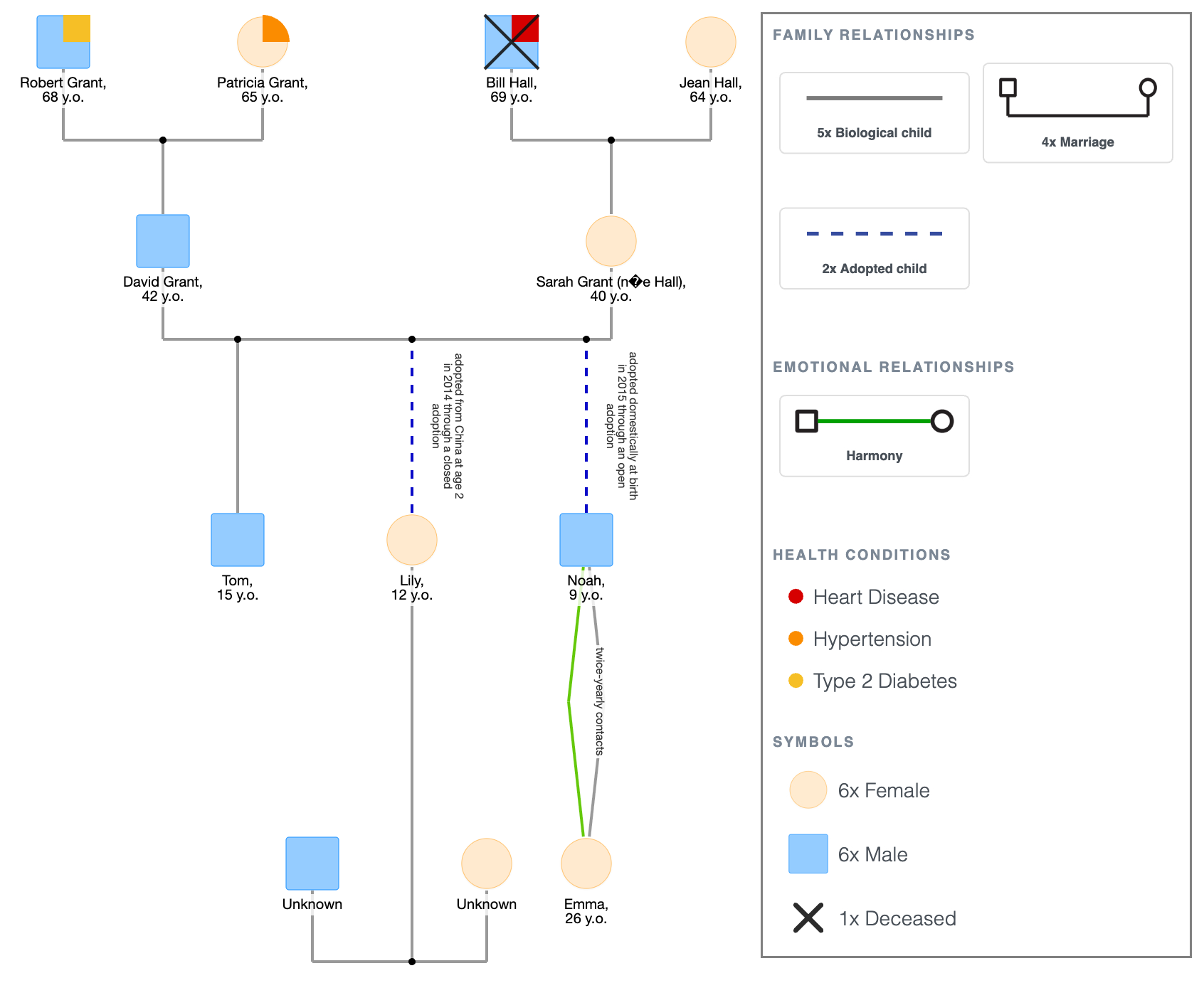
The family:
- Robert Grant, 68, type 2 diabetes. Patricia Grant, 65, hypertension. Connected by marriage line. David below them, connected by a solid biological child line.
- Bill Hall (deceased 2024, heart disease, age 70). Jean Hall, 64. Connected by marriage line. Sarah below them, connected by a solid biological child line.
- David Grant and Sarah Grant; married.
- Tom Grant, 15; biological son, solid line.
- Lily Grant, 12; adopted, dashed blue line. Adoption date 2014 noted. Biological parents: two unknown symbols placed separately, labeled unknown. Country of origin: China noted beside Lily's symbol.
- Noah Grant, 9 adopted, dashed blue line. Adoption date 2015 noted. Emma, 26; Noah's birth mother, shown separately with a biological child line to Noah and a thin solid relationship line showing twice-yearly contact.
What this genogram shows:
- Tom, Lily, and Noah sit on the same sibship line. Their connection lines (one solid, two dashed) show their different relationships to David and Sarah. Their position in birth order is maintained.
- Lily's biological parents are present in the diagram as unknown symbols. Their position acknowledges that two people exist even where no information about them is available. This matters clinically; a therapist working with Lily as an adolescent can see that the biological history is genuinely unknown rather than simply absent from the record.
- Emma's relationship line to Noah is active and positive. She sits outside the household but is present in Noah's life.
- Robert's diabetes and Patricia's hypertension sit one row above David and his children. Bill's heart disease is marked on his symbol with the cause of death noted. The health history from the adoptive side is fully visible.
Genogram Example for Adoptive Families
Explore this genogram and adapt it to your needs.
How to Build a Genogram for an Adoptive Family
- Build the adoptive family structure first: three generations, with the grandparents at top, parents in middle, and children at bottom.
- Add biological children with solid lines and adopted children with dashed blue lines: in chronological order on the sibship row.
- Add biological parents where known: separately from the main structure, with biological child lines connecting to the adopted child.
- Add health history: document what is known from both sides; mark biological history as unknown where information is not available.
- Add relationship lines for open adoption contact: show the nature and quality of any ongoing contact between biological parents and the child.
For a full step-by-step guide, see how to make a genogram. For the adoption-specific notation, see the adoption genogram article.
FAQ
What does a genogram for an adoptive family look like?
An adoptive family genogram has the same three-generation structure as any other genogram. What differs is that adopted children are connected to their adoptive parents with a dashed blue line rather than a solid line, and biological parents may appear separately in the diagram with their own connection lines to the child.
How do you show both biological and adoptive parents in a genogram?
Adoptive parents appear in the main household structure with the child connected to them by a dashed line. Biological parents are placed separately, outside the household, with a biological child line running from them to the child. In an open adoption, an additional relationship line shows the nature of any ongoing contact. In a closed adoption or where biological parents are unknown, a symbol is placed in the correct position and labeled unknown.
Should I include biological parents in an adoptive family genogram?
Yes, where they are known or partly known. Their presence in the diagram, even as unknown symbols, gives a more complete picture of the child's family history than omitting them. For clinical and therapeutic work with adopted individuals, acknowledging both lineages is important.
How do you track health history in an adoptive family genogram?
The adoptive family's health history is documented in the standard way; conditions noted beside each person's symbol with diagnosis year or cause of death. For biological parents, add health history where it is available. Where biological health history is unknown, note this beside the adopted child's symbol as a clinical flag. This is particularly relevant for adopted children reaching the age where hereditary conditions become clinically significant.
Is there a genogram template for adoptive families?
Open the Grant family genogram above in EasyGenogram and replace the family details with your own. It is set up with the correct notation for a three-generation adoptive family, including biological parent connections and open adoption contact. For a blank starting point, see the genogram template page in Qwoach.
Sources
- Genograms: Assessment and Intervention (3rd ed.). W.W. Norton & Company.