Appearance
Remarriage & Step-Family Genogram Template
A remarriage and step-family genogram template helps you map who belongs to which household, how step- and half-sibling ties work, and where co-parenting tension sits. Use it when a blended family case is hard to understand without seeing the full remarried family structure on one page.
Remarriage & Step-Family Genogram Template
What This Template Shows
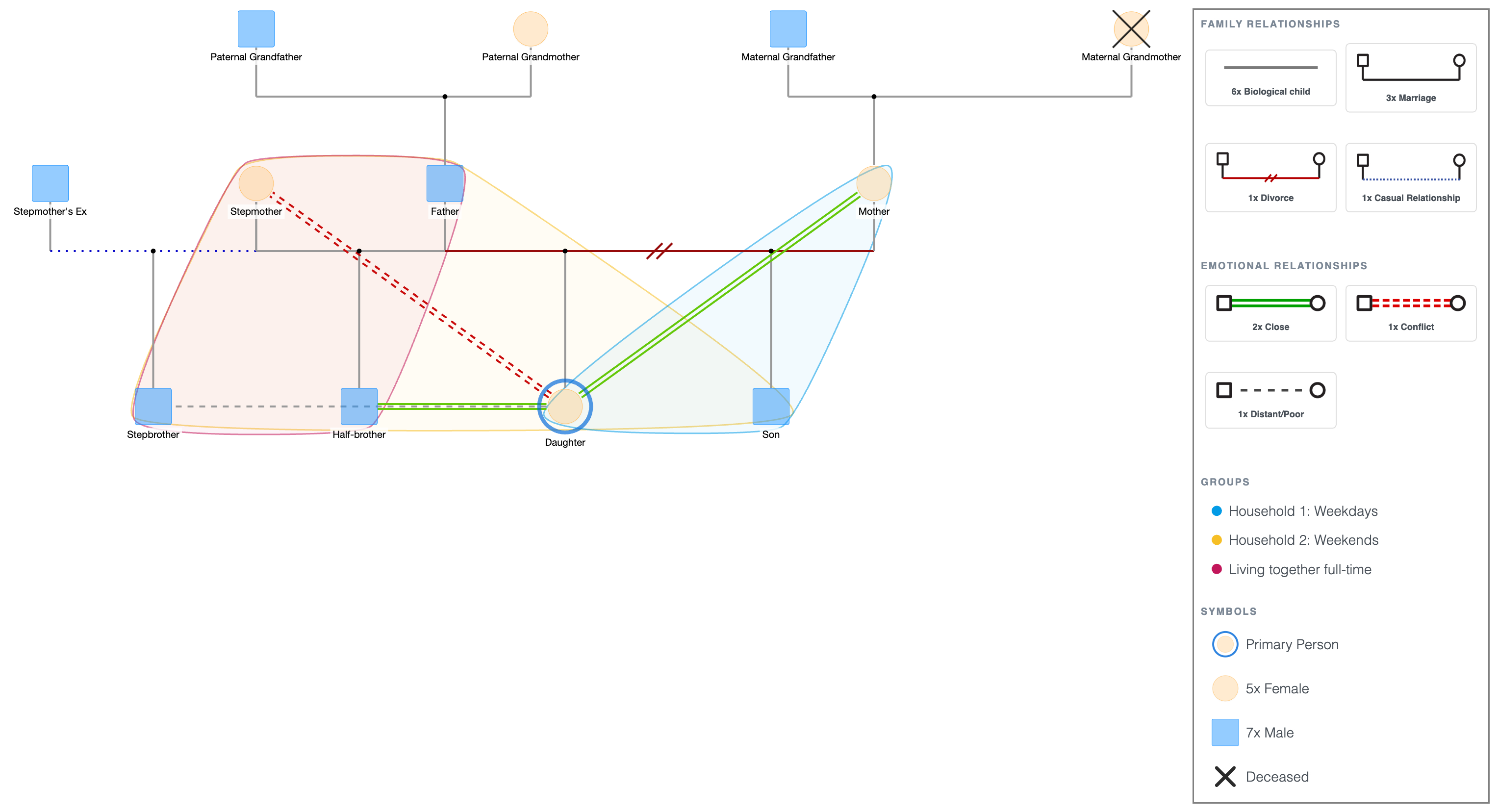
One dissolved marriage and one remarriage, mapped across two active households.
The father and mother divorced; the father has since remarried a stepmother who has a son from a prior relationship.
The father and stepmother also have a child together.
The daughter, the primary person, and her brother split time between both households. The maternal grandmother is deceased.
The step-family dynamics are visible in the diagram: the daughter is close to her biological mother, in conflict with her stepmother, distant from her stepbrother, and warmer with her half-brother.
The two-household co-parenting structure sits underneath all of it.
This is the family picture a therapist or caseworker builds when working with a remarried household; who lives where, how each child connects to each adult, and where the relational tensions sit across the step-family system.
The symbol legend is displayed below the diagram. For full definitions, see Genogram Symbols Explained.
When to Use This Template
- Family therapy with remarried and step-family households: map the full household configuration; biological, step, and half-sibling relationships, co-parenting arrangements, and the relational dynamics across both households, before or during the first session.
- Co-parenting conflict assessment and mediation: document the custody arrangement and the relational dynamics between biological parents, step-parents, and children to inform mediation or parenting plan development.
- Custody and step-parent adoption documentation: establish the legal and relational structure of the step-family for court or legal documentation purposes.
- MFT and counseling coursework: meets standard requirements for assignments involving remarriage, step-family structures, and co-parenting dynamics.
How to Use This Template
1. Download as-is
Click the PDF or PNG button under the embed to download immediately. Use as a session reference, supervision document, or teaching example for remarriage and step-family notation.
2. Customize before downloading
Click "Use this genogram" to open the template in EasyGenogram. Replace the generic labels with real or fictional names, adjust the household configuration, and update the relationship lines to reflect the actual step-family structure.
Export as PDF or PNG when done, or share via link with a supervisor or colleague.
Remarriage & Step-Family Genogram Template
Explore this genogram and adapt it to your needs.
FAQ
How do you show remarriage in a genogram?
A remarriage is shown as a second marriage line connecting the person to their new partner. The first marriage line carries the divorce notation; a double slash through the line. The second marriage line is drawn without any slash, indicating the current union. Both marriage lines connect to the same person, with each partner on either side.
How do you show a step-parent in a genogram?
A step-parent appears in the diagram connected to the biological parent by a marriage line. The step-parent does not have a biological child line to the step-children; the biological child lines run from each child up to their own biological parents only. The household boundary marker shows who lives together, which establishes the step-parent relationship structurally without a separate line type.
What is the difference between a step-sibling and a half-sibling in a genogram?
A step-sibling shares no biological parent with the primary person; each has a different biological parent, and they live together because their parents married. In the diagram, a step-sibling connects to one parent only via a biological child line. A half-sibling shares one biological parent with the primary person; both children connect to the same parent via biological child lines, but their other biological parent is a different person.
Is this template free?
Yes. Open and customize it in EasyGenogram at no cost. Export requires a subscription for most users; students with a valid school email can export free.
Can I use this for a family therapy or MFT assignment?
Yes. The template follows McGoldrick-Gerson-Petry standard notation and includes the divorce, remarriage, step, and half-sibling lines required for step-family documentation. Open it in EasyGenogram, adjust the household configuration to match your assignment or case, and export as PDF for submission.