Appearance
How to Read a Genogram: Step-by-Step Guide
Before a genogram tells you anything, you have to know how to look at it. These are 6 steps on reading a genogram:
1. Find Your Bearings First
Before reading anything else, locate two things:
- The primary person the genogram is built around.
- The generations, stacked top to bottom, oldest at the top.
Everything else on the diagram orients around these two facts.
2. Read the Shapes
Shapes carry the basic facts about each person:
- Square: male.
- Circle: female.
- X through a shape: deceased.
- Ages, birth years, and health notes usually sit beside or beneath the shape.
For the full symbol set, including extended gender identity shapes, pregnancy, pets, and more, see Genogram Symbols.
3. Read Structural Lines
Structural lines show the family's legal and biological architecture:
- A line between two people marks a couple. Slashes through it mark separation or divorce.
- A line dropping down connects parents to children.
- Siblings sit left to right, oldest to youngest.
These lines describe structure only, not emotional quality. That's a separate layer.
4. Read Emotional Lines
This is where the relational picture comes in:
- Close, fused, distant, conflict, cutoff, and more, each with its own line style.
- Emotional lines connect any two people directly, not just couples, so they can run between a grandparent and grandchild, or across branches of the family.
For the full set, see Genogram Relationship Symbols.
A Reading Walkthrough: The Coleman Family
The Coleman Family
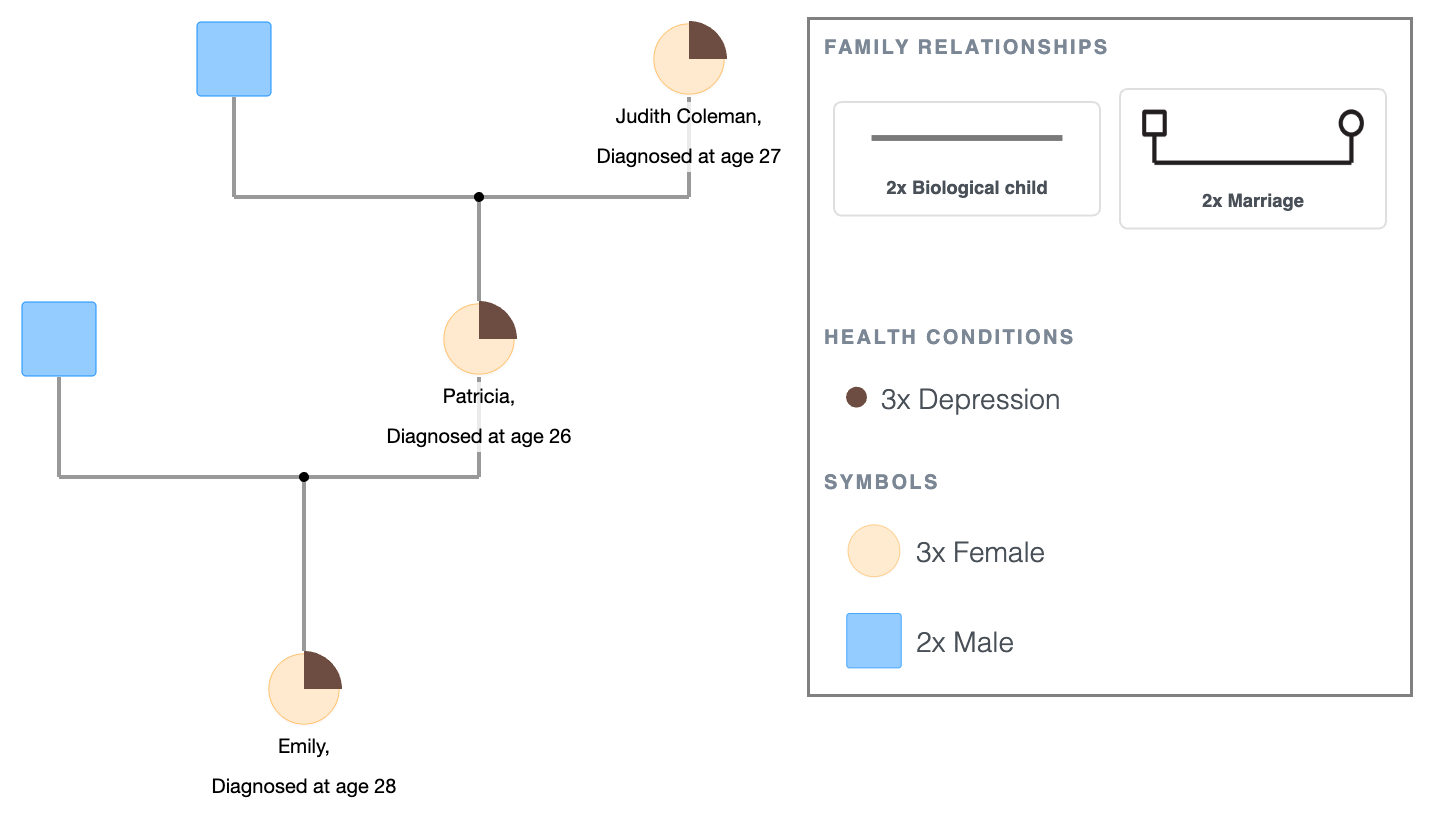
The family:
- Judith Coleman was diagnosed with depression at 27.
- Her daughter, Patricia, was diagnosed with depression at 26.
- Patricia's daughter, Emily, was diagnosed with depression at 28.
- All three notations sit close to each woman's shape, in the same position on each generation's row.
What you can now see:
- Reading top to bottom, the same health note appears in the same generational position three times.
- The diagnosis age barely shifts, it occurs in each of the women’s late twenties (26 to 28), across three generations.
- This only shows up once you've read the whole column, generation by generation.
From Reading to Interpretation
Reading a genogram is decoding the notation, shapes, structural lines, emotional lines.
Interpreting it is making sense of what those elements add up to.
The Coleman example above is a reading exercise, and having identified a repeated health note, asking what that repetition might mean, and what to do with it, is the next skill.
That's covered in full on Genogram Interpretation.
The Coleman Family
Explore this genogram and adapt it to your needs.
FAQ
What does a square or circle mean on a genogram?
A square represents a male individual and a circle represents a female individual. An X through either shape means that person is deceased.
What's the difference between reading and interpreting a genogram?
Reading is accurately decoding what's on the page, shapes, structural lines, and emotional lines. Interpreting is making clinical or personal sense of the patterns those elements form once you step back and look at the whole diagram.
How many generations should a genogram show?
Three generations is standard for most clinical, academic, and personal genograms. It's usually the minimum needed for a repeating pattern to become visible.
Is there a genogram reading template or PDF I can use?
EasyGenogram lets you build and read genograms directly in the tool, with a legend built into the interface, so there's no separate template needed to decode the notation.
What do the relationship lines mean?
Relationship lines mark the emotional quality of a connection between two people, close, distant, conflict, cutoff, and more. They're separate from structural lines, which only show legal and biological connections like marriage or parentage.
Sources
- Genograms: Assessment and Intervention (3rd ed.)
- Family Therapy in Clinical Practice