Appearance
Genogram Interpretation Example
A genogram interpretation example shows how structure and relationship lines turn into a readable family pattern. This example walks through a repeated mother-daughter closeness and spouse-distance pattern so you can see how to move from individual symbols to a cautious, evidence-based interpretation.
The Bennett-Higgins Family Example
Genogram Interpretation Example
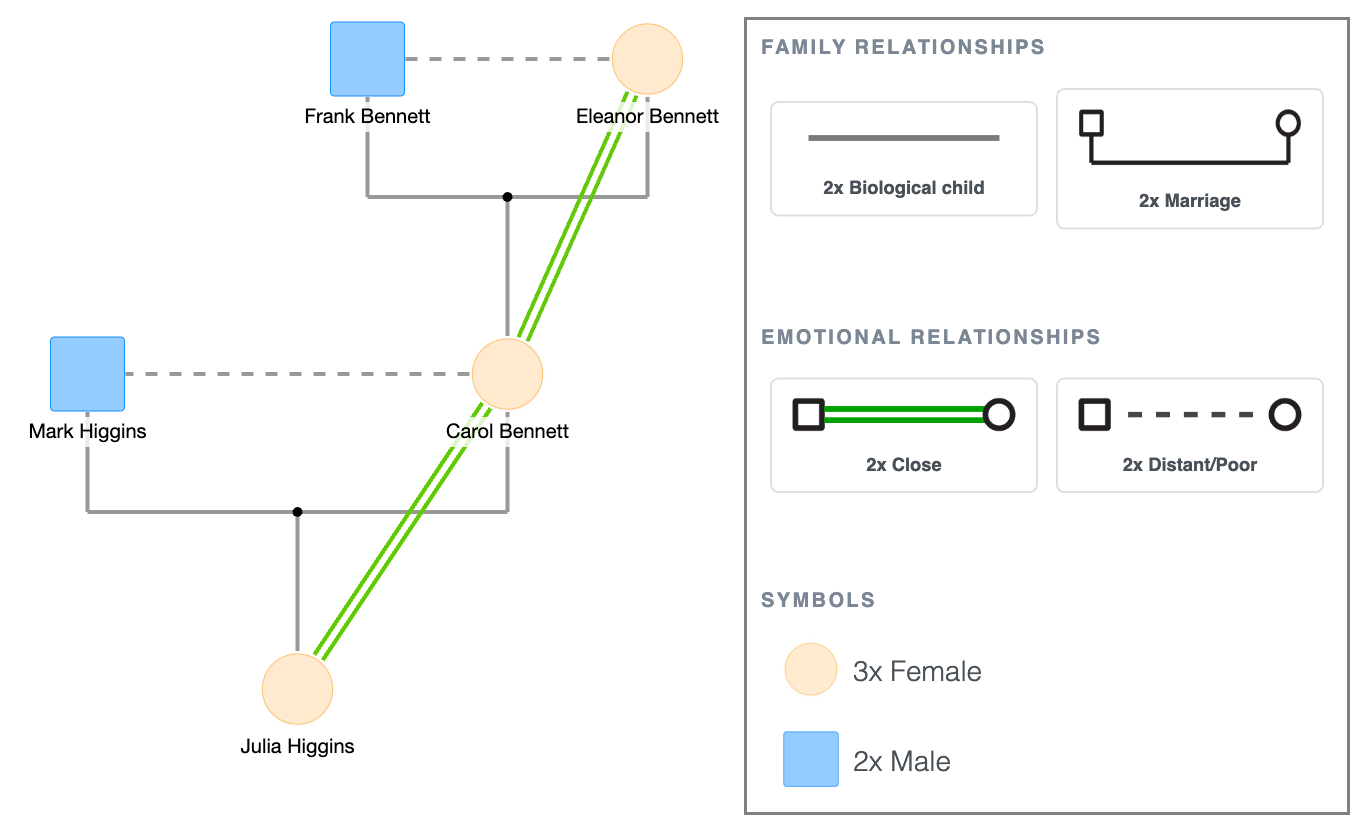
The family:
- Eleanor Bennett was close to her daughter, Carol Bennett, and distant from her husband, Frank Bennett.
- Carol grew up, married, and had a daughter of her own, Julia Higgins.
- Carol is close to Julia and distant from her husband, Mark Higgins.
- The same shape repeats one generation apart; mother and daughter close, father pushed to the outside.
What you can now see:
- Eleanor's close line to Carol and distant line to Frank sit in the top generation.
- Carol's close line to Julia and distant line to Mark sit directly beneath, in the same configuration.
- The pattern is a triangle between a mother, daughter, and outside spouse, repeating itself down the family.
Reading the Pattern
Two things are happening here at two different levels:
- Relational: the close and distant lines themselves, mother-daughter closeness paired with father-spouse distance.
- Multigenerational: the fact that the same shape shows up twice, one generation apart.
Neither level on its own tells the full story.
But together, they show a pattern.
Bowen described this three-person configuration as a triangle, the basic way families manage tension between two people by pulling in a third.
How to Apply This
- Build the structure first, both generations, before adding any relationship lines.
- Add the close and distant lines where they actually apply.
- Once the structure is in place, look across generations for the same shape repeating, not just at each relationship on its own.
Genogram Interpretation Example
Explore this genogram and adapt it to your needs.
FAQ
What does a genogram interpretation show?
It shows how individual relationship lines add up to a pattern once you look at more than one generation at a time, not just what each line means in isolation.
What's the difference between reading a genogram and interpreting one?
Reading identifies what a symbol or line means. Interpreting connects those meanings into a bigger picture, patterns, triangles, and repetition across the family.
Can one genogram example apply to my own family?
The mechanics do. Every family's specific pattern will look different, but the process, building the structure, adding relationship lines, then checking for repetition, applies the same way.
Where do I learn the full interpretation process?
The Genogram Interpretation guide on Qwoach covers the full methodology, including all four levels of interpretation and a checklist you can use on your own diagram.
Sources
- Family Therapy in Clinical Practice.