Appearance
Genogram Homework
A genogram homework exercise asks you to map your family using standard symbols. What you include and how much detail is expected depends on who gave you the homework, whether a teacher or a therapist.
Two Types of Genogram Homework
- School or class exercise: assigned by a teacher at secondary school or in an introductory college course. Usually two to three generations, structure and basic family information, and can be with or without an analysis paper. The goal is to learn what a genogram is and practice drawing one. If that sounds like your brief, start with genogram for class.
- Therapy homework: therapists give clients a genogram to complete between sessions, usually in the early stages of treatment. The exercise covers at least three generations and typically involves talking to family members to fill in gaps for names, significant events, health history, details that wouldn't surface in a single session. Some therapists provide a template and symbols; others leave the format open. What comes back to the session is a map of the client's family system that the therapist would otherwise take weeks to build through conversation alone. For a completed clinical-style reference, compare it with this genogram sample.
Type 1 - School or Class Exercise
Most school-level genogram exercises ask for two to three generations, the names and ages of family members, basic structural lines (marriages, parent-child connections, siblings), and a simple key. An analysis paper is not usually required at this level.
School or Class Exercise Genogram
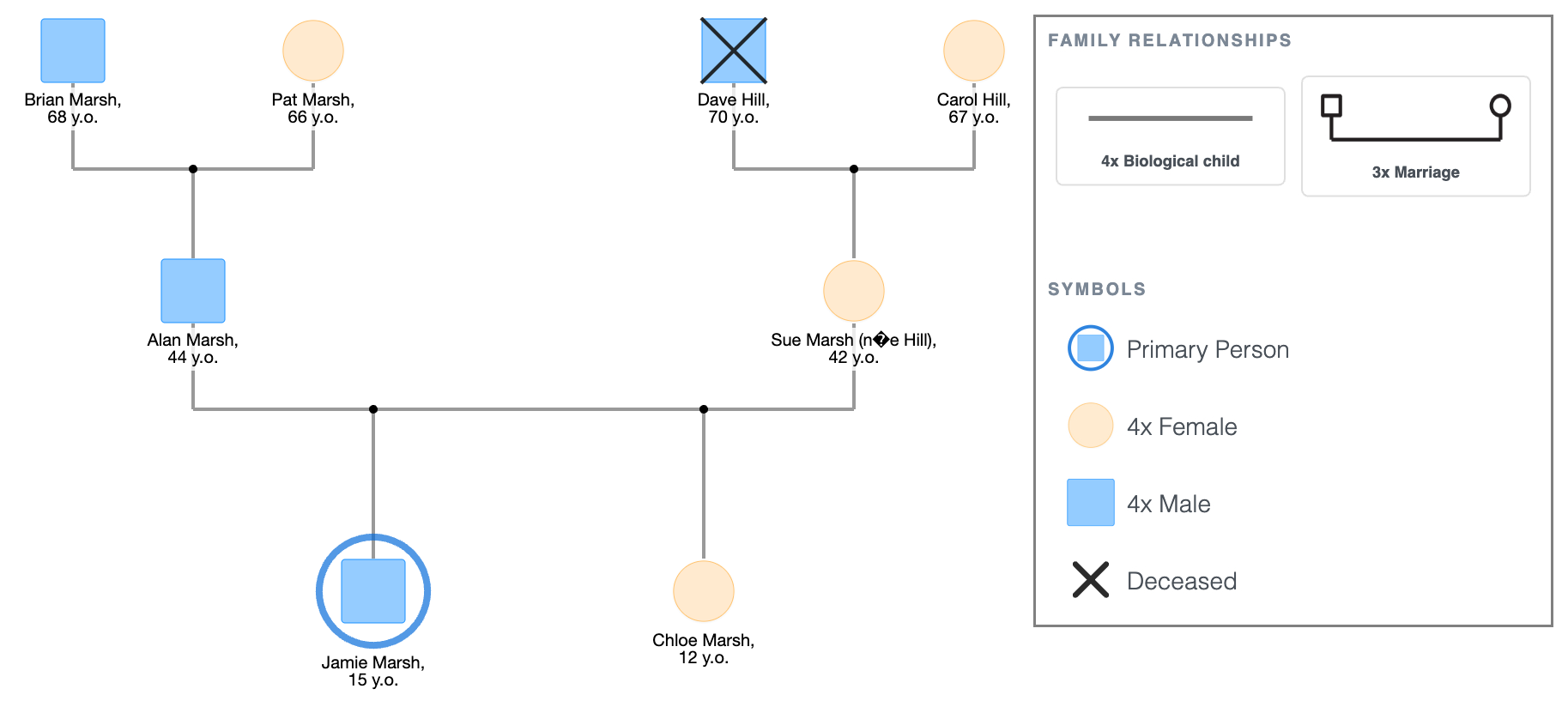
A sample school exercise: The Marsh Family
- Jamie Marsh, 15, primary person.
- Parents: Alan Marsh, 44, and Sue Marsh (née Hill), 42. Married.
- Jamie's sibling: Chloe Marsh, 12.
- Paternal grandparents: Brian Marsh, 68, and Pat Marsh, 66.
- Maternal grandparents: Dave Hill (deceased, 2022 at age 70) and Carol Hill, 67.
What this genogram covers:
- Three generations, everyone named and aged. Dave's X marks him as deceased with the year noted under his symbol.
- The structure shows two complete households in the grandparent generation and one in the parent generation. Jamie and Chloe sit at the bottom on the same sibship line, older on the left.
- A key at the bottom lists squares (males), circles (females), the X for deceased, the horizontal marriage line, and the vertical and horizontal lines for parent-child and sibling connections.
This is what a complete, submission-ready school genogram homework looks like. No relationship lines, no health annotations; those are not expected at this level unless the brief specifically asks for them.
School or Class Exercise Genogram
Explore this genogram and adapt it to your needs.
Type 2 - Therapy Homework
A therapist might ask you to draw your genogram between sessions as a reflective exercise. The purpose is different from a school assignment. You are not being assessed on technical accuracy; you are using the diagram to think about your family before you talk about it.
Therapy genogram homework usually focuses on relationship lines. Your therapist wants to see how you experience the connections in your family, not just who is in it.
Therapy Genogram Homework
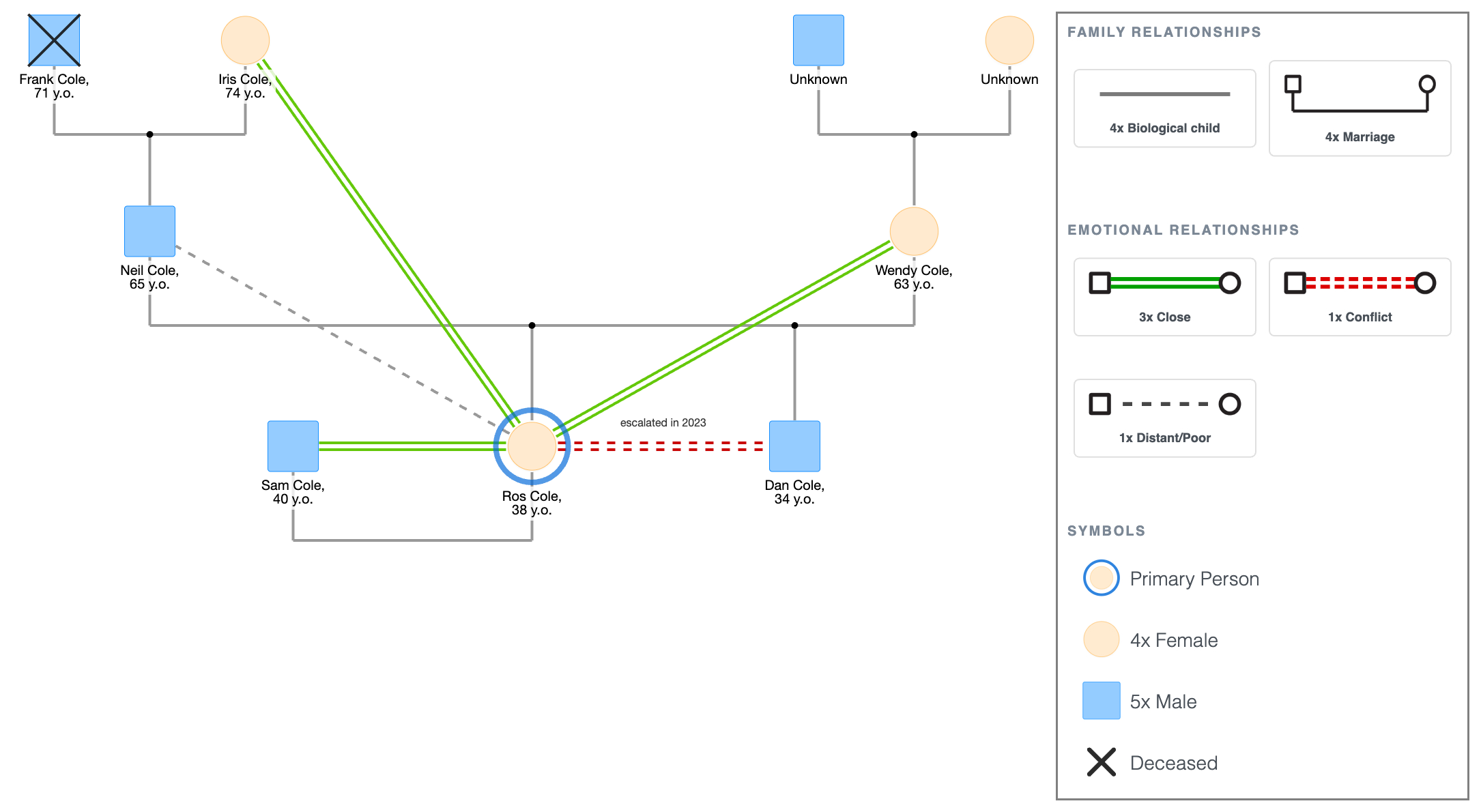
A sample therapy homework: The Cole Family
- Ros Cole, 38, primary person. In therapy following a period of increased anxiety around family contact.
- Partner: Sam Cole, 40. Close line between Ros and Sam.
- Ros's parents: Neil Cole, 65, and Wendy Cole, 63. Distant line between Ros and Neil. Close line between Ros and Wendy.
- Ros's sibling: Dan Cole, 34. Conflict line between Ros and Dan, escalated in 2023.
- Paternal grandparents: Frank Cole (deceased, 2018, age 71) and Iris Cole, 74. Ros and Iris have a close line; they stayed in regular contact after Frank's death.
- Wendy's family: Ros does not have information about Wendy's parents. Their positions are marked as unknown on the diagram.
What this genogram shows:
- The relationship lines carry most of the information. Ros's distant line to Neil and close line to Wendy sit side by side in the parental row. Her conflict with Dan is recent and dated. Her close line to Iris is the one paternal relationship that held after Frank died.
- Wendy's parents are marked as unknown. That absence has a position on the diagram. A therapist looking at this genogram can see that one entire family line is informationally blank, and that is something to explore.
- Sam and Ros's close line is the only line in Ros's current household. It sits below a generation of mixed and difficult relationships. The diagram shows that without stating it.
When you bring a genogram like this to your next session, your therapist will use it to ask important questions.
Therapy Genogram Homework
Explore this genogram and adapt it to your needs.
What to Do After Completing the Genogram
- For a school exercise: submit it the way your teacher specified, either printed or as a PDF. Make sure the key is included. If you drew it by hand, take a photo or scan it before submitting. Export the template above from EasyGenogram as PNG or PDF directly.
- For therapy homework: bring it to your next session. You don't need to have it finished or perfect. A partially completed genogram with questions noted beside it is useful. Your therapist will work from what you've brought.
How to Complete It Quickly
Open either sample above in EasyGenogram and replace the names and details with your own family. For a full step-by-step guide, see how to make a genogram.
- Start with yourself: place your symbol in the middle row and mark it with a double border.
- Add parents and siblings: parents in the row above connected by a marriage line, siblings beside you on the same row.
- Add grandparents: both sets, connected to their children above the parent row.
- Add names and ages: fill in each person's name and current age or birth year.
- Add a key: list every symbol you used. For a school exercise this is required. For therapy homework it's optional but helpful.
- Add relationship lines if needed: school exercises at basic level don't require them. Therapy homework is where they matter most.
- Export: download as PDF or PNG.
FAQ
What is a genogram homework assignment?
Genogram homework is a family mapping exercise assigned either by a teacher as a class activity or by a therapist as a between-session exercise. The symbols are the same; what you're expected to do with the result is different.
How do I complete a genogram for homework?
Start with yourself as the primary person, add your parents and siblings, then your grandparents. Fill in names and ages. Add health notes or relationship lines if your brief asks for them. Include a key listing every symbol you used.
What does a genogram homework template include?
A basic template includes positions for three generations with names, ages, marriage lines, parent-child lines, and sibling lines already set up, plus a key.
Can I do my genogram homework online?
Yes. EasyGenogram runs in your browser with no download required. Open either sample on this page, replace the family details with your own, and export as PDF or PNG when done.
What do I do with my genogram after I've drawn it?
For a school exercise, submit it as specified by your teacher, printed or as a PDF file. Make sure the key is visible. For therapy homework, bring it to your next session. It doesn't need to be finished; a partial genogram with questions or gaps noted is a useful starting point for the conversation.
Sources
- Genograms: Assessment and Intervention (3rd ed.). W.W. Norton & Company.
- Genogram Worksheet. Barry Litt MFT.