Appearance
Genogram Assignment
You've been assigned a genogram and you need to get it done. Here's exactly what to include, how to build it, and how to write the analysis that goes with it.
What a Genogram Assignment Requires
A genogram assignment is generally made up of two parts, the diagram and your written analysis.
The diagram is graded based on how complete and accurate it is; whether you have put in the right people and used proper symbols, whether there’s enough detail mapped out so that patterns come through.
As for the analysis, the grade depends on your ability to make sense of what the diagram is telling you and tie it back to the theory from the course.
Standard requirements across most courses:
- Three generations minimum, i.e., grandparents, parents, and your own generation.
- All family members in each generation, including siblings, deceased relatives, and anyone who shaped the family's structure.
- Standard genogram symbols; squares for males, circles for females, an X for deceased, a double border or arrow for the primary person (you).
- Structural lines connoting marriage, divorce, parent-child connections, sibling order left to right.
- At least one health or life event noted per generation where relevant.
- Relationship lines for significant connections, e.g., close, distant, conflict, cutoff.
- A key (legend) listing every symbol used.
- A written analysis of 3-10 pages depending on the course level.
Which Courses Assign Genograms
- Nursing and family health courses: the focus is health history across generations. You're expected to document conditions, causes of death, risk factors, and hereditary patterns. The relationship layer is secondary. The purpose is to produce a diagram a care team could read quickly.
- Social work and HBSE courses: the focus is the family as a system. You're documenting structural facts alongside relationship quality, i.e., who is estranged, who is carrying the family's weight, what patterns repeat across generations. The written analysis is expected to connect observations to family systems theory.
- Psychology and counseling courses: these often assign a self-of-therapist genogram, which means mapping your own family and reflecting on what the patterns might mean for your clinical work. The analysis is reflective as much as analytical. Bowen's concepts like differentiation, triangulation, and multigenerational transmission are usually part of the framework.
- Marriage and family therapy (MFT) programs: the genogram here is a clinical tool. You're expected to produce a diagram accurate enough to use in a real intake session and an analysis that demonstrates your ability to read a family system.
- Family development and lifespan courses: the focus is on developmental milestones, family transitions, and how events in one generation shaped the next. The genogram is used to track those transitions visually.
Part 1: Building the Genogram
Who to Include
Start with yourself and work outward. Include:
- Yourself, marked as the primary person with a double border.
- Your parents and their siblings.
- Your grandparents on both sides.
- Your own partner and children if you have them.
- Anyone whose absence is significant, such as an estranged sibling, an unknown parent, a deceased relative whose impact on the family is still felt, etc.
You do not need to include every extended family member. Include the people who are necessary for the patterns in your family to be visible.
If your course specifically asks for your own household and relatives rather than a general coursework sample, use the family genogram assignment alongside this page.
How Many Generations
Three generations is the rule of thumb. You will find most courses make that a hard and fast requirement. With two you have the present family, but it takes depicting three for any real patterns to come to light, such as a health issue shared by a parent and grandparent, some dynamic in their relationship that is bound to repeat, or a loss that has restructured the whole system.
Should your assignment call for four, then you put in the great-grandparents as well. But if trying to fit all four on the diagram gets unmanageable, just stick with one branch.
What to Mark
- Health conditions: note conditions beside the relevant person's symbol, with a diagnosis year where you know it. For deceased relatives, note the cause of death and their age. You do not need a medical record; what the family knows and passes down is what goes in the diagram.
- Life events: marriages with years, divorces with years, deaths with years and causes. Major relocations or transitions if they are relevant to the patterns you will analyze.
- Relationship lines: draw these for every relationship that is significant. These lines each carry information that the structure alone cannot show. These are often where the most important patterns are.
- The key: include a legend at the bottom of the diagram listing every symbol and line type you used. An assignment submitted without a key is incomplete regardless of how accurate the diagram is.
A Sample Genogram Assignment
Assignment brief:
Construct a three-generation genogram of your own family to include your grandparents, parents, aunts, uncles, and siblings. Give the name, age, and relevant health history for each person. Include relationship lines for significant connections. Your genogram should be detailed enough that a reader unfamiliar with your family can understand the family structure and identify patterns across generations.
Student: Alex Barker, 22, first-year social work student.
Sample Genogram Assignment
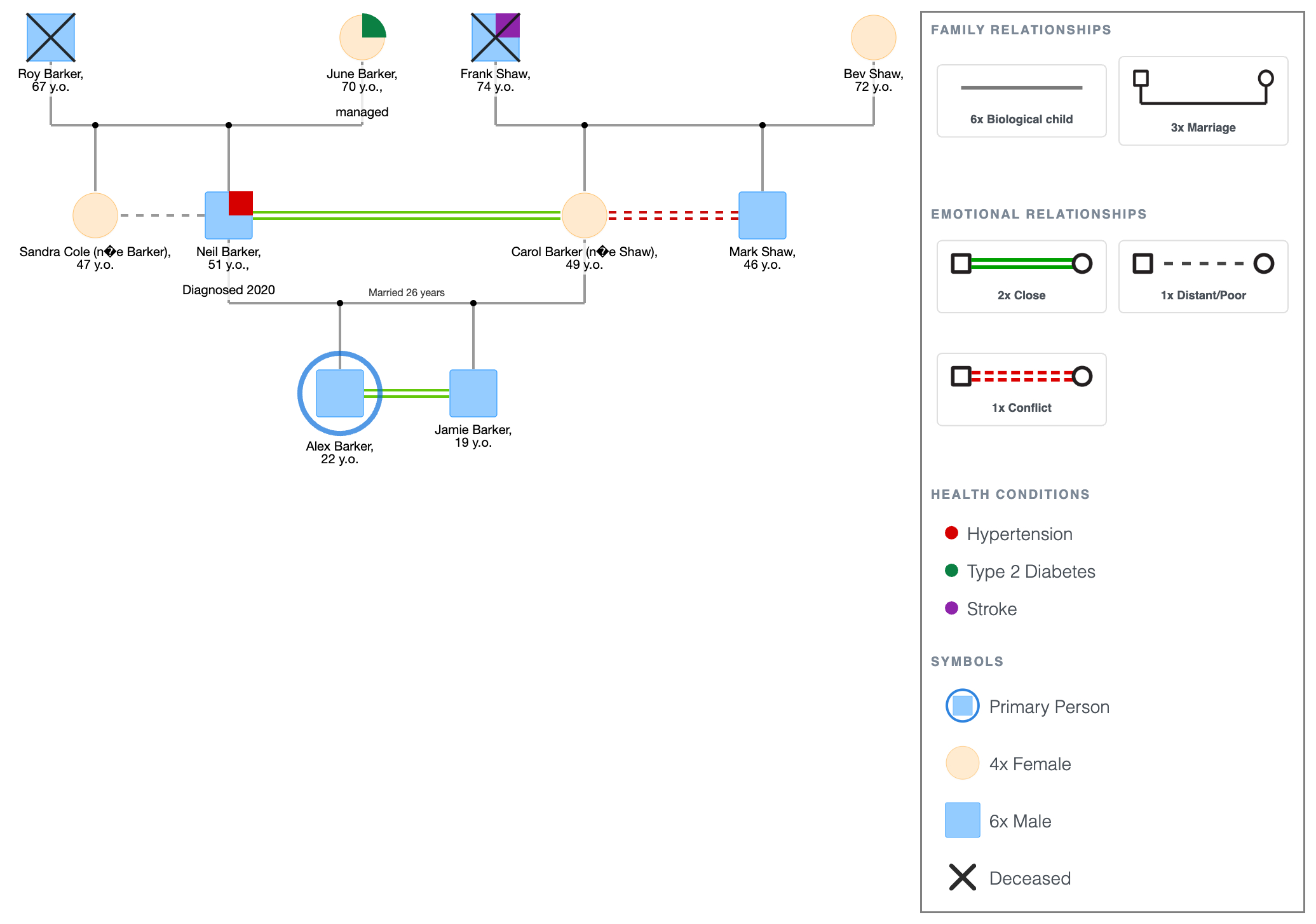
The family:
- Alex Barker, 22, primary person.
- Parents: Neil Barker, 51 (hypertension, diagnosed 2020) and Carol Barker (née Shaw), 49. Married 26 years. Close relationship line between them.
- Alex's sibling: Jamie Barker, 19. Close line between Alex and Jamie.
- Paternal grandparents: Roy Barker (deceased, 2018, heart disease, age 67) and June Barker, 70 (type 2 diabetes, managed).
- Neil's sibling: Sandra Cole (née Barker), 47. Distant line between Neil and Sandra.
- Maternal grandparents: Frank Shaw (deceased, 2021, stroke, age 74) and Bev Shaw, 72.
- Carol's sibling: Mark Shaw, 46. Conflict line between Carol and Mark; escalated following Frank's death over estate matters.
Sample Genogram Assignment
Explore this genogram and adapt it to your needs.
Part 2: Writing the Analysis
Most genogram analysis papers run between 5 and 10 pages. For a full step-by-step walkthrough of how to structure and write it, see the genogram assignment guide. The structure most professors expect:
1. Introduction
State the purpose of the assignment, the scope of your genogram (how many generations, which family branches), and the theoretical framework you are using. Most social work and counseling courses expect Bowen's family systems theory. Nursing courses may expect a health risk framework. Check your syllabus.
2. Family Structure Overview
Describe the basic composition of the family; who is in the genogram, their relationships, significant events. This section narrates the diagram for a reader who has not seen it. Keep it factual and descriptive. Save interpretation for the next section.
3. Pattern Identification
This is the core of the analysis. Identify recurring patterns across generations: health conditions that appear on one or both sides of the family, relationship dynamics that repeat, behavioral patterns, losses that restructured the family, or communication styles that carry through. Name the pattern specifically and point to the evidence in the diagram.
4. Theoretical Framework Application
Apply course concepts to the patterns you identified. If using Bowen's theory: where do you see differentiation of self, triangulation, or multigenerational transmission? If using a structural framework: what does the genogram show about subsystems, boundaries, and hierarchy? Connect theory to the specific facts in your diagram, not to the theory in general.
5. Reflection
Reflect on what you learned from building the genogram. What did the diagram show you that you had not seen before? If writing from a clinical perspective, discuss what patterns in your own family might become relevant in your clinical work and how you would manage that.
Sample Analysis
Below is an excerpt from Alex's written analysis of the Barker family genogram above, showing what the pattern identification and reflection sections look like in practice.
Pattern identification
The most visible health pattern in my genogram runs through the paternal line. My grandfather Roy died of heart disease at 67. My father Neil was diagnosed with hypertension in 2020 at 51. I am 22 and sit directly below both of them in the diagram. The condition has not skipped a generation, it has moved through it. That is not something I had considered before mapping the family.
On the relationship side, both of my parents have a strained sibling relationship. My father Neil has a long-standing distant relationship with his sister Sandra. My mother Carol and her brother Mark were in relatively normal contact until my grandfather Frank died in 2021, after which a dispute over the estate escalated into open conflict.
Theoretical framework application
Using Bowen's family systems theory, the conflict between Carol and Mark following Frank's death reflects what Bowen describes as a triangle, i.e., the estate becoming a third point through which unresolved tension between the siblings was routed. Frank's death removed a stabilising presence in the maternal family, and tension that had previously been managed surfaced in his absence.
Reflection
Building this genogram showed me a cardiovascular thread in my family that I was aware of individually but had not seen as a pattern until it was mapped across three generations. It also surfaced a sibling dynamic on both sides of my family that I had treated as two separate situations. With the diagram, I can see it now in a way I couldn't before.
Common Mistakes in Genogram Assignments
These are the most common mistakes students make in genogram assignments:
1. Including only two generations
Most assignments specify three. Two generations show the current family; three generations are where patterns become visible. If you've only mapped yourself and your parents, go back and add the grandparent level.
2. Leaving out relationship lines
A genogram without relationship lines is a family tree. The structural layer shows who is in the family; the relationship layer shows how the family actually functions. Both are required.
3. No key
Every symbol and line type on the diagram needs to appear in a legend. An assignment without a key forces the reader to guess, which is a basic error in any clinical diagram.
4. Health conditions without enough detail
"Grandma had cancer" is not enough. Specify the type, the age of diagnosis or death, and the current status where known. The detail matters for the pattern analysis.
5. Writing an analysis that only describes the diagram
The overview section describes the diagram, but the pattern section interprets it. The theoretical section applies course concepts to it. If your entire paper is describing who is in the genogram, you have missed the assignment.
6. Marking health conditions without noting relationship quality
A genogram that shows every health condition but has no relationship lines is incomplete for any course that requires a family systems perspective.
FAQ
What is a genogram assignment?
A genogram assignment asks you to map your own family across at least three generations using standardized symbols, then write an analysis of the patterns you find. It is assigned in nursing, social work, psychology, counseling, and MFT programs as a way to develop both technical diagramming skills and the ability to read a family system. Most assignments have two components: the diagram and a written analysis.
How many generations should a genogram assignment include?
Three generations is the standard minimum; your grandparents, your parents, and your own generation. Some advanced assignments ask for four generations. Check your assignment brief for the specific requirement.
Do I have to use my real family for a genogram assignment?
Although most assignments ask for your own family, some courses allow students to use a fictional family if personal disclosure is a concern, but always check with your instructor. If your family structure is complex (blended, adoptive, unknown members, etc.,), map it as accurately as you can and note gaps with appropriate notation.
What should a genogram analysis paper include?
It should include five sections: an introduction stating the purpose and theoretical framework, a family structure overview describing the diagram, a pattern identification section analyzing recurring dynamics across generations, a theoretical framework application connecting course concepts to your findings, and a personal reflection. Length is typically 5-10 pages depending on the course level.
What tool should I use to build a genogram for an assignment?
EasyGenogram is built specifically for genograms and it has all the standard symbols, relationship line types, and an export function for PDF and PNG. Open the sample genogram above and replace the family details with your own, or start from scratch.
:::
sources
title: Genograms: Assessment and Intervention (3rd ed.). W.W. Norton & Company.
author: McGoldrick, M., Gerson, R., & Petry, S.
year: 2008
title: Family Therapy in Clinical Practice. Jason Aronson.
author: Bowen, M.
year: 1978
title: Genogram Assignment Sample
author: University of Hawaii Maui College.
year: 2018 :::