Appearance
Genogram Project
A genogram project maps your family using standard symbols and explores a specific pattern or theme across generations. The difference from a standard assignment is scope; most projects give you enough choice that you need to decide what to focus on before you start drawing.
Four Directions for a Genogram Project
Most project briefs will point you toward one of these. If yours doesn't, choose the direction most relevant to the theory your course covers.
1. Health and medical history
Mapping hereditary conditions, causes of death, and health patterns across three or more generations. Useful for nursing, family medicine, and genetics coursework. The genogram shows which conditions appear on which sides of the family, how they track across generations, and where the current generation sits in relation to them. If you need a reference point for the finished coursework format, compare it with the genogram assignment.
2. Occupational and career patterns
Mapping work roles and how they have or haven't transmitted across generations. Shows intergenerational mobility, family vocational traditions, and the point where someone broke from the family pattern. Useful for career development and family development coursework.
3. Emotional and relationship patterns
Mapping relationship quality across the family. Shows how the family relates rather than just who is in it. Useful for counseling, psychology, and family therapy coursework.
4. Cultural and migration history
Mapping where family members were born, where they moved, and when. Shows how geographic movement shaped the family's current structure and which branches stayed connected or drifted apart. Useful for sociology, social work, and family heritage projects. If your instructor allows a famous family rather than your own, a documented multi-generational royal family can be a useful public case.
A Sample Genogram Project: The Hudson Family
Project focus: Educational patterns across three generations
Student: Ella Hudson, 22, family development student. Her brief asked her to identify a pattern in her family and explore it using a genogram.
Sample Genogram Project
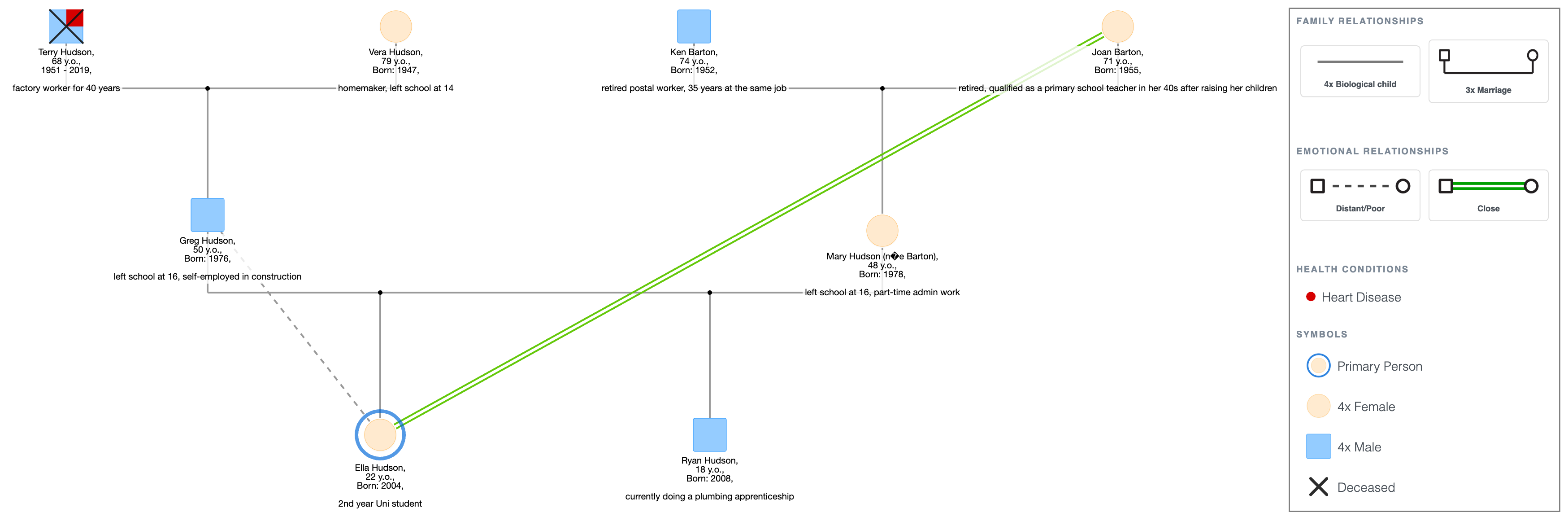
The family:
- Ella Hudson, 22, primary person. Currently in her second year of university (the first person in her family to attend).
- Parents: Greg Hudson, 50 (left school at 16, self-employed in construction) and Mary Hudson (née Barton), 48 (left school at 16, part-time admin work). Distant line between Greg and Ella.
- Ella's sibling: Ryan Hudson, 18 (currently doing a plumbing apprenticeship).
- Paternal grandparents: Terry Hudson (deceased, 2019, heart attack, age 68, factory worker for 40 years) and Vera Hudson, 72 (homemaker, left school at 14).
- Maternal grandparents: Ken Barton, 74 (retired postal worker, 35 years at the same job) and Joan Barton, 71 (retired, qualified as a primary school teacher in her 40s after raising her children). Close line between Ella and Joan.
What the project found:
- Every person on the paternal side left school at 16 or earlier. Terry worked in a factory for 40 years. Greg is in construction. Ryan is doing a trade apprenticeship. The pattern holds across three generations on that side without exception.
- Joan is the one person in the maternal line who pursued formal education beyond school age, and she did it at 40, after her children were grown. She and Ella are the only two people in the entire diagram with a qualification above school level. They also have a close relationship.
- Greg's distant line with Ella sits in the diagram alongside his own educational history. He left school at 16 and built a successful business. The distance is not unexplained; the diagram shows a father whose own path worked without a degree, looking at a daughter who chose a different one.
- Ryan and Ella are on the same sibship line, one going to university, one doing a trade. Two adult children from the same household diverging at the same moment. Whether that means the pattern is breaking or branching is a question the genogram project raises without fully answering.
Sample Genogram Project
Explore this genogram and adapt it to your needs.
The Written Component
Most genogram projects include a written report alongside the diagram.
A project paper should explain the focus you chose and why, describe what the genogram shows about that focus specifically, and draw a conclusion about the pattern you set out to explore.
If you chose educational patterns, the paper is about educational patterns, not about every relationship line on the diagram.
Keep the written component anchored to the diagram. Every claim in the paper should have a corresponding element on the genogram. If you're saying a pattern repeats across generations, point to where on the diagram it appears.
For a full guide to writing the analysis component, see the genogram assignment guide.
How to Build a Genogram Project
Open the Hudson family genogram in EasyGenogram and adapt it to your own family and focus, or start from scratch. For a full step-by-step walkthrough, see how to make a genogram.
- Decide your focus first: what pattern or question are you exploring? This determines what information you need to collect before you start drawing.
- Place the primary person: mark yourself or your subject with a double border and build outward.
- Map the structure: add all family members across the required generations before adding any annotations.
- Add the layer relevant to your focus: these include health notes for a medical project, occupation labels for a career project, location markers for a migration project, etc.
- Add relationship lines where relevant: even a health or occupational project benefits from a few key relationship lines where they change how the diagram reads.
- Export: download as PDF or PNG for submission.
FAQ
What is a genogram project?
A genogram project is a structured family mapping exercise that uses standard genogram symbols to explore a specific pattern or theme across generations. It combines a visual diagram with a written analysis and is commonly assigned in family development, social work, nursing, psychology, and counseling courses. The main difference from a standard genogram assignment is that a project usually gives you scope to choose what to focus on.
What are some good genogram project ideas?
The four most common directions are health and medical history, occupational and career patterns, emotional and relationship dynamics, and cultural or migration history. The best choice depends on your course. A nursing or family medicine course points toward health history. A family development or sociology course might suit an occupational or migration focus. If your brief doesn't specify, choose the direction most relevant to the theory your course covers.
How many generations should a genogram project include?
Three is the standard minimum, and most project briefs specify this. Three generations are enough for patterns to become visible; two generations show the current family, three show whether something repeats. Add a fourth only if the information is available and directly relevant to your focus.
What is the difference between a genogram project and a genogram assignment?
A genogram assignment has a fixed brief with specific requirements for what to include and how to analyze it. A genogram project typically gives you more scope to choose your focus, your family, and sometimes your format. The diagram and the symbols are the same; what changes is the degree of choice you have in how you approach it.
Can I do a genogram project on a fictional or famous family?
Some courses allow this, particularly for students who are uncomfortable using their own family or don't have access to enough family history. Check your brief. If it's allowed, famous families with well-documented multi-generational histories work well. A fictional family needs to be detailed enough that the diagram has real patterns to show, not just structure.
Sources
- Genograms: Assessment and Intervention (3rd ed.). W.W. Norton & Company.
- Family Therapy in Clinical Practice. Jason Aronson.