Appearance
Family Genogram Assignment
Your professor wants your own family, not a case study family, depicted on your genogram. It makes the assignment harder in that you might not have complete information, some of what you do have is sensitive, and the people in the diagram are real.
The diagram itself follows standard notation. What changes is the judgment calls, like who counts as significant enough to include, what to do when a whole branch of the family is unknown, and how much detail the analysis actually needs.
Who to Include in a Family Genogram Assignment
Start with yourself as the primary person, marked with a double border. Work outward from there.
- Your parents and their siblings belong on the diagram.
- So do your grandparents on both sides.
- If you have a partner or children, include them.
- Also include anyone whose absence shapes the family too, such as an estranged relative, an unknown parent, or a grandparent whose history is largely undocumented. The empty position on the diagram means "this person exists but I don't have information." Leaving the position out entirely means something different: it says the person doesn't exist, which is usually wrong.
- If a relative is estranged, include them. An estrangement is a relationship fact. Draw the appropriate line type and note when it began if you know.
- If your family includes step-parents or half-siblings, use the correct structural notation for each. The blended family genogram example covers the most common configurations if you're unsure how to draw a specific setup.
What to Do with Sensitive Information
Not everything true about your family belongs in a coursework submission.
For health conditions, include what the family knows and what's relevant to the patterns you're analyzing. You don't need a medical record. "History of depression" is enough. For causes of death, the condition and approximate age is what matters.
For relationship dynamics, the line type carries the information. A conflict line between two people documents that the relationship is conflictual. The analysis is where you explain what that means for the family system; the diagram doesn't need to carry the explanation.
Check your assignment brief for any confidentiality guidelines. Some programs ask you to anonymize names.
Sample Family Genogram Assignment: Sophie Carter's Genogram
Sophie is a 20-year-old nursing student.
Her assignment asked for three generations, health history, and relationship lines for significant connections.
Her family includes a single-parent household, limited paternal family information, and an estrangement on her mother's side.
Sample Family Genogram Assignment
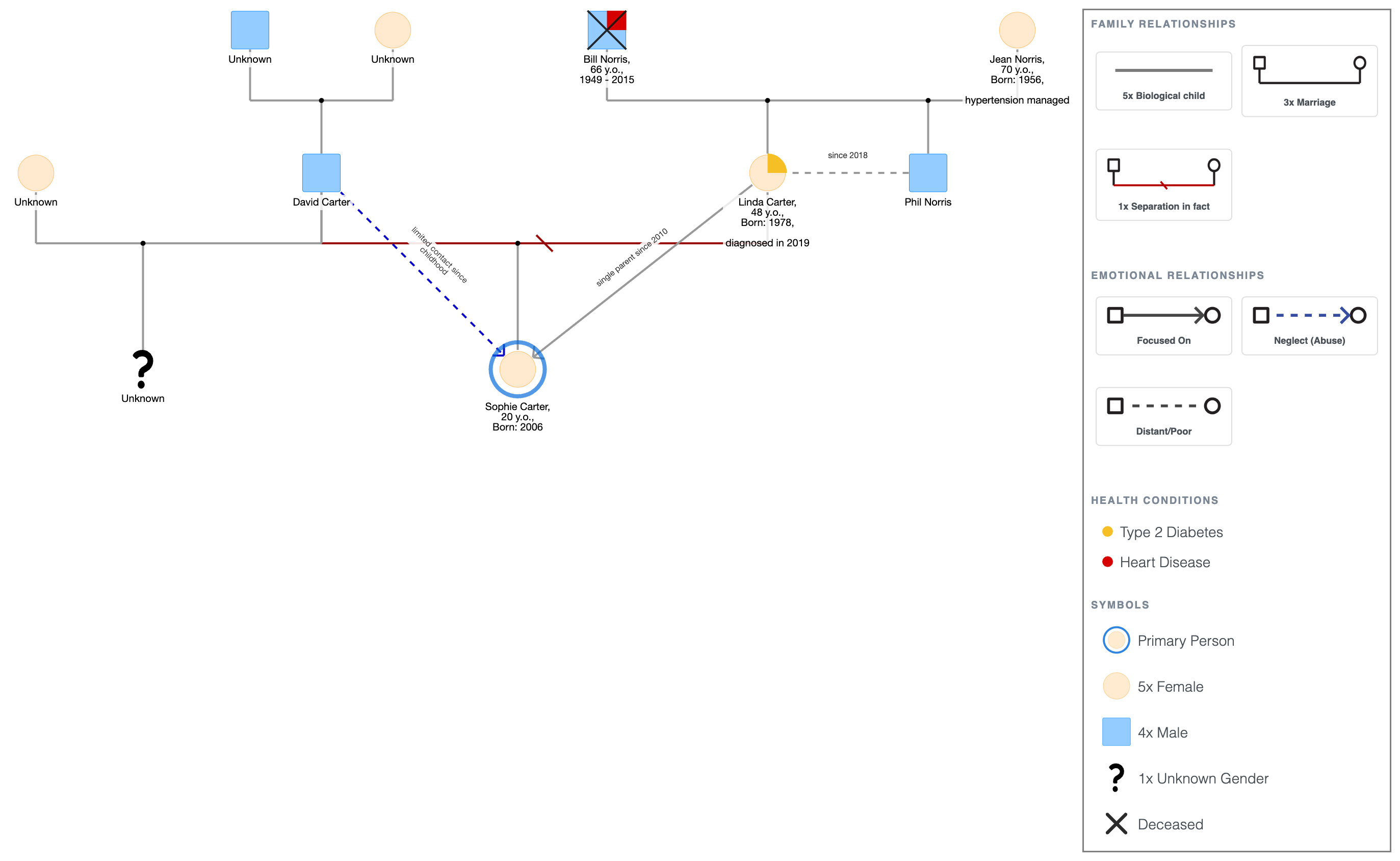
The family:
- Sophie Carter, 20, primary person.
- Mother: Linda Carter, 48, single parent since Sophie was 4, type 2 diabetes diagnosed 2019. Separated from Sophie’s father.
- Father: David Carter, age unknown, limited contact with Sophie since childhood, remarried (unknown woman with her age unknown), one child together, unknown with age unknown.
- Maternal grandparents: Bill Norris, deceased 2015, heart disease, age 66; Jean Norris, 70, hypertension managed.
- Linda's sibling: Phil Norris, age unknown, estrangement from Linda since 2018.
- Paternal grandfather and grandmother unknown. Sophie has never met them, no relationship line drawn.
What this genogram shows:
Bill's heart disease and Jean's hypertension sit on the maternal side. Linda's type 2 diabetes appears one generation below. Three conditions across two generations, and Sophie at 20 is the next person in that line. She can see that before any clinician points it out.
The paternal side is structurally present but almost entirely unknown. Both of David's parents are unidentified with no names, ages, health history or relationship lines. David himself has an unknown age, remarried someone whose name and age are also unknown, and has a child whose details aren't recorded either. He’s also separated from Sophie’s mother and neglects Sophie. The diagram shows a father and his whole family as a set of blanks.
Linda's estrangement from Phil and her single-parent status both sit in the same generation. Two separate facts that together show a woman who has been managing largely alone since Sophie was four with no partner, and a cut relationship with her only sibling.
Sample Family Genogram Assignment
Explore this genogram and adapt it to your needs.
The reflection component
Most professors expect the analysis to go beyond describing the diagram. The reflection should say something about what the exercise revealed, i.e., what you didn't know before you started, what only became clear once everything was mapped, and what the diagram suggests about how your family history might appear in clinical work.
This doesn't mean the paper needs to be confessional. It means the reflection has to do more than walk through what's already visible in the diagram.
For nursing students, this often connects to health risk awareness, i.e., what the diagram shows about hereditary risk factors, and how that might change the way you approach family health history conversations with patients. For Sophie, that might look something like: "I knew my maternal grandfather died of a heart attack, and that my maternal grandmother is currently hypertensive, but mapping three generations made me realize I'd never actually connected those conditions as a pattern before."
For social work and counseling students, the focus tends to be relational, i.e., what the diagram shows about the dynamics you grew up in, and how those might show up in clinical work.
Common challenges
- Not knowing grandparents' history: Place their symbols in the correct positions and mark what you know. Note gaps in the analysis as undocumented rather than leaving them unmarked on the diagram.
- Adoptive or blended family structures: Map the family as it actually is. Adoptive parents do not use the same structural lines as biological parents in most standard notation. The blended family genogram example covers step-parents and half-siblings.
- Estrangements that are still raw: Include the person and draw the line. You don't need to explain it in detail in the analysis. The line type carries the fact of it.
- Sensitive health information: Use the level of detail that's accurate without being more specific than necessary. "Substance use disorder" is a standard clinical notation. You don't need to specify the substance.
- Assignments that require exactly three generations: Map three. If a fourth generation is directly relevant to the patterns you're analyzing, include it and note why. Don't add generations just to be thorough if your brief doesn't ask for them.
How to Build Your Family Genogram
Open the Sophie Carter sample above in EasyGenogram and replace the details with your own family, or start from scratch. For a full walkthrough, see how to make a family genogram. If your professor gave you a broader brief before narrowing it to your own family, the genogram assignment guide shows how to translate that brief into a finished diagram and paper.
- Place yourself as the primary person: mark your symbol with a double border.
- Add your parents and their siblings: include everyone at that generation level, including people you have limited contact with.
- Add your grandparents on both sides: use unknown notation where information is missing rather than leaving the position out.
- Add health conditions and life events: causes of death, diagnoses, and significant dates next to the relevant person.
- Add relationship lines: draw lines for every significant relationship, including difficult ones. Missing lines are also information.
- Add a legend: list every symbol and line type used.
- Export as PDF or PNG for submission.
FAQ
What is a family genogram assignment?
A family genogram assignment asks you to map your own family across at least three generations using standard genogram symbols, then write an analysis identifying patterns in the family system. It is commonly assigned in nursing, social work, psychology, and counseling courses. The diagram covers structure, health history, and relationship quality. The analysis connects what you find to course theory and personal reflection.
What if I don't know my full family history?
Mark what you know and use standard notation for gaps. Unknown family members get a symbol in the correct position labeled as unknown. Missing information about health history or causes of death can be noted in the analysis as undocumented. A genogram with honest gaps is more accurate than one that fills in guesswork.
Do I have to include sensitive information about my family?
Include what's relevant to the patterns you're analyzing, at the level of detail that's accurate without being more specific than necessary. Standard clinical notation covers most sensitive information without requiring personal narrative. Check your assignment brief for any confidentiality guidelines your program requires.
How personal should the analysis be?
Personal enough to show you engaged honestly with the material, not so personal that it becomes a disclosure exercise. The reflection should say something specific about what the diagram showed you and how it connects to your professional practice.
Can I use a template for a family genogram assignment?
Yes. Open the Sophie Carter sample above in EasyGenogram and replace the family details with your own. For a blank starting structure, see the family genogram template. Students with a valid school email can export free.
Sources
- Genograms: Assessment and Intervention (3rd ed.). W.W. Norton & Company.
- Family Therapy in Clinical Practice.
- Genogram Assignment Sample.