Appearance
Spiritual Genogram
A spiritual genogram maps religious affiliation, devotion, and significant faith events across at least three generations, tracing how belief, doubt, and disconnection from faith move through a family over time.
What a Spiritual Genogram Adds
A standard genogram has room for a religious note here and there, but a spiritual genogram puts faith at the center of the assessment: not just what religion each person identified with, but how devoutly they practiced, what shook their belief, and how faith caused connection or conflict within the family.
This is the history-facing companion to a Spiritual Ecomap, which maps a person's current spiritual connections. The ecomap shows where someone's faith life stands today; the genogram shows what produced it.
The Langley Family Example
Spiritual Genogram Example
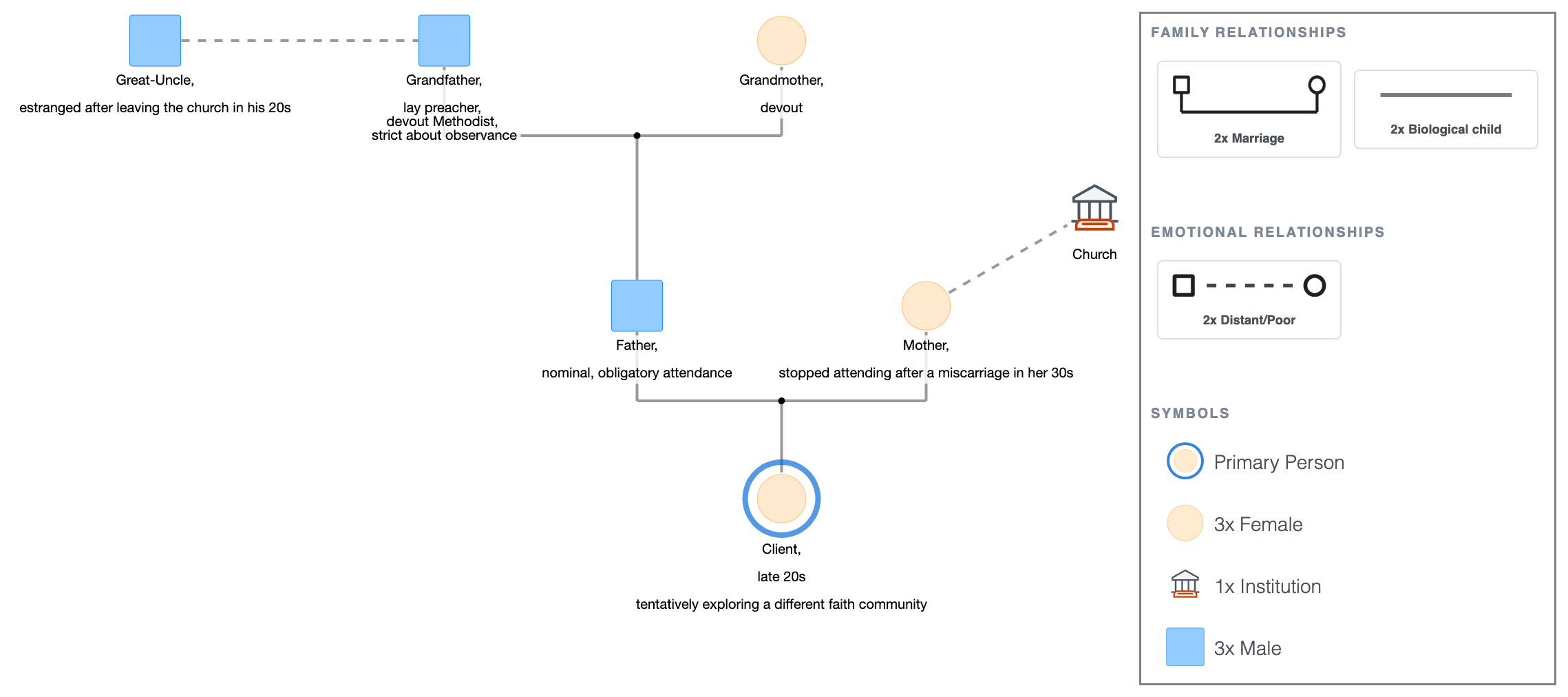
- Grandfather (lay preacher, devout Methodist, strict about observance); grandmother (devout); great-uncle noted as estranged after leaving the church in his 20s.
- Father (nominal, obligatory attendance); mother (Distant/Poor line to the church, stopped attending after a miscarriage in her 30s).
- Gen 3: client, primary person, late 20s, tentatively exploring a different faith community.
The client came to counseling describing guilt she couldn't quite explain, a sense of falling short spiritually without a clear standard she was failing to meet.
Building the genogram made the standard visible; her grandfather had been a lay preacher, devout enough that Sunday observance and church attendance organized the family's entire week.
Reading the Pattern
Her father continued attending as an adult, but nominally, out of family obligation rather than devotion, a quiet loosening of his father's rigidity without an open break.
Her mother's relationship with the church ended more specifically; after a miscarriage in her thirties, she felt the congregation offered platitudes instead of real support, and she stopped attending without ever formally leaving or discussing it as a decision.
That's marked on the genogram as a Distant/Poor line rather than a Cutoff, since she never renounced her faith outright, she simply stopped showing up, carrying an unresolved grief that was never named as such within the family.
The client grew up between these two responses; her father's obligatory presence and her mother's quiet absence, with neither parent modeling an actively chosen faith.
Her current guilt about "not being where her grandfather was" makes more sense once it's clear that no one in the two generations between them was actually living up to that standard either.
Her own tentative exploration of a gentler faith community isn't a departure from the family pattern.
It's the first attempt in three generations to choose a spiritual path deliberately rather than out of obligation or unspoken hurt.
That reframe doesn't resolve her uncertainty about which spiritual community fits her, but it removes the false comparison to a grandfather whose devotion was never actually replicated by the two generations in between.
Build One for a Session
There's no dedicated symbol set for faith in standard genogram notation, so use the notes field on each person to record religious affiliation, level of devotion, and significant events like conversions, crises of faith, or a quiet stepping-away.
Use the standard relationship lines, Close, Distant/Poor, Cutoff, Conflict, to show how faith affected each relationship, since the emotional dimension often matters more than the affiliation itself.
Ask specifically about crises of faith and unspoken departures, not just denominations, since those are often where the more clinically useful information sits.
Export as PDF once it's built.
For the full guide, see How to Make a Genogram.
Spiritual Genogram Example
Explore this genogram and adapt it to your needs.
FAQ
What is a spiritual genogram?
It's a genogram that maps religious affiliation, devotion, and faith events, conversions, crises, quiet departures, across at least three generations, revealing how a family's relationship with faith has shifted over time.
What is an example of a genogram like this?
The Langley family genogram in this article is one example; three generations moving from devout obligation to nominal practice to unresolved grief to a tentative, deliberately chosen faith path. Every family's pattern looks different, but the value is in seeing the shifts laid out generation by generation rather than assumed to be constant.
Is a spiritual genogram used in training and supervision?
Yes. Many pastoral counseling and marriage and family therapy programs assign a self-directed spiritual genogram so students can recognize their own religious background and potential blind spots, similar in purpose to the self-genogram assignment used more broadly in counselor training.
Can a spiritual genogram help with religious trauma?
Yes. Seeing a rigid or harmful religious pattern mapped across generations, rather than treated as an isolated personal experience, often helps a client understand that what they experienced was part of a family and institutional pattern, not something uniquely wrong with them.
Does every family member need to share the same religion for this to be useful?
No. Some of the most useful spiritual genograms show exactly the opposite; a family with conversions, disaffiliations, or interfaith marriages across generations, since the differences and the reasons behind them are often what's most clinically relevant.
Sources
- The spiritual genogram in family therapy
- Spiritual genograms: A generational approach to assessing spirituality