Appearance
Spiritual Ecomap
A spiritual ecomap shows a person's current connections to spiritual and religious systems using the same circle and line structure as a standard ecomap.
What a Spiritual Ecomap Shows
- Faith community - place of worship, congregation, religious group.
- Religious or spiritual leader - pastor, imam, priest, spiritual director, mentor.
- Spiritual practices - prayer, meditation, scripture study, nature, fasting, ritual.
- Service and mission - volunteering, community outreach connected to faith.
- Spiritual support network - family members or friends who share or support the person's spiritual worldview.
When It's Used
- Pastoral counseling: to map a client's current spiritual connections and identify where support or strain exists.
- Faith-based social work: to understand the role of religious community and practice in a client's life.
- Couples assessment: to map how each partner's spiritual connections overlap, differ, or create tension.
- Therapy with religious clients: to give a spiritually competent therapist a picture of the client's faith ecology before treatment planning.
- Personal reflection: individuals use it independently to examine which spiritual connections are sustaining and which have become depleted.
A Completed Spiritual Ecomap Example
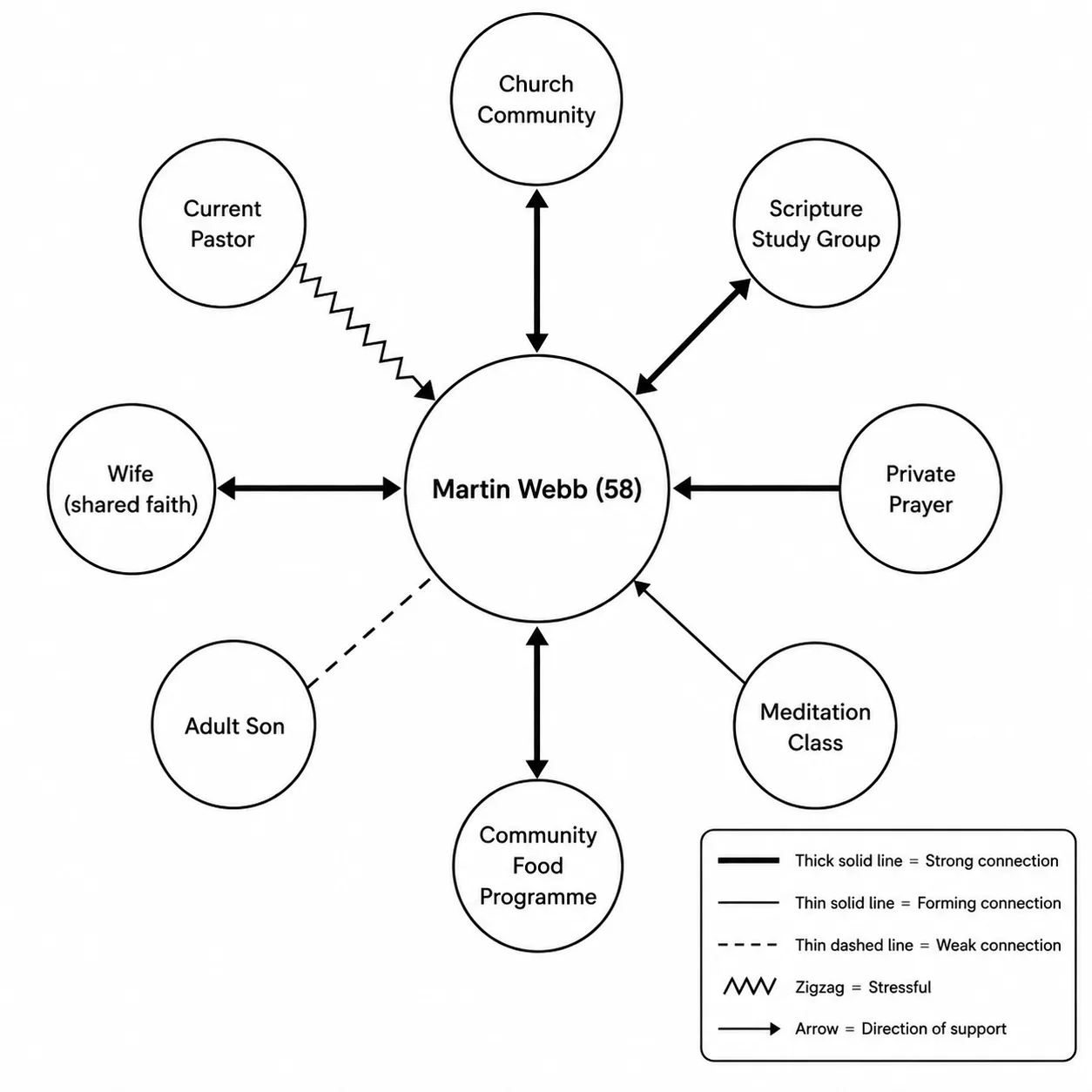
Martin Webb is 58 and recently retired. He has been attending pastoral counseling following a period of spiritual uncertainty that coincided with his retirement. He has also been part of the same church community for 22 years.
The connections:
- Church community: strong, mutual. Martin attends weekly and is known within the congregation. He both gives and receives from this connection.
- Current pastor: stressful, toward the center. A disagreement over church direction two years ago created a rift that has not been resolved. Martin continues to attend but the pastoral relationship is under strain.
- Scripture study group: strong, mutual. Four men who have met weekly for twelve years. This connection is separate from his relationship with the pastor.
- Private prayer: strong, toward center. A daily practice Martin describes as the most consistent spiritual anchor he has.
- Wife (shared faith): strong, mutual. They attend together and their faith is a shared part of the marriage.
- Adult son: dashed, no arrow. Martin's son does not share his faith and the spiritual dimension of their relationship is largely absent.
- Meditation class: thin solid, toward center. Martin started attending six weeks ago, outside his faith tradition. Still forming.
- Community food programme (church-linked): mutual. Martin volunteers monthly. The connection is practical and sustaining.
What this ecomap shows:
- Martin has a strong spiritual core; private prayer, the scripture group, his wife, and the food programme all carry solid mutual lines. His spiritual life is not depleted overall.
- The pastor line sits in the same diagram as the scripture group line. Both connect to the same church. One is stressful, one is strong.
- His son's dashed line with no arrow sits in the diagram too. The spiritual dimension of that relationship is absent rather than conflictual.
- The meditation class is thin and still forming. A counselor reviewing this diagram six months later would look for whether that line has thickened, disappeared, or created tension with the existing faith connections.
For a full guide to building and reading ecomaps, see the ecomap guide.
How to Create a Spiritual Ecomap
- Place the person or family at the center - individual or couple.
- Identify the spiritual connections - work through faith community, leadership, practices, service, and support network.
- Draw connecting lines - solid for sustaining, dashed for weak or lapsed, zigzag for stressful. For a full reference of line types, see the ecomap symbols guide.
- Add directional arrows - mark whether each connection gives to or takes from the person.
- Add a key and the date - required for any clinical or pastoral record.
For the full process, see how to create an ecomap. You can also create one from this blank template.
FAQ
What is a spiritual ecomap?
A spiritual ecomap is a visual assessment tool that maps a person's current connections to spiritual and religious systems; faith communities, spiritual leaders, practices, service involvement, and sources of meaning. It uses the same circle and line structure as a standard ecomap. It was developed by David Hodge in 2000 as a tool for spiritually sensitive clinical assessment with individuals, couples, and families.
How is a spiritual ecomap different from a standard ecomap?
A standard ecomap maps all significant external systems; schools, employers, healthcare, family, community organizations, while a spiritual ecomap maps specifically the spiritual and religious connections in a person's life. The format and symbols are identical; the scope is narrower and focused on faith and meaning rather than general social ecology.
What should be included in a spiritual ecomap?
The person or family at the center, with outer circles for the faith community, religious or spiritual leader, spiritual practices, service or mission involvement, and any family members or friends whose spiritual connection is significant. Include connections that are stressful or lapsed as well as the sustaining ones.
Where can I find a free spiritual ecomap template?
You can find a free ecomap template on Qwoach. It is a blank template and free to download.
Who uses spiritual ecomaps?
Pastoral counselors, chaplains, faith-based social workers, and therapists working with religious clients use spiritual ecomaps in assessment and treatment planning. They are also used in couples counseling to map how each partner's spiritual life connects or diverges. Individuals sometimes use them independently as a reflective exercise.
Sources
- Spiritual ecomaps: A new diagrammatic tool for assessing marital and family spirituality. Journal of Marital and Family Therapy, 26(2), 217–228.
- Diagrammatic assessment of family relationships. Social Casework, 59(8), 465–476.