Appearance
Genogram for Pastoral Counseling
A pastoral counseling genogram maps each partner's family faith history side by side, revealing assumptions about religious practice that neither person has necessarily named out loud before marriage.
Why Pastoral Counselors Use a Genogram
A couple in premarital counseling can describe their own beliefs clearly enough.
What's harder to see without a diagram is how each partner's family modeled faith in daily life, whether it was public or private, obligatory or chosen, a source of connection or a source of pressure.
A genogram makes that family pattern visible before it becomes an unspoken point of friction in the marriage itself.
The Bradford and Cole Families
Mark Bradford's Family Genogram
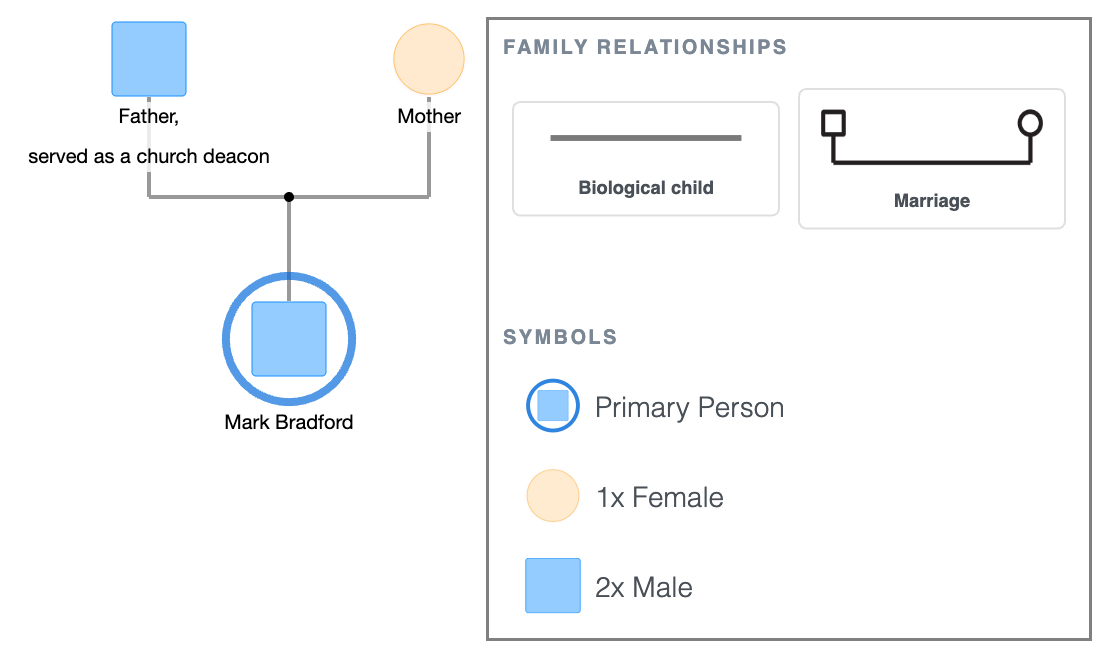
- Mark Bradford's family: father served as a church deacon; so faith was practiced visibly, and church leadership was treated as an expected path for the eldest son.
Sophie Cole's Family Genogram
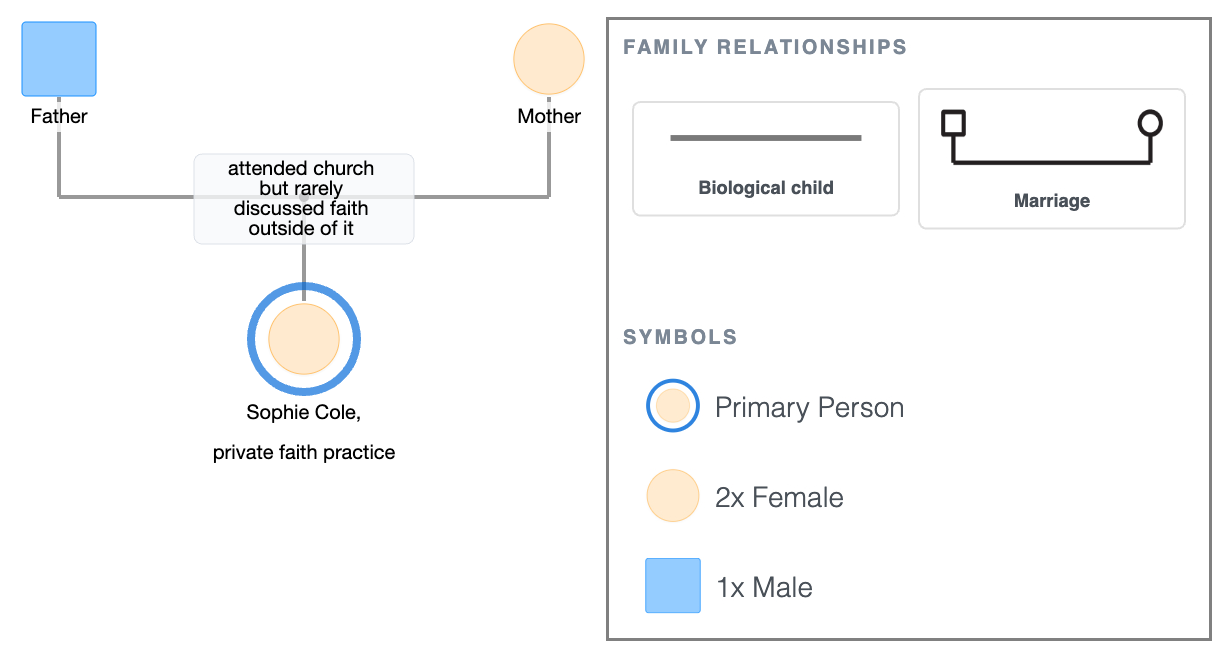
- Sophie Cole's family: faith was treated as personal and private; church attendance was framed as a choice, not a family obligation.
Mark Bradford and Sophie Cole came to premarital counseling with no major disagreements they could point to.
Their pastor built a genogram for each of their families rather than relying on a single conversation about "what faith means to you," and set the two diagrams side by side.
What the Two Genograms Revealed
Mark's family history showed faith as something practiced visibly and collectively; his father served as a deacon for years, and church involvement was simply what a Bradford man did, an expectation passed down rather than a decision anyone in the family remembered actively making.
Sophie's family history showed something quieter; her parents attended church but rarely discussed faith outside of it, and her own spiritual life had always been treated as hers to shape privately.
Neither pattern had been named directly in the relationship.
Mark had assumed that a shared, visible devotional life, family prayer, active church roles, was simply what a Christian marriage looked like.
Sophie had quietly assumed her own private approach to faith would continue largely unchanged.
Both assumptions were reasonable given each of their family histories.
Build One for a Premarital Session
Build a separate genogram for each partner's family, using the notes field to record religious affiliation, practice level, and whether faith was treated as public or private, obligatory or chosen.
Set both diagrams side by side rather than combining them into one, since the comparison itself is often the most useful part.
Ask each partner directly what they expect shared faith practice to look like in their own marriage, and check that expectation against the pattern their own genogram shows.
For the full guide, see How to Make a Genogram.
Sophie Cole's Family Genogram
Explore this genogram and adapt it to your needs.
FAQ
Why build two separate genograms instead of one combined family genogram?
The comparison between two distinct family patterns is often more useful in premarital counseling than a single combined diagram, since the goal is surfacing where each partner's expectations came from, not yet mapping a shared family system that doesn't exist yet.
What if one partner doesn't want to discuss their family's religious history?
Note that reluctance directly rather than skipping the exercise. Sometimes the resistance to discussing it is itself meaningful information, particularly if faith was a source of pressure or conflict in that partner's family.
Does this only apply to couples from different religious traditions?
No. Mark and Sophie were raised in the same broad tradition but had very different family patterns around how faith was practiced. The differences that matter most in pastoral counseling are often about practice and expectation, not just denomination.
How is a pastoral counseling genogram different from the individual spiritual genogram used in personal reflection?
A spiritual genogram usually maps one person's own faith history for personal insight. A pastoral counseling genogram, especially in premarital work, often maps two people's histories side by side specifically to compare expectations before a shared decision, like marriage.
Can this approach work outside premarital counseling?
Yes. The same side-by-side comparison is useful whenever two family systems are merging or in tension, blended families navigating differing faith practices, or a family crisis where generational faith expectations are part of the conflict.
Sources
- Emotionally Healthy Spirituality (Updated ed.)
- The spiritual genogram in family therapy