Appearance
Forensic Genogram
A forensic genogram is a three-generation family diagram used in legal, criminal justice, and forensic psychology settings to document patterns of violence, abuse, incarceration, and substance use across a family system.
What a Forensic Genogram Documents
- Violence and abuse history: physical abuse, sexual abuse, domestic violence, and neglect, marked by generation and by who was perpetrator versus victim.
- Incarceration history: who was incarcerated, for what offense, and for how long, across generations.
- Substance use patterns: alcohol and drug use, and how it correlates with the abuse or violence markers.
- Mental health diagnoses: conditions such as PTSD, depression, or antisocial personality disorder, where documented.
- Cutoffs and family fragmentation: relationships that ended, gaps in contact, and secrecy around family history.
The Whitfield Family
Forensic Genogram
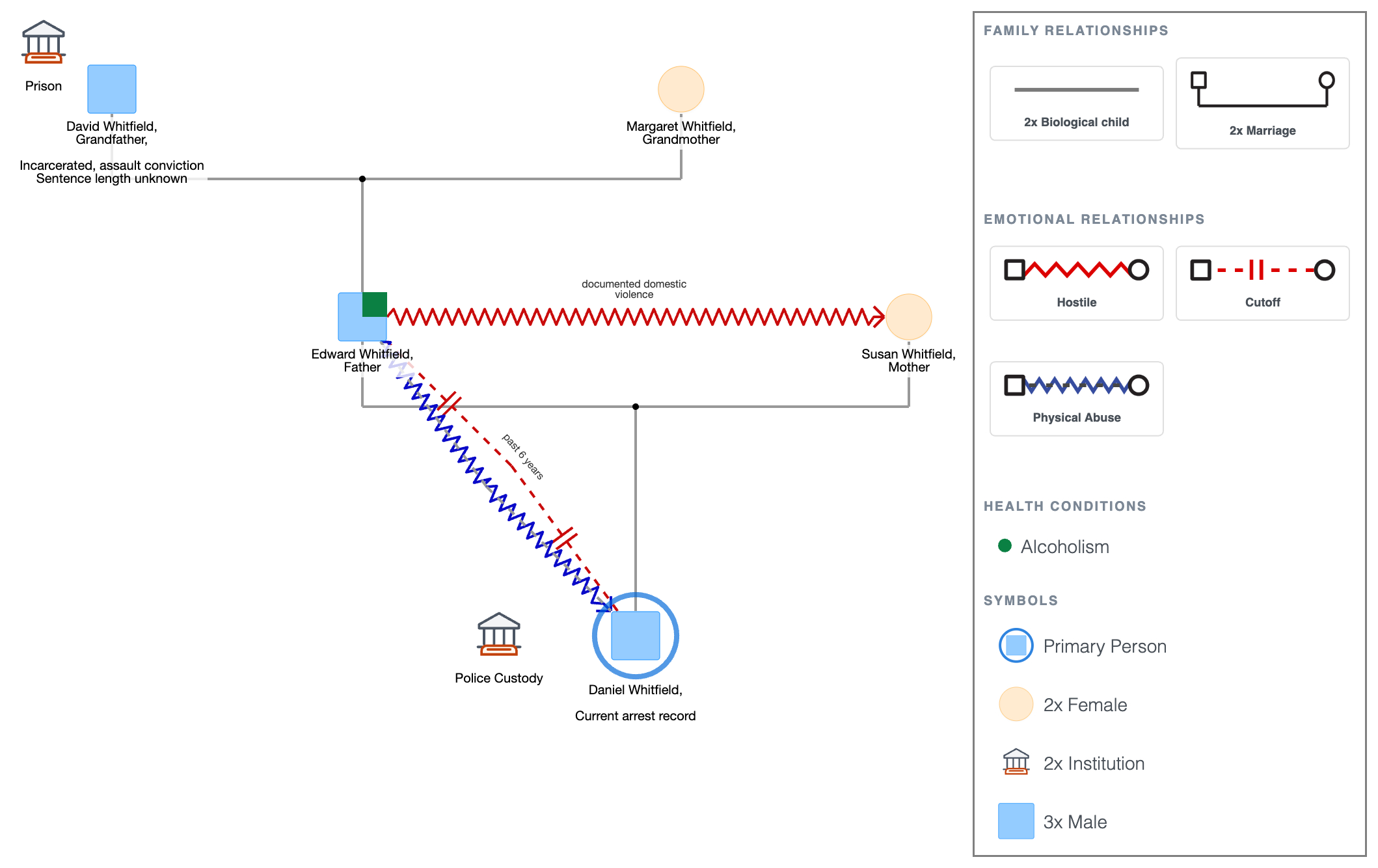
- David Whitfield (grandfather): incarcerated, assault conviction.
- Edward Whitfield (father): alcoholism marker, domestic violence marker, Hostile line to his partner.
- Daniel Whitfield: primary person, physical abuse marker (childhood), current arrest record noted.
- Cutoff line between Daniel and Edward.
A forensic psychologist was retained to prepare a mitigation report ahead of Daniel Whitfield's sentencing.
The genogram was built as part of that evaluation, mapping three generations to give the court context for the behavior at issue, not to excuse it.
What the Genogram Revealed
Daniel's grandfather, David, was incarcerated for assault when Daniel's father, Edward, was a child.
Edward grew up largely without him and developed a pattern of heavy drinking and domestic violence in his own household.
Daniel experienced physical abuse from Edward through most of his childhood, and the two have had no contact for the past six years, marked on the diagram as a cutoff.
Daniel's own arrest record, noted on his line, is the third generation-level entry in a pattern that runs unbroken through the family.
Laid out this way, the pattern reads as continuous rather than isolated, which is exactly what a mitigation report needs to show.
Documenting It for Legal Use
A forensic genogram carries more weight, and more risk, than a genogram built for a therapy session.
It's likely to be read by a judge, opposing counsel, and other parties who never met the family.
- Use clinical language, not judgmental terms: for marking abuse, violence, or substance use.
- Note the source of every claim: self-report, official records, or collateral interview, on the diagram or in an accompanying key.
- Document disagreement, don't resolve it: when family members disagree about history, note whose version is being used and why; the disagreement itself is often clinically relevant.
- Mark unknown information clearly: don't leave gaps blank. Gaps around violence, incarceration, or trauma are common in forensic cases, and the gap itself can be part of the pattern.
How This Differs from a CPS or Clinical Genogram
A forensic genogram and a CPS genogram can look similar on the page, both map risk factors across generations, but they're built for different purposes.
A CPS genogram centers the child; household composition, placement history, and the protective relationships that support a care plan.
A forensic genogram centers the subject of a legal proceeding; their behavioral and legal history, built to inform a court's understanding of risk, mitigation, or treatment planning, not a placement decision.
Build a Forensic Genogram for a Legal Case
Start with the subject and build out two to three generations, including family members with limited or no current contact.
Add abuse and violence history for each generation, noting perpetrator and victim roles where known.
Track incarceration history; who, for what offense, and when.
Map substance use alongside it, since the two frequently correlate.
Once the structure is in place, look for where the pattern seems to begin and where an intervention might have interrupted it. That's the piece a court or treatment team is usually most interested in.
For the full guide, see How to Make a Genogram.
Forensic Genogram
Explore this genogram and adapt it to your needs.
FAQ
What are the different types of genograms used in forensic settings?
Forensic settings use a three-generation genogram similar to a clinical genogram, but with additional markers specific to legal contexts; incarceration history, abuse and violence tracking, and substance use patterns. Some evaluators also use attachment-focused or trauma-focused variants depending on the purpose of the assessment.
What is the purpose of a forensic genogram in court?
A forensic genogram gives the court visual context for a defendant's or client's behavior by showing intergenerational patterns of violence, abuse, incarceration, or substance use. It's most commonly used in mitigation reports, custody evaluations, and risk assessments, where it supplements testimony rather than replacing it.
Is a forensic genogram the same as a pedigree chart?
No. A pedigree chart, used mainly in genetics, tracks biological inheritance and medical conditions across generations. A forensic genogram tracks relational and behavioral patterns, violence, abuse, incarceration, substance use, for legal and psychological assessment purposes.
What is an example of a forensic genogram?
The Whitfield family example in this article is typical; three generations showing incarceration, domestic violence, and abuse, built as part of a mitigation report ahead of sentencing. The structure documents where a pattern started and how it continued.
How do you document sensitive information ethically in a forensic genogram?
Document only what's relevant to the assessment's purpose, using clinical rather than judgmental language. Note the source of each piece of information, and be aware that a forensic genogram may become part of a legal record reviewed by multiple parties, which should shape how carefully it's worded.
Sources
- Forensic Family Genogram: An Assessment & Intervention Tool
- Genograms: Assessment and Intervention (4th ed.)