Appearance
Interpreting a Medical Genogram
In a medical genogram, three patterns matter most: vertical transmission, skipped generations, and early-onset clustering. Together, they show whether a condition is likely hereditary.
Vertical Transmission
A condition appears in consecutive generations, straight down one line of the family.
Vertical Transmission Example in a Medical Genogram
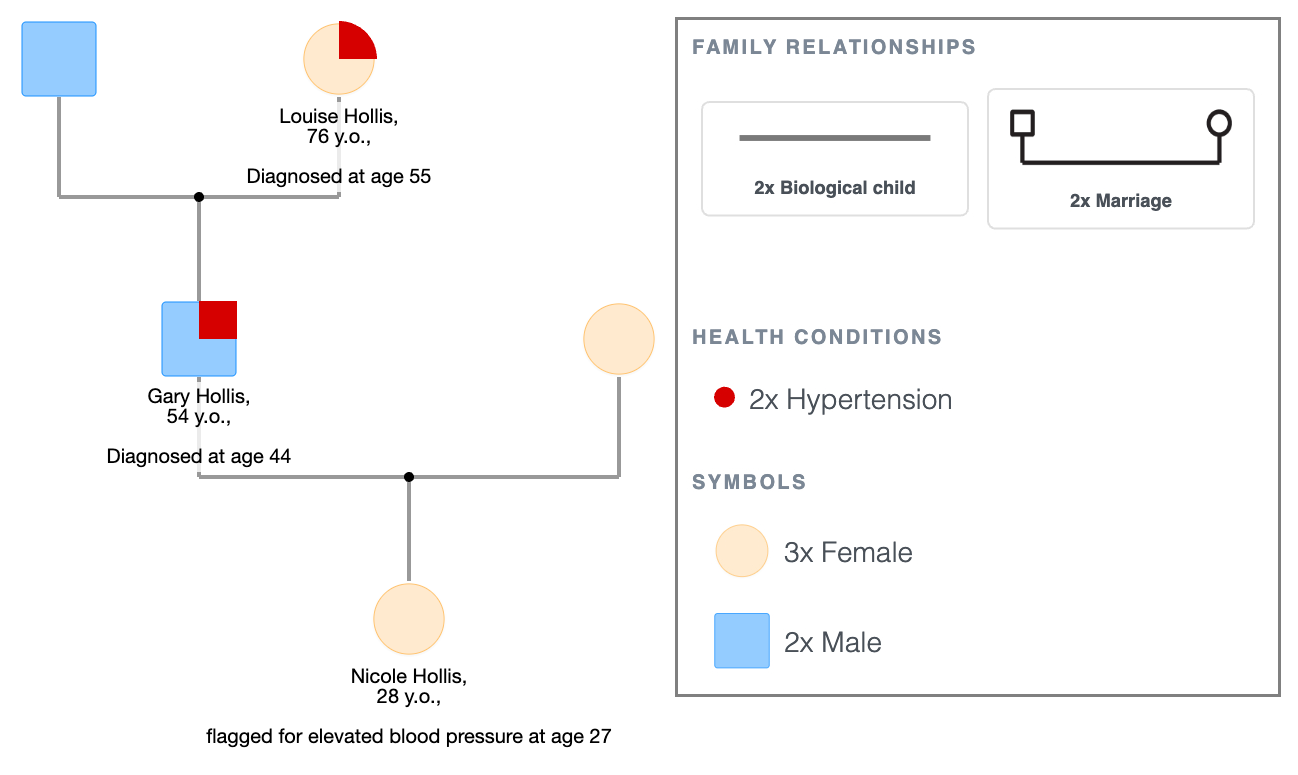
Louise Hollis (b. 1950) was diagnosed with hypertension at 55, in 2005.
Her son, Gary Hollis (b. 1972), was diagnosed with hypertension at 44, in 2016.
Gary's daughter, Nicole Hollis (b. 1998), was flagged for elevated blood pressure at a routine screening at 27, in 2025.
Same condition appearing in three generations in a row.
Skipped Generations
A condition disappears for a generation, then reappears in the next.
Skipped Generation Example in a Medical Genogram
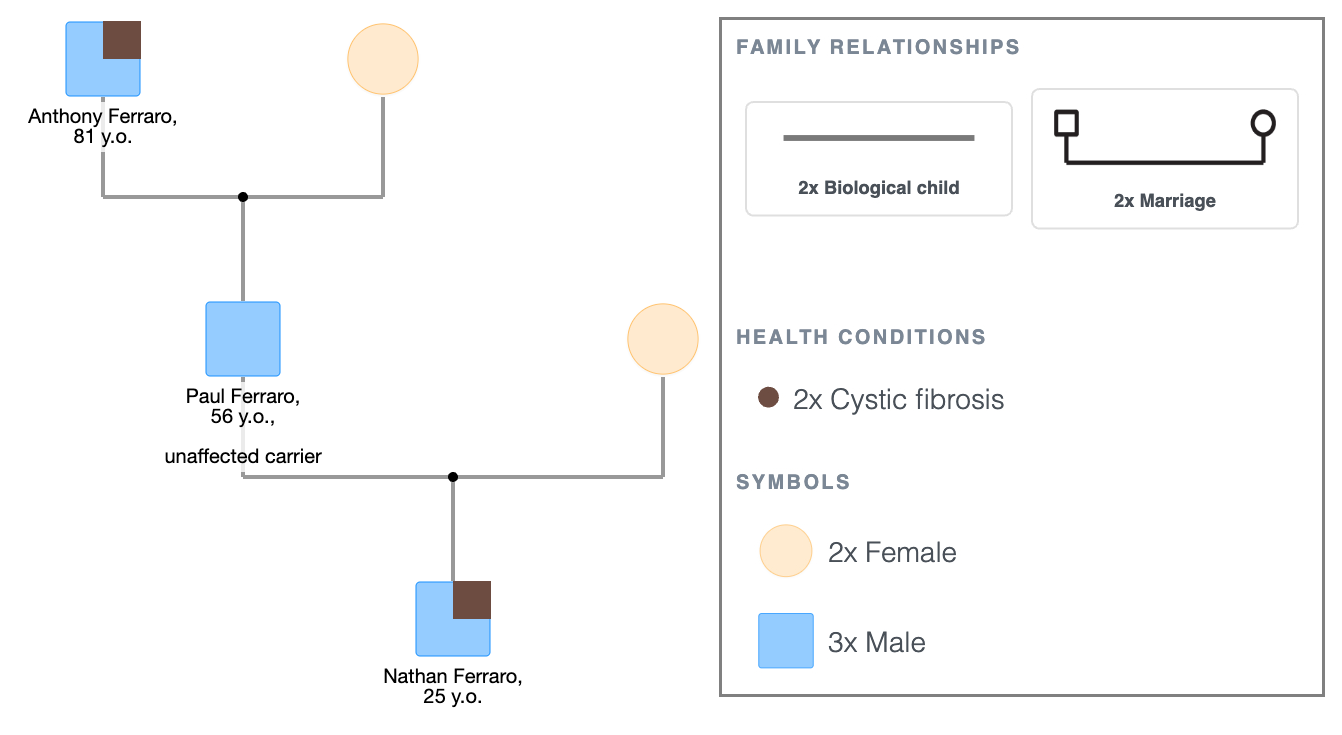
Anthony Ferraro (b. 1945) has cystic fibrosis.
His son, Paul Ferraro (b. 1970), is an unaffected carrier.
Paul's son, Nathan Ferraro (b. 2001), has cystic fibrosis.
The condition skips Paul entirely before reappearing in Nathan, a pattern that points toward recessive inheritance rather than coincidence.
Early-Onset Clustering
The same condition shows up at a progressively younger age each generation.
Early-Onset Clustering Example in a Medical Genogram
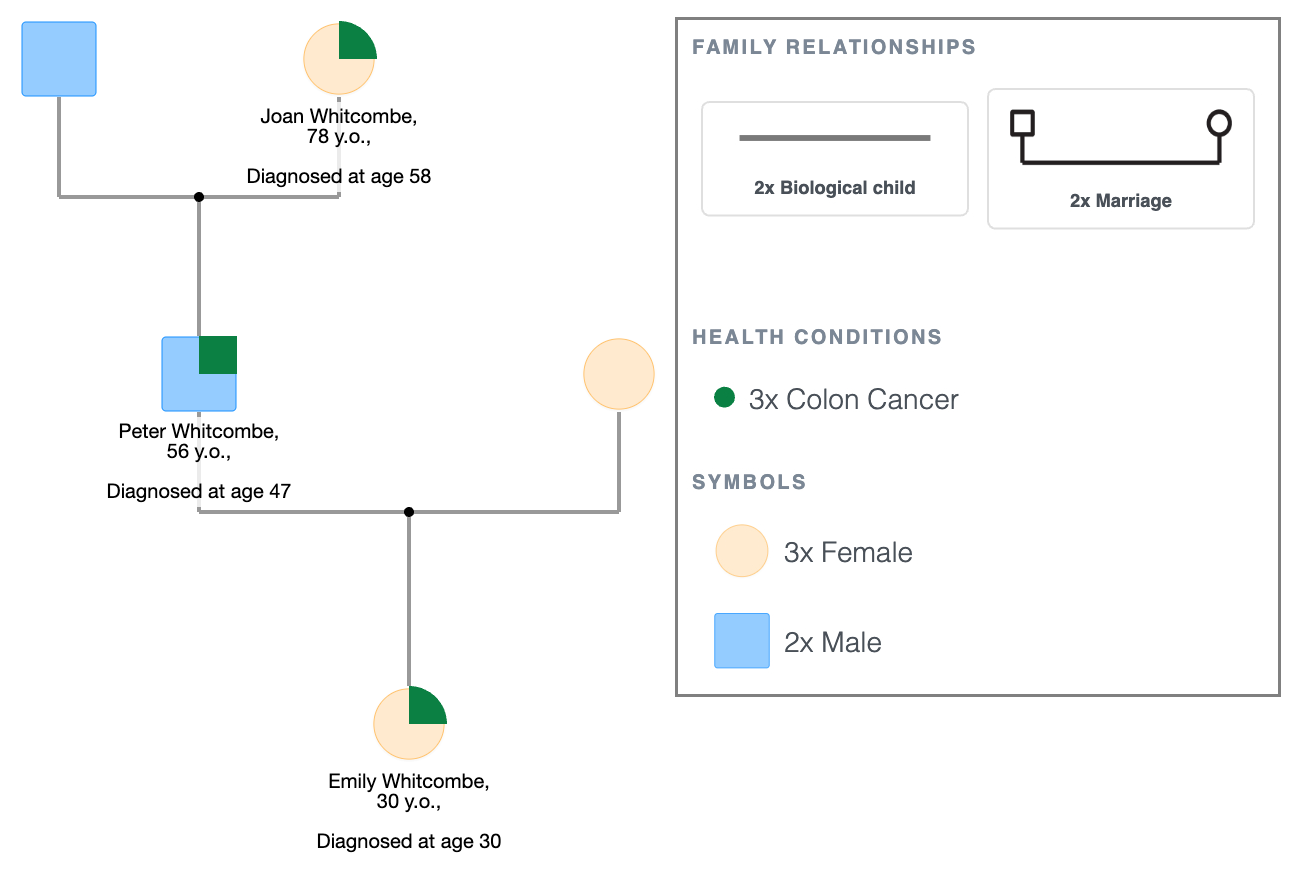
Joan Whitcombe (b. 1948) was diagnosed with colon cancer at 58, in 2006.
Her son, Peter Whitcombe (b. 1970), was diagnosed at 47, in 2017.
Peter's daughter, Emily Whitcombe (b. 1996), was just diagnosed at 30, in 2026.
The age at diagnosis drops roughly a decade each generation.
Red Flags Worth Flagging for Genetic Counseling
- The same condition in three or more relatives.
- A diagnosis at an unusually young age for that condition.
- Multiple relatives with the same specific cancer type.
- Conditions from both sides of the family meeting in one descendant.
When to Suggest Genetic Counseling
Patterns like Nicole Hollis's family history of hypertension, Nathan Ferraro's recurrence of cystic fibrosis, or Emily Whitcombe's earlier age of diagnosis, the same condition repeating, skipping a generation, or dropping in age of onset, are standard reasons to suggest genetic counseling.
See Genetic Counseling Genogram for what that process typically covers.
Early-Onset Clustering Example in a Medical Genogram
Explore this genogram and adapt it to your needs.
FAQ
What is vertical transmission on a medical genogram?
Vertical transmission is a condition appearing in consecutive generations, straight down one line of the family, grandparent to parent to child.
What does it mean if a condition skips a generation?
A condition that disappears for one generation and reappears in the next often points to a recessive inheritance pattern rather than coincidence.
Why does early-onset clustering matter?
When the same condition shows up at a progressively younger age each generation, it's one of the strongest signals that a hereditary factor is involved, rather than lifestyle or chance.
What counts as a red flag for genetic counseling?
The same condition in three or more relatives, an unusually young diagnosis, multiple relatives with the same specific cancer type, or conditions from both sides of the family converging in one person.
What symbols show medical conditions on a genogram?
Medical genograms use the same base symbols as any genogram, squares and circles for individuals, with health conditions added as labels, color-coded markers, or shading directly on or beside the relevant person's shape.
Sources
- Genograms: Assessment and Intervention (4th ed.)
- Reading and Interpreting Genograms: A Systematic Approach