Appearance
Genogram vs Family Tree
A family tree maps who is in the family, while a genogram maps what is happening in it. Both use a similar structure of generations, connecting lines, names and dates, but they're built for different purposes, and one cannot substitute for the other when the situation calls for the other.
What a Family Tree Shows
A family tree records lineage; details such as who descended from whom, when people were born and when they died, and how the generations connect. It answers questions about ancestry and heritage.
What it includes:
- names and birth years
- marriage and death dates
- biological connections across generations
- ancestry and descent
What it doesn't include:
- the quality of relationships
- health history
- significant life events like divorces or estrangements,
- or any information about how the family functions as a system.
A family tree can show that two people were married for 40 years without showing that those 40 years were characterized by distance or conflict.
What a Genogram Adds
A genogram starts with the same structural layer as a family tree, then adds:
- Health conditions: documented in each person's symbol, with cause of death for those who have died.
- Relationship quality: lines showing whether a connection is close, distant, conflictual, or cut off, or something else.
- Life events with dates: divorces, estrangements, significant losses, and how they fit in the family's timeline.
- The primary person: a marked individual the diagram is built around, rather than a generalized record of ancestry.
The structural layer is nearly identical, but the difference is in what sits on top of it.
Same Family, Two Diagrams: The Rowe Family
As a family tree:
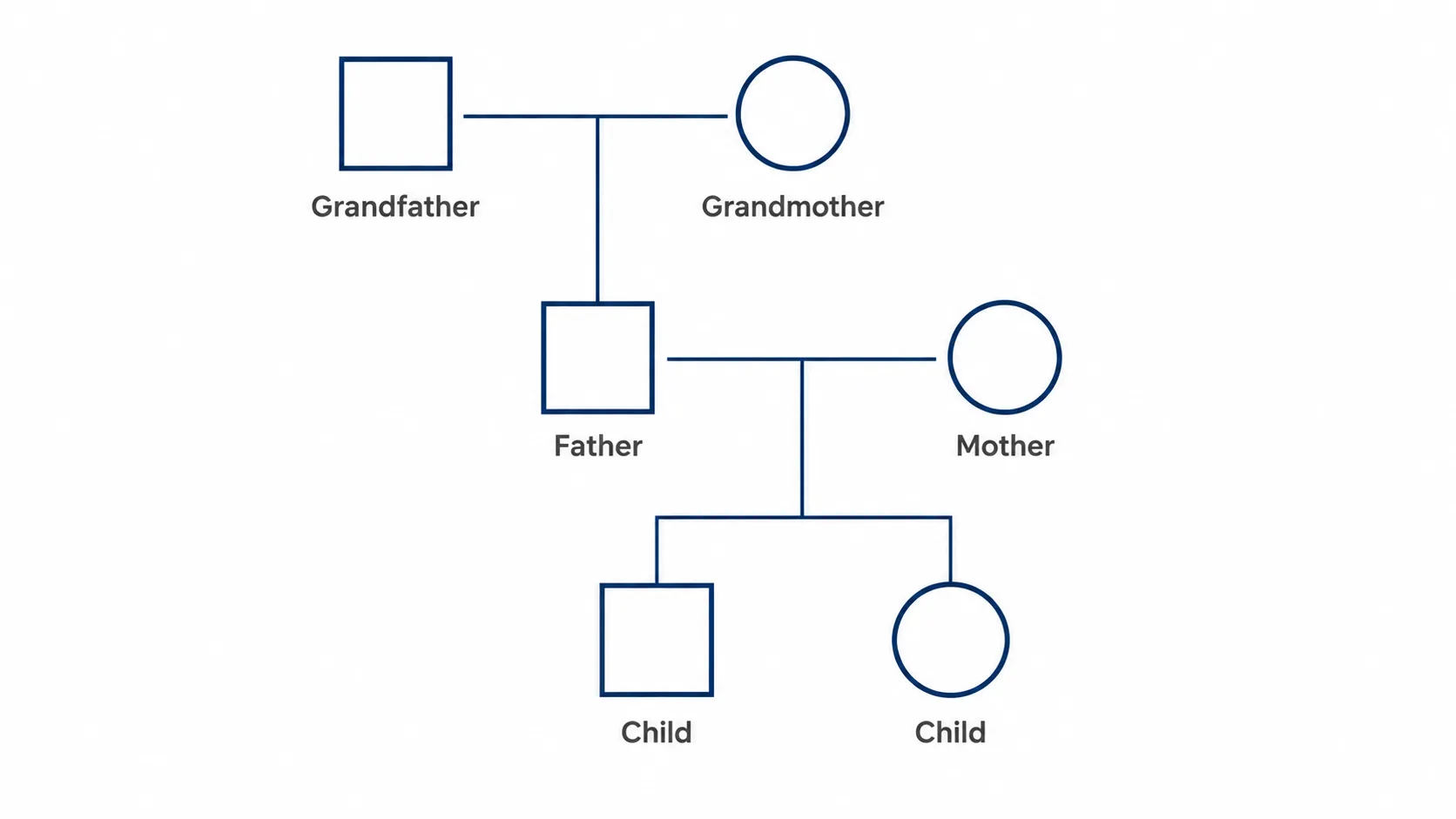
The family tree shows Phil Rowe married to Sandra Hill.
Their children: Mia and Dan, listed below them in birth order.
Phil’s parents: Alan Rowe and Joyce Rowe.
Phil has one sibling, Tom.
Sandra's parents: Derek Hill and Patricia Hill.
Every member is present and connected.
Alan's birth and death years mark him as deceased.
What you cannot see: why Alan died, what his relationship with Phil was like, what is happening between Phil and his brother, or what Sandra's relationship with her parents looks like. This is where a genogram becomes useful.
As a genogram:
The Rowe Family Genogram Example
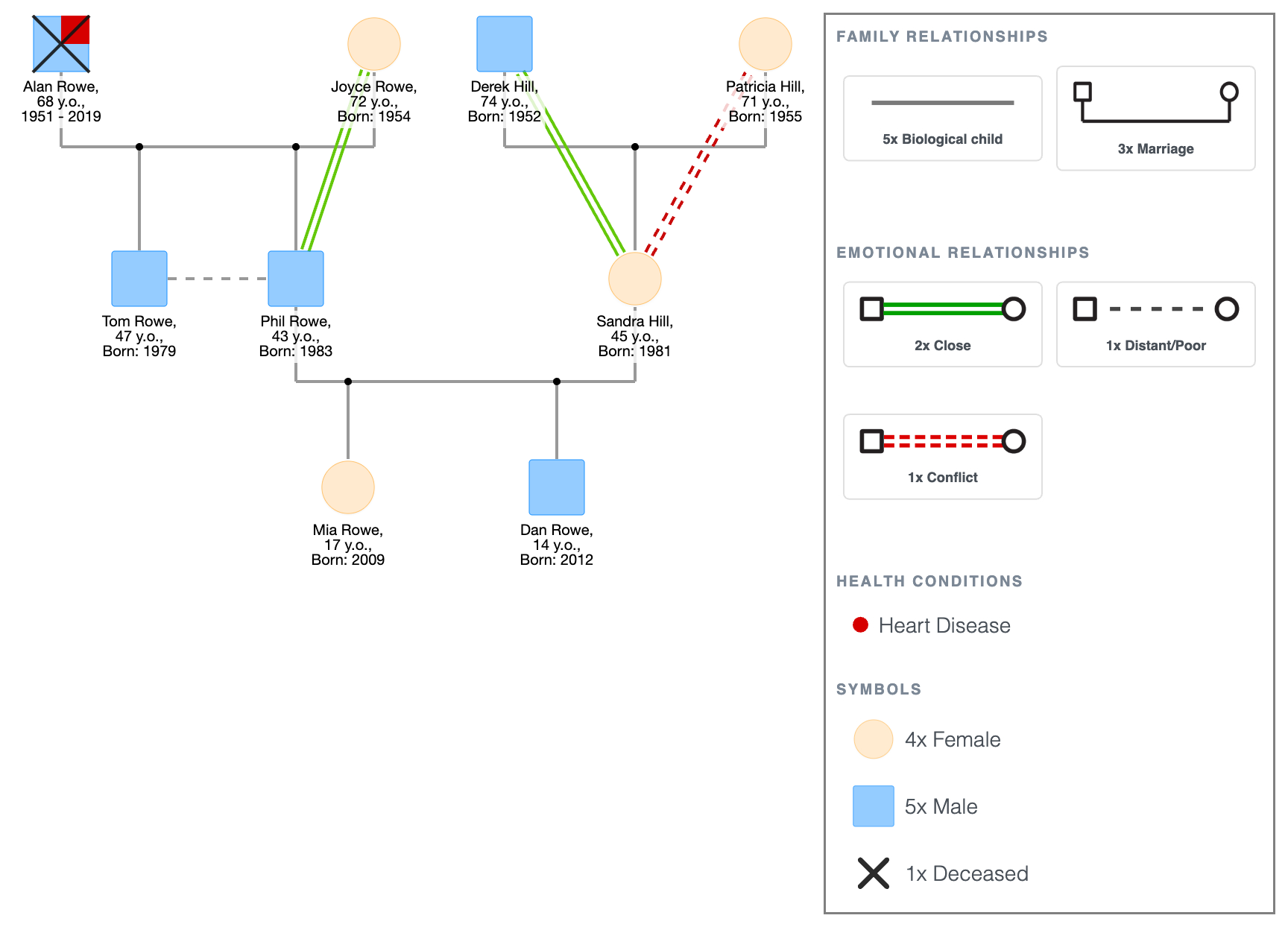
The same family, with the additional layers:
- Alan's heart disease is noted in his symbol; the cause of death that the family tree only gestured at with a death year.
- Close relationship line between Phil and Joyce; after Alan's death, Phil became Joyce's primary contact.
- Distant line between Phil and Tom; two brothers who share the same parents and have never been close.
- Conflict line between Sandra and Patricia; a long-standing tension that predates Sandra's marriage.
- Close line between Sandra and Derek.
What you can now see:
- Alan's heart disease sits one row above Phil, and even Tom. That fact has a different weight on a genogram, as a risk factor to them.
- Phil's close line to Joyce and distant line to Tom sit in the same sibling row. After his father's death, Phil absorbed the parental relationship without the sibling one to share it. The diagram shows the weight of that.
- Sandra's conflict with Patricia and her closeness to Derek appear on the same row. Her relationship with her parents is not uniform. A family tree shows both parents as equally present, but the genogram shows they are not.
- Mia and Dan sit at the bottom of a diagram that now includes their paternal grandfather's health history, their parents' relationship dynamics with their own parents, and an uncle they may rarely see. None of that is visible in the family tree, but all of it is visible here.
When a Family Tree Is Enough
A family tree is the right tool when the goal is genealogical: tracing ancestry, documenting where family members came from, building a record of biological descent for heritage or historical purposes. It is also sufficient for simple school projects that ask students to show who is in their family without any clinical or analytical component.
If the question is "who are my ancestors and how do they connect?" a family tree answers it.
When You Need a Genogram
A genogram is necessary when the diagram needs to carry more than lineage:
- Course assignments in social work, nursing, psychology, and counseling: these almost always require relationship lines and health history.
- Therapy intake: a therapist needs the relational layer, not just who is in the family.
- Medical history documentation: health conditions and causes of death across generations need to be visible in context.
- Any situation where relationship quality matters: estrangements, close bonds, conflicts, cutoffs, and living arrangements all have dedicated notation in a genogram that a family tree has no equivalent for.
For genogram assignments specifically, the genogram assignment guide covers what most course briefs require. For examples of completed genograms across different scenarios, see the genogram examples page.
How to Build a Genogram
EasyGenogram is built specifically for genograms. Open the Rowe family example above and replace the details with your own family, or start from a blank canvas. For a step-by-step walkthrough, see how to make a genogram.
- Place the primary person: mark your symbol with a double border.
- Add parents and siblings: connected by marriage and sibling lines.
- Add grandparents: on both sides, if necessary.
- Add health conditions: via the Health Conditions panel for each person.
- Add relationship lines: close, distant, conflict, cutoff for the connections that matter.
- Export: as PDF or PNG for submission or sharing.
FAQ
What is the difference between a genogram and a family tree?
A family tree maps lineage across generations while a genogram maps the family system, usually in three generations or more. Both use a similar generational layout, but the difference is in what information sits on top of the structure.
Can a genogram replace a family tree?
For most purposes, yes. A basic structural genogram with names, ages, and connection lines contains everything a family tree does. For genealogical research or ancestry documentation where detailed lineage records matter more than relationship dynamics, a dedicated family tree tool may be more appropriate. For anything clinical, academic, or therapeutic, a genogram covers more ground.
Do therapists use genograms or family trees?
Genograms. A family tree shows who is in the family, but a genogram shows how the family functions. Therapists need the relational layer, i.e., the quality of connections, the patterns across generations, the significant events that shaped the family system. A family tree does not carry that information.
How do I turn a family tree into a genogram?
Start with the structure you already have, then add three layers: health conditions and causes of death beside each person's symbol, relationship quality lines between the people whose connections are significant, and any major life events (divorces, estrangements, losses) with dates.
What is the difference between a pedigree chart and a genogram?
A pedigree chart is used in genetics to track the inheritance of specific traits or conditions across biological relatives. It focuses narrowly on biological descent and the presence or absence of a particular characteristic. A genogram is broader; it maps the whole family system including relationship dynamics, health history across multiple conditions, and significant life events. Pedigree charts are used in medical genetics; genograms are used in clinical practice, social work, counseling, and academic coursework.
Sources
- Genograms: Assessment and Intervention (3rd ed.). W.W. Norton & Company.
- Genogram and genealogical tree