Appearance
5-Generation Genogram Template
A 5-generation genogram template helps you trace family structure and patterns from great-great-grandparents down to the primary person in one diagram. Use it when a three- or four-generation map is too shallow and you need to see longer-term medical, relational, or genealogical patterns across both sides of the family.
5-Generation Genogram Template
What This Template Shows
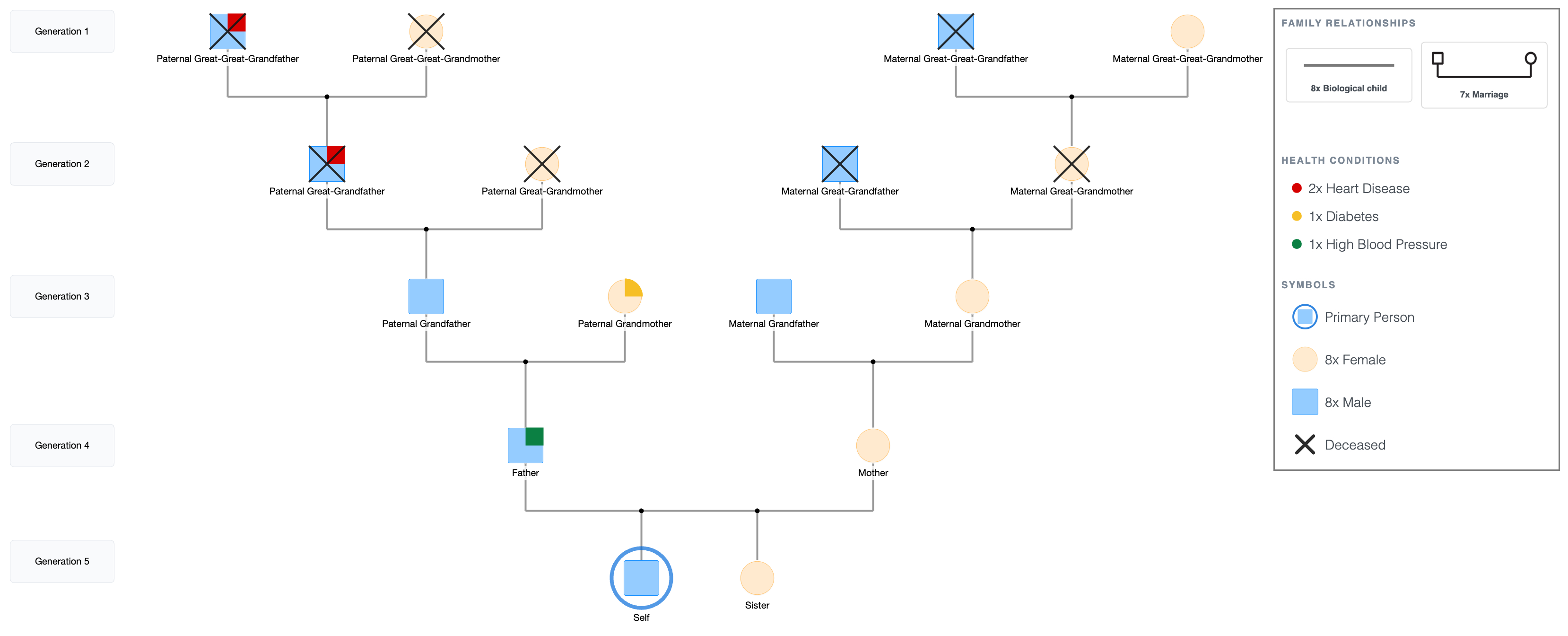
Five generations across both the paternal and maternal sides: great-great-grandparents at the top then great-grandparents, grandparents, parents, and the primary person and their sibling at the base. Two separate family lines converging at the parents' level in Generation 4.
On the paternal side, a heart disease marker runs from the great-great-grandfather through the great-grandfather, a diabetes marker appears on the grandmother, and a high blood pressure marker on the father. Four generations of the same organ issue.
The maternal side carries no markers.
At five generations, the origin point of the pattern is visible; it starts at the top of the paternal line, not somewhere in the middle.
The symbol legend is displayed below the diagram. For a full reference, see Genogram Symbols Explained.
When to Use This Template
- Genetic counseling and hereditary research: when four generations aren't enough to show where a hereditary condition originates or whether it follows a dominant, recessive, or X-linked inheritance pattern across the full family line.
- Longitudinal clinical work: when tracking a behavioral or relational pattern like substance use, domestic violence, emotional cutoff, that requires five generations to show its full transmission history.
- Academic research and dissertation work: when a doctoral or graduate student needs to document multi-generational family data for a research project or clinical case study.
- Genealogical and heritage documentation: when the purpose is historical mapping of a family line rather than a clinical assessment, and depth matters more than breadth.
How to Use This Template
1. Download as-is
Click the PDF or PNG button under the embed to download the template immediately. Print and fill in by hand, or use it as a structural reference.
2. Customize before downloading
Click "Use this genogram" to open the template in EasyGenogram. Replace the generic labels with real names, update or remove the health condition markers, and adjust relationship lines to match the actual family. To add a sixth generation, click either great-great-grandparent's shape and select Add Parents.
Export as PDF or PNG when done, or share via link with a supervisor, colleague, or client. Students with a valid school email can export free; other users export from $9/mo/seat.
If you need the diagram in Microsoft Word, Google Docs, or for a Canva design, export as PNG and insert it into your document.
5-Generation Genogram Template
Explore this genogram and adapt it to your needs.
FAQ
Is this 5-generation genogram template free?
Yes, open and customize it in EasyGenogram at no cost. Export requires a subscription for most users; students with a valid school email can export free.
When do you need a 5-generation genogram instead of a 3 or 4-generation one?
When the pattern you're tracking (e.g., hereditary, behavioral, or relational) doesn't have a visible origin point in three or four generations. Five generations give you enough depth to see where something starts, not just that it repeats.
Can I use this template for genetic counseling?
Yes. The five-generation structure is used in genetic counseling when inheritance patterns need to be traced across multiple generations, particularly for conditions with variable penetrance or skipped-generation presentation.
How do I add health condition markers to this template?
Open the template in EasyGenogram, click any person's shape, and use the Add Health Condition field in the details panel. Conditions appear as color-coded markers on the shape and are listed automatically in the legend.
What is the difference between a 5-generation genogram and a 5-generation family tree?
A family tree maps ancestry and lineage. A genogram maps relationships, health history, and emotional patterns. The five-generation genogram uses standardized clinical notation such as health markers, relationship line types, deceased markers that a family tree doesn't include.