Appearance
Sexual Genogram
Trace family patterns around sex, gender, and orientation across three or more generations. Move from assumption to understanding by mapping what was actually said, and left unsaid.
What Is a Sexual Genogram?
A sexual genogram is a genogram with one additional layer; every person on the diagram gets a self-identified gender and sexual orientation, rather than an assumed default.
It also maps the family's sexual communication climate and any secrets that shaped how sexuality was discussed, or avoided, across generations.
A Sexual Genogram Example
Sam Paul has been with their partner, Jordan, for two years and hasn't told their mother.
On a sexual genogram, each person gets a short letter code for their orientation next to their name: H for heterosexual, G for gay, B for bisexual, and so on.
Here's how that looks for this family.
Sexual Genogram Example
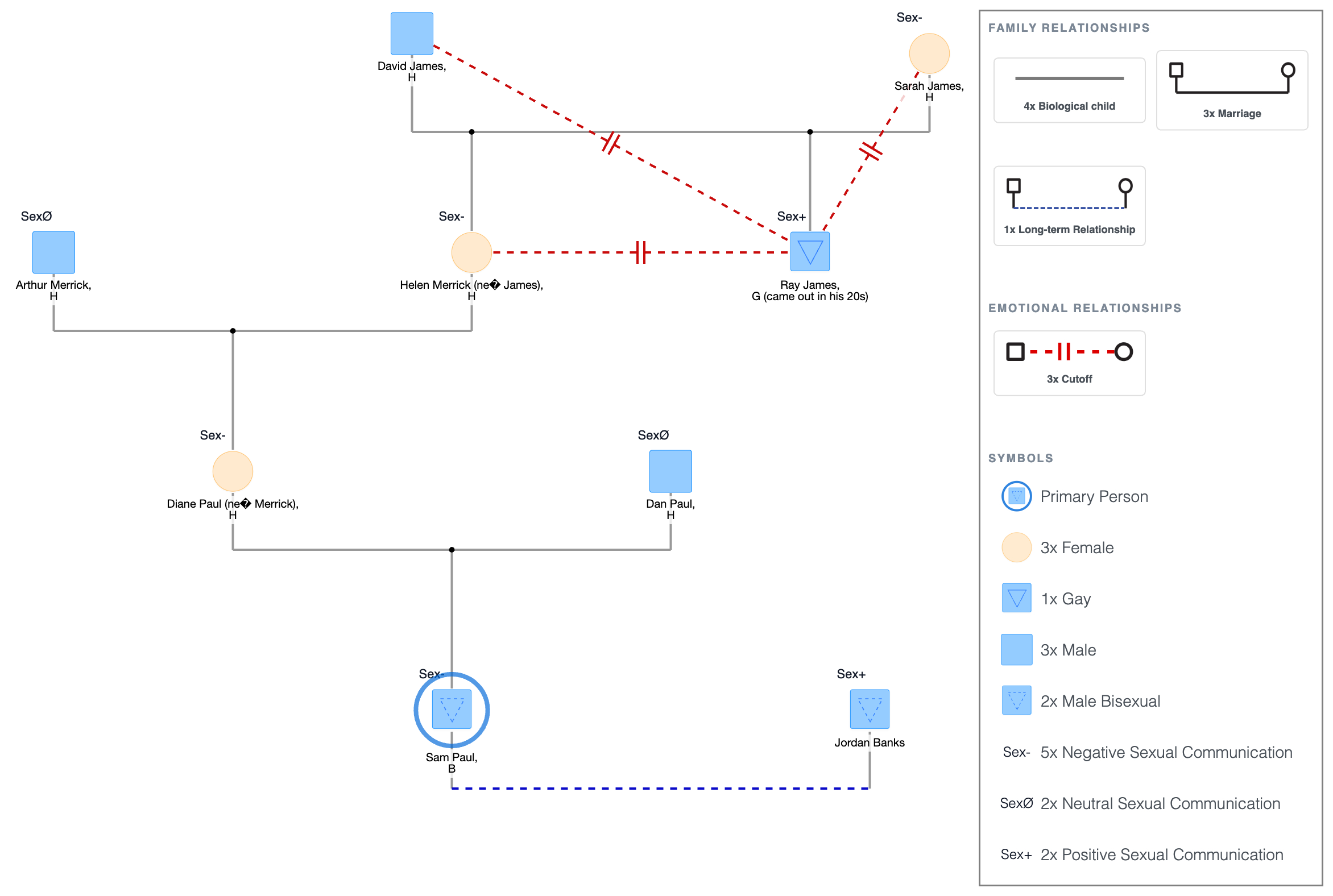
The Family
- Gen 1: David James and Sarah James, Sam's great-grandparents, married, both heterosexual (H).
- Gen 2: Their children, Helen Merrick (née James), heterosexual (H), married to Arthur Merrick, also heterosexual (H); and Ray James, Helen's brother, who came out as gay (G) in his twenties. Ray is shown cut off from both his parents and from Helen, marked with the double-hash line for estrangement.
- The members of the household are marked Sex−, meaning sex and orientation were treated as closed, fear-based topics no one brought up.
- Gen 3: Diane Paul (neé Merrick), Helen and Arthur's daughter, heterosexual (H).
- Gen 4: Sam Paul, Dan and Diane's child and the client, identifies as bisexual (B). Sam is in a committed, long-term relationship with Jordan Banks. Sam hasn't come out to Diane yet.
What This Genogram Shows
Nothing has ever happened directly to Sam to justify the fear of rejection.
Diane has never said anything negative about orientation, not once.
But the genogram traces the fear back two generations, to Ray: an unspoken family rule set when he came out and the family responded with silence and cutoff, never revisited since.
Sam inherited the assumption that coming out goes badly, without inheriting any actual evidence for or against it.
What a Sexual Genogram Can Map
- Self-identified gender and sexual orientation for every person on the diagram, not just a default assumption of straight.
- Relationship lines that reflect real commitment, including same-sex relationships, rather than legal marriage status.
- The family's sexual communication climate: open, closed, or neutral.
- Sexual secrets: events or relationships that were never discussed, like Ray's.
Where This Comes From
Hof and Berman introduced the sexual genogram in 1986 as an extension of the standard family genogram. Belous, Timm, Chee, and Whitehead updated it in 2012 to move away from assuming heterosexuality by default and to include a wider range of gender and orientation identities.
When It's Used
Originally built for couples in sex therapy, the sexual genogram is now used with individuals as well. For how it plays out in an actual session, see Sexual Genogram in Therapy.
Building One
Open a blank canvas in EasyGenogram, which already includes gay, lesbian, bisexual, and trans symbols, and build out the family structure first before adding orientation and communication details.
Read How to Create a Sexual Genogram for the full steps, and Sexual Genogram Symbols for the complete notation reference.
Handle With Care
Every identity marked on this diagram comes from the client's own words, never the therapist's assumption.
A client who hasn't labeled their orientation yet shouldn't have one assigned for them.
What gets disclosed while building a sexual genogram is often more sensitive than anything else on a family diagram, so confidentiality and pacing matter more here than in most genogram work.
FAQ
What's the difference between a sexual genogram and a regular family genogram?
A regular family genogram maps structure and general relationship quality. A sexual genogram adds each person's self-identified gender and orientation, the family's openness around the topic, and any sexual secrets, alongside the standard structure.
Does everyone on a sexual genogram need a labeled sexual orientation?
Yes, that's one of the core updates to the approach. Marking everyone's orientation, rather than only labeling non-heterosexual family members, avoids treating heterosexuality as the unstated default.
Is a sexual genogram only useful for couples?
No. It was originally developed for couples in sex therapy, but it's now used in individual therapy as well, particularly when a client's history with orientation, identity, or family reaction is relevant to what they're working on.
How does a sexual genogram represent gender identity?
Beyond the standard square and circle symbols, a sexual genogram can note transgender identity and a range of gender-diverse identities based on how the client describes themselves, rather than assuming gender from the person's assigned sex.
What if a client doesn't want to answer questions about family sexual history?
They don't have to. Clients share only what they're comfortable with, and gaps in a sexual genogram are left as gaps rather than filled in with assumptions.
Sources
- The Sexual Genogram
- Revisiting the Sexual Genogram