Appearance
Sexual Genogram Symbols
Sexual genogram symbols add gender identity, sexual orientation, and sexual communication notation to the standard genogram symbol set. This page covers the full notation used specifically for building one.
Gender Identity and Sexual Orientation
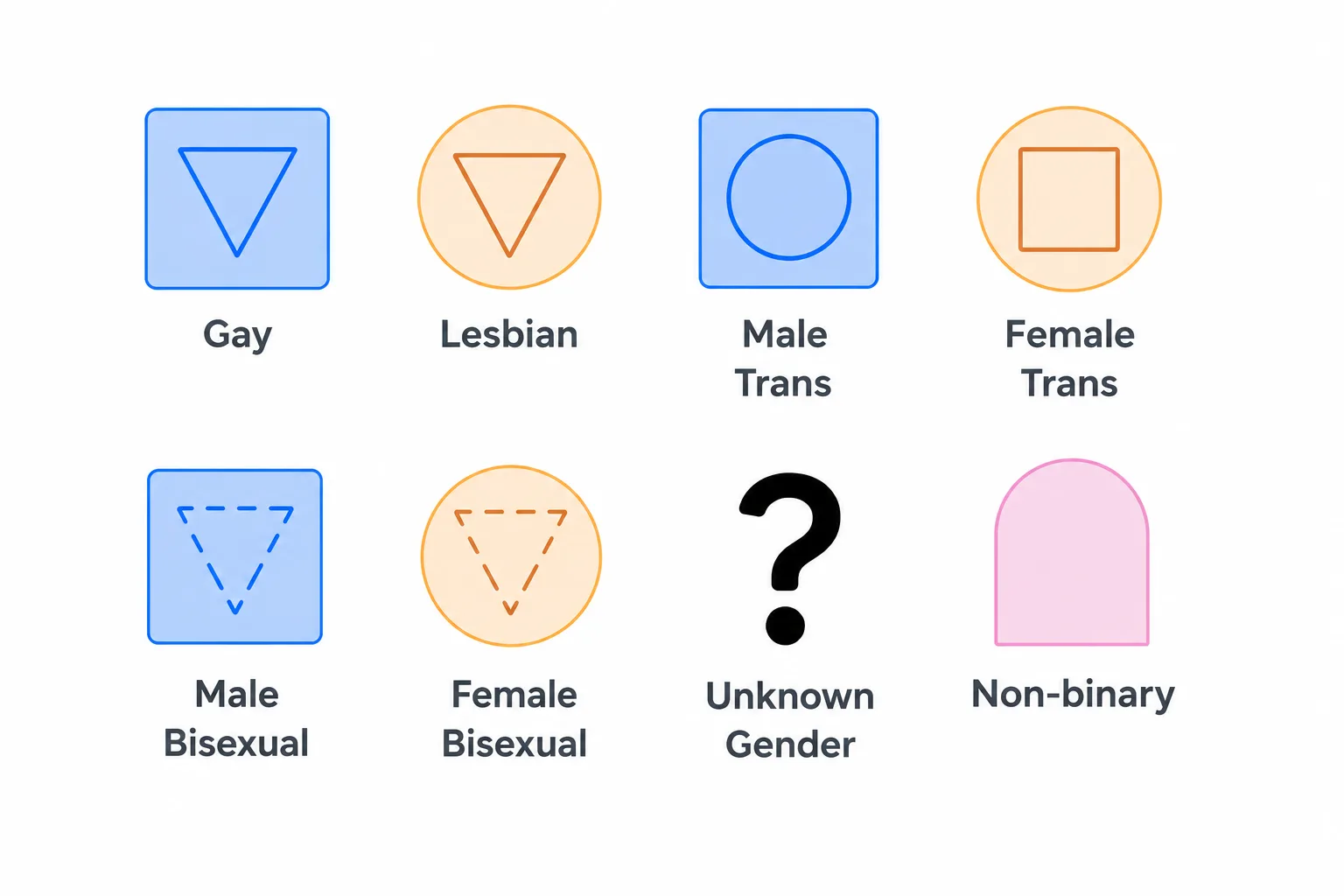
- Gay - square with an inverted triangle.
- Lesbian - circle with an inverted triangle.
- Male Trans - square with a circle inside.
- Female Trans - circle with a square inside.
- Male Bisexual - square with a dashed inverted triangle.
- Female Bisexual - circle with a dashed inverted triangle.
- Unknown - question mark.
- Non-binary - arch or dome shape.
These shapes are part of the standard EasyGenogram set.
For the full shape reference, see Genogram Symbols.
Alongside the shape, a sexual genogram adds a letter code under the person's name for orientation:
- H - heterosexual
- G - gay
- L - lesbian
- B - bisexual
- P - pansexual
- Q - queer or questioning
- A - asexual
Sexual Communication Climate
Each person, or a whole household, gets marked with one of three labels showing how openly sex was discussed growing up:
- Sex+ - open, non-judgmental communication about sex.
- Sex− - closed, fear-based messaging about sex.
- Sex∅ - neutral; the topic simply wasn't discussed.
For instance, on the Merrick/Paul family genogram, most of the household is marked Sex−.
Ray and Jordan are marked Sex+.
Dan and Arthur are marked Sex∅.
Relationship Lines in a Sexual Genogram
- Solid line: all committed relationships, including same-sex, based on how the couple describes it, not legal marriage status.
- Dashed line: dating, non-committed relationships, or affairs.
This is a simplified two-line convention.
It replaces the standard genogram's marriage, divorce, and cohabitation-specific lines with one distinction: whether the relationship is committed, as defined by the client.
Marking Secrets and Cutoffs
A double-hash mark on a relationship line shows a cutoff, the same symbol used on a standard genogram. On a sexual genogram, this mark also represents an estrangement tied to a sexual secret, like a family member who came out and was cut off afterward.
On the Merrick/Paul genogram, Ray James's line to both his parents and to his sister Helen carries this mark.
What You Need by Purpose
- For an individual client exploring family patterns: orientation codes and communication climate marks for the people directly relevant to the pattern.
- For couples work: both partners' orientation codes, relationship line, and climate marks for both families, placed side by side.
- For a first-session overview: the shapes and codes alone are usually enough. Climate marks and cutoffs can be added as they come up in later sessions.
FAQ
What's the difference between the standard gender shapes and the sexual genogram shapes?
The standard set covers male, female, and deceased. The sexual genogram shapes add gay, lesbian, trans, bisexual, and non-binary options, paired with a letter code for the person's self-identified orientation.
Is the Sex+/−/∅ marking assigned to a person or a household?
Either. Mark an individual if their experience differed from the rest of the family, like Ray in the Merrick/Paul example. Circle a whole household if everyone shared the same communication climate growing up.
What does a dashed relationship line mean on a sexual genogram?
A dating or non-committed relationship, or an affair. This differs from the standard genogram, where a dashed line usually means cohabitation specifically.
Do I need to use every symbol on this page?
No. Use only what's relevant to the client's presenting issue. A genogram built for one intake session might only need orientation codes; a deeper case might add climate marks and cutoffs as well.
Where can I see these symbols used in a full example?
See Sexual Genogram Example on Qwoach for a complete diagram built with this notation.
Sources
- The Sexual Genogram
- Revisiting the Sexual Genogram