Appearance
Sexual Genogram Example
A sexual genogram example shows more than family structure. It shows how a family's messaging about sex, gender, and identity gets passed down, and where a client's current pattern actually comes from.
Example 1 - Coming Out and Family Silence: The Merrick/Paul Family
The Merrick/Paul Family Sexual Genogram
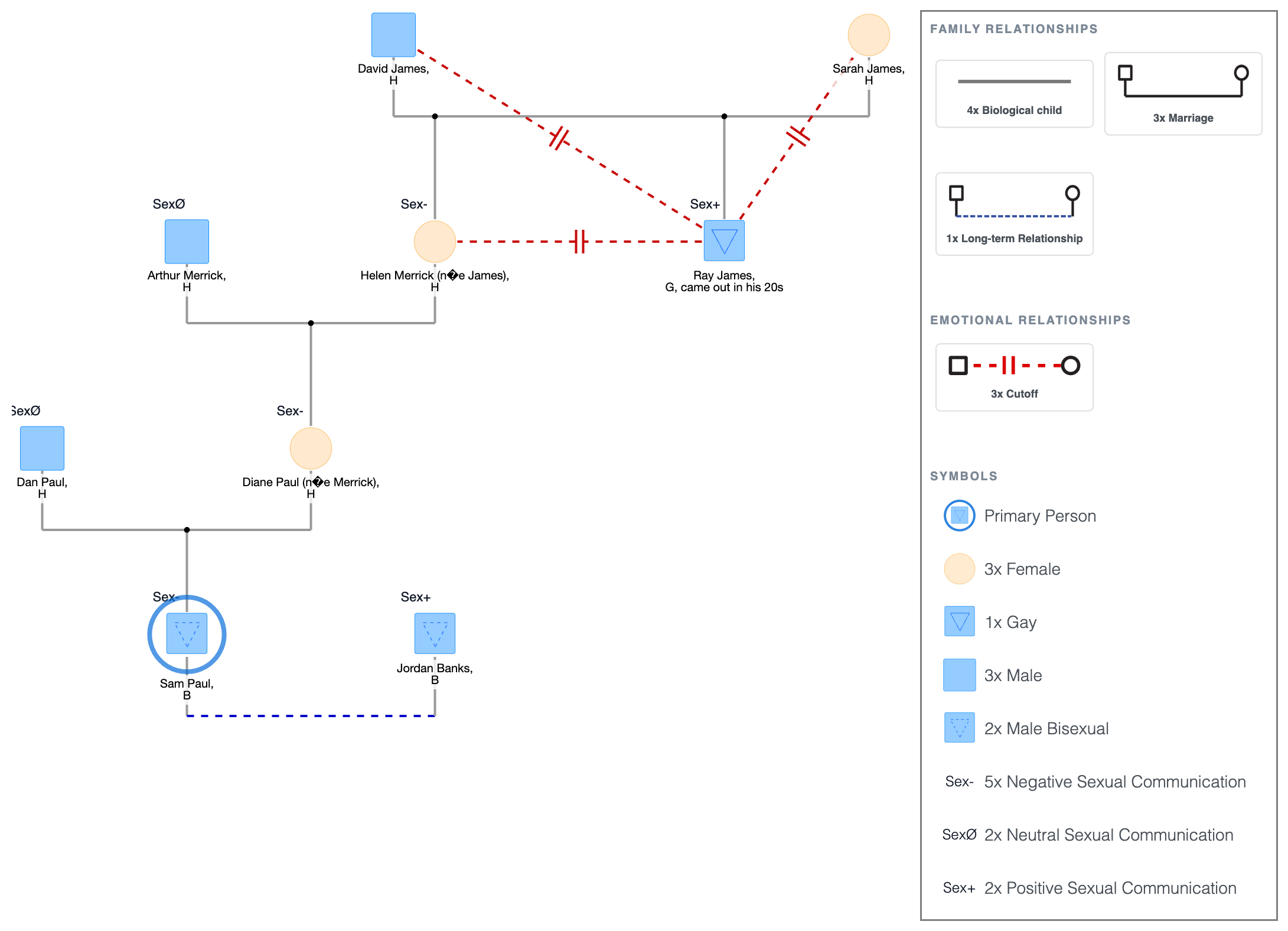
The family:
- David James and Sarah James, Sam's great-grandparents, married, both heterosexual (H).
- Their children: Helen Merrick (née James), heterosexual (H), married to Arthur Merrick, also heterosexual (H); and Ray James, Helen's brother, who came out as gay (G) in his twenties.
- The family cut contact with Ray after he came out and never discussed him again; his line to both parents and to Helen carries a cutoff mark.
- Diane Paul (née Merrick), Helen and Arthur's daughter, heterosexual (H), married to Dan Paul, also heterosexual (H).
- Sam Paul, Dan and Diane's child and the client, identifies as bisexual (B). Sam is in a committed relationship with Jordan Banks, also bisexual (B).
- Most of the household is marked Sex−, meaning sex and orientation were treated as closed, fear-based subjects no one brought up. Ray is marked Sex+. Dan and Arthur are marked Sex∅.
What you can now see:
- Sam has never come out to Diane, and nothing Diane has ever said or done predicts rejection.
- The fear traces back two generations, to Ray: an unspoken family rule set when he came out and was cut off, never revisited since.
- Sam inherited the assumption that coming out goes badly, without inheriting any actual evidence for or against it.
- The Sex− marking across most of the family shows why the subject never came up long enough for that assumption to be tested.
The Merrick/Paul Family Sexual Genogram
Explore this genogram and adapt it to your needs.
Example 2 - Sex-Positive and Sex-Negative Family Climates: The Voss/Talbot Couple
The Voss/Talbot Couple Sexual Genogram
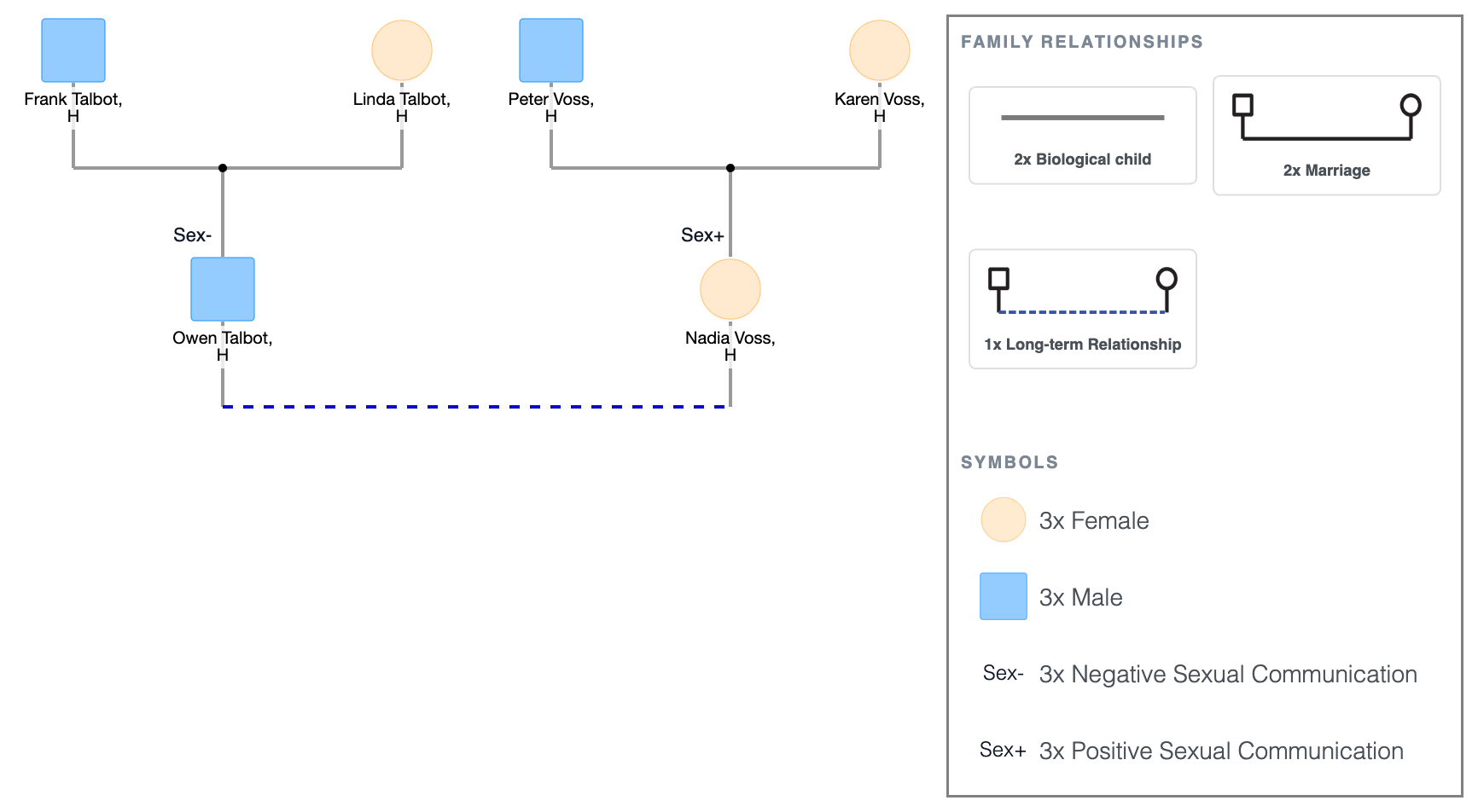
The family:
- Nadia Voss's parents, Karen and Peter Voss, both heterosexual (H), marked Sex+.
- Owen Talbot's parents, Linda and Frank Talbot, both heterosexual (H), marked Sex−. Owen grew up in a household where the topic was avoided entirely.
- Nadia and Owen, both heterosexual (H), are in a long-term relationship, shown with a dashed blue relationship line.
What you can now see:
- Nadia wants to talk directly about what's going on between them, but Owen goes quiet or changes the subject.
- Neither pattern is a character flaw; it's the family climate each of them grew up in showing up in the relationship.
- Nadia's Sex+ upbringing taught her that talking about intimacy is normal. She grew up in a household where sex and bodies were discussed openly and without shame.
- Owen's Sex− upbringing taught him that it's safer not to.
- Once both family climates are on the same page, the conflict reads as two inherited habits colliding, not one partner being more difficult than the other.
The Voss/Talbot Couple Sexual Genogram
Explore this genogram and adapt it to your needs.
Example 3 - Gender Identity Across Generations: The Rourke Family
The Rourke Family Sexual Genogram
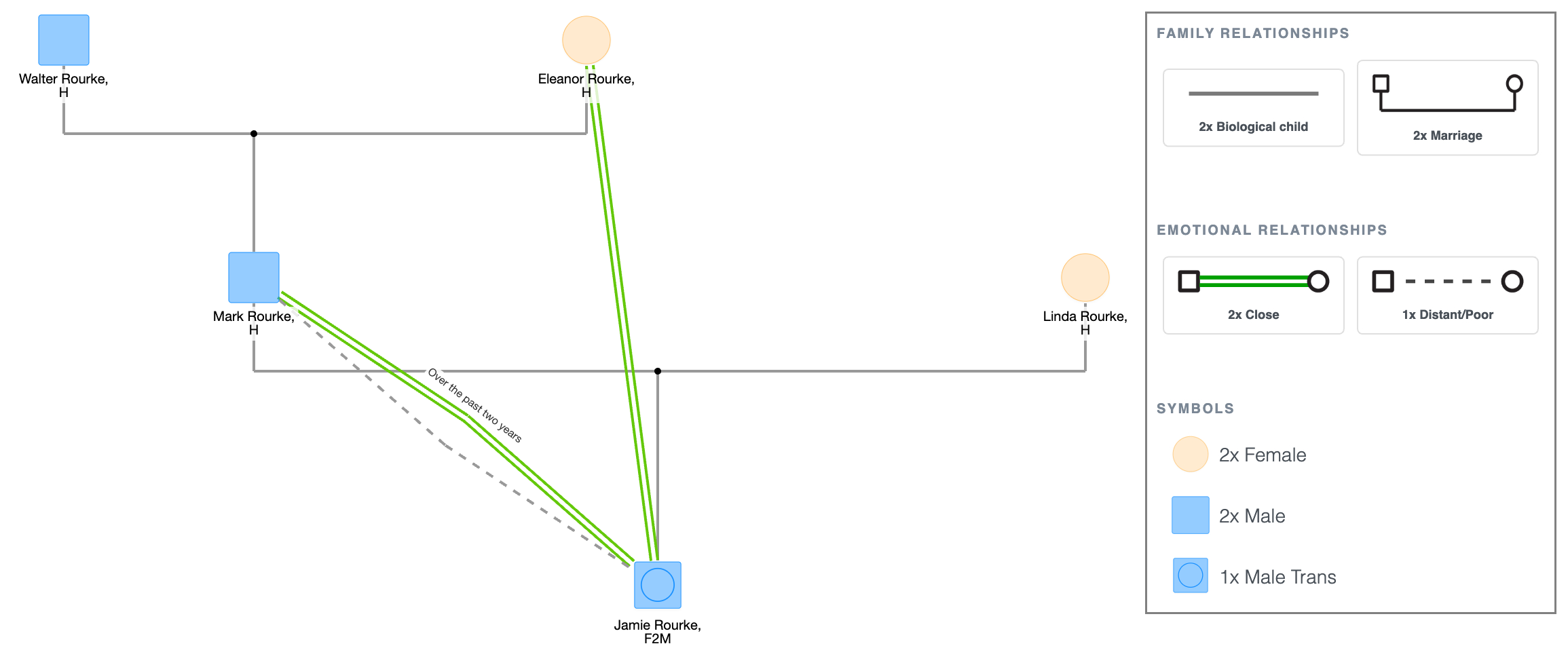
The family:
- Eleanor Rourke and Walter Rourke, Jamie's grandparents, both heterosexual (H).
- Their son, Mark Rourke, heterosexual (H), married to Linda Rourke, also heterosexual (H).
- Jamie Rourke, Mark and Linda's child and the client, is transgender, female to male, marked F2M.
- Eleanor was the first person in the family to affirm Jamie when he came out as trans; their relationship is marked close.
- Mark's relationship with Jamie started distant and has moved toward close over the past two years, shown as a relationship that's changed rather than fixed at one mark.
What you can now see:
- Acceptance in this family didn't happen all at once, and it didn't happen in birth order either. Jamie's grandmother got there before his father did.
- Marking Mark and Jamie's relationship as changed, rather than just close or distant, keeps the genogram accurate. It shows where the family is now without erasing where it started.
- A sexual genogram doesn't need a rejection story to be useful. Here it shows a family gradually building the language and comfort to support Jamie, generation by generation.
What a Sexual Genogram Tracks
Across all three examples, the diagram is doing the same core job:
- Self-identified gender and sexual orientation for each person.
- The family's sexual communication climate, whether marked by household or by individual.
- Secrets and cutoffs tied to identity or orientation.
- How a family's response to identity can shift across generations, not just stay fixed.
When to Use a Sexual Genogram
- Individual therapy, when a client's assumption about family reaction doesn't match anything in their actual experience, as with Sam.
- Couples or sex therapy, when partners keep circling the same conflict and it turns out to be two family climates, not a compatibility issue, as with Nadia and Owen.
- Any case where a client's identity has been received differently across generations of the same family, as with Jamie.
When Not to Use
- Before a therapeutic alliance is established. This material is sensitive enough that timing matters more than usual.
- When a standard genogram already answers the clinical question and orientation, gender identity, or sexual communication aren't relevant to the presenting issue.
- If the client isn't ready to discuss family history at this depth. The diagram can wait.
How to Build One
Each of these examples follows the same process: map the family structure first, add self-identified gender and orientation for every person, mark the sexual communication climate, then note any secrets or cutoffs.
For the full walkthrough, see How to Create a Sexual Genogram.
FAQ
Do all three examples use the same notation?
Yes. All three use the same orientation codes, Sex+/−/∅ climate marks, and relationship line conventions covered in Sexual Genogram Symbols. The notation doesn't change; only the scenario does.
Why does the Merrick/Paul example show more generations than the other two?
It's tracing a pattern back to its origin, Ray's estrangement, which took four generations to reach the client. The Voss/Talbot and Rourke examples are answering narrower questions and don't need the extra generation to make their point.
Can a sexual genogram show a family's response changing over time, like in the Rourke example?
Yes. A relationship line isn't locked to one meaning forever. Noting that a relationship moved from distant to close over time keeps the diagram accurate to where the family actually is now.
Is the Voss/Talbot example specific to couples therapy, or does it apply elsewhere?
It's most common in couples or sex therapy, since it depends on comparing two people's family climates side by side. The same concept, one person's sexual communication climate, is still useful in individual work.
What's the fastest way to adapt one of these examples to a real client?
Keep the structure and notation, and replace the names, generations, and specific details with the client's actual family. The process is the same one covered in the How to Create a Sexual Genogram guide on Qwoach.
Sources
- The Sexual Genogram
- Revisiting the Sexual Genogram