Appearance
Geriatric/Elder Care Genogram Template
A geriatric genogram template helps you see an older adult’s caregiving network, family health history, and the relationships that shape care planning. Use it when elder care decisions depend on who is actually involved, who is distant, and where family tension sits.
Geriatric/Elder Care Genogram Template
What This Template Shows
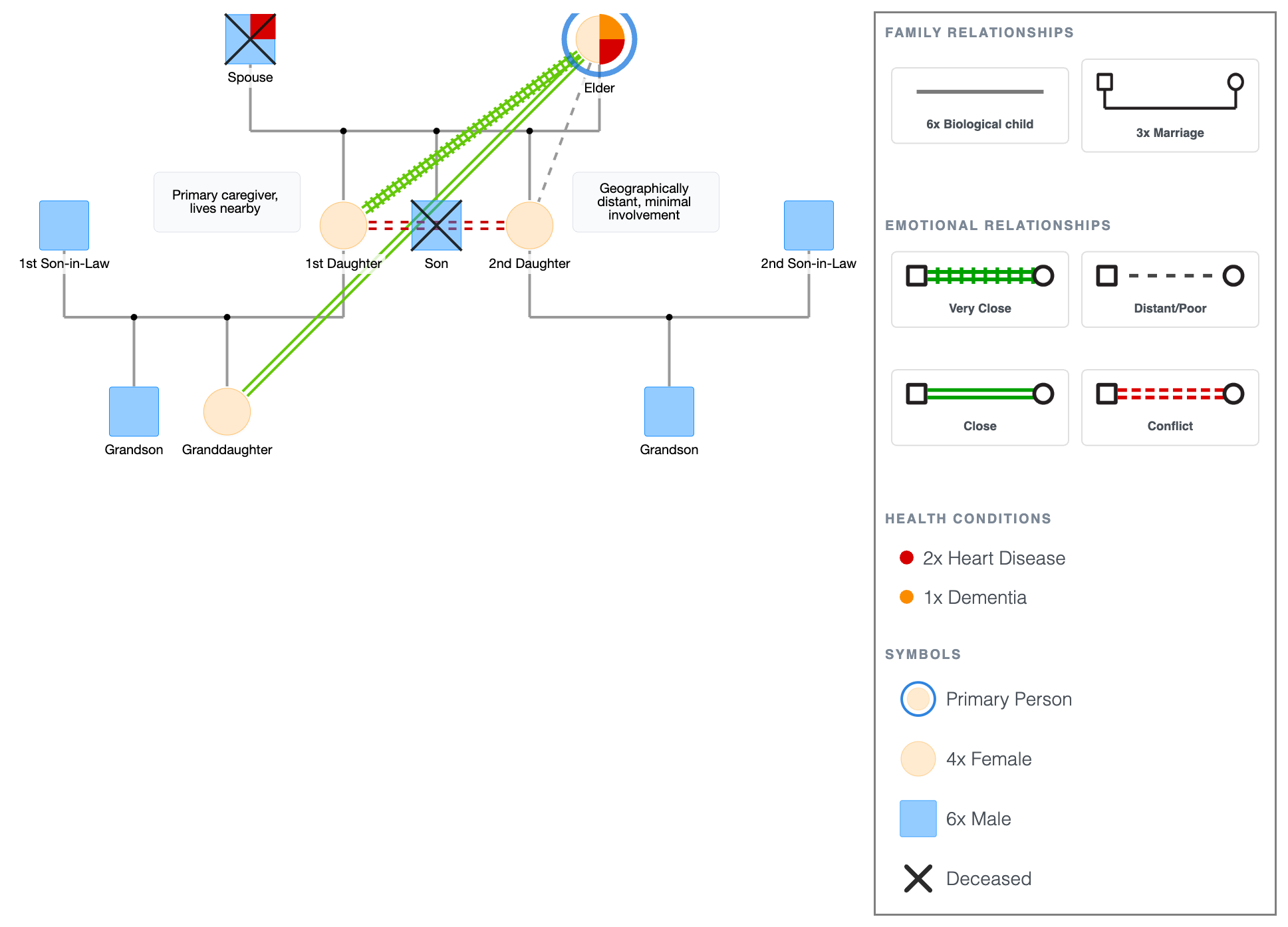
Three generations mapped around an elderly woman as the primary person.
Her husband is deceased, also with a heart disease marker. She carries dementia and heart disease markers.
Her 1st daughter, the primary caregiver, lives nearby and has a very close relationship with her. Her son is deceased. Her other daughter is geographically distant and has a distant relationship with her. The two daughters are in conflict with each other.
The caregiving imbalance is visible in the diagram: one daughter close and present, the other distant and disengaged, the conflict between them sitting directly above the elderly primary person who depends on the care they cannot agree to share.
A grandchild is close to the elder, adding another layer to the support picture.
This is the family map a geriatric care coordinator or elder care social worker builds to understand who is actually providing care, who is absent, and where the tension sits.
The symbol legend is displayed below the diagram. For full definitions and clinical usage, see Genogram Symbols Explained.
When to Use This Template
- Geriatric care management assessment: map the elderly client's family structure, health history, and caregiving network during an initial assessment to identify resources, gaps, and potential conflicts.
- Family meeting preparation for care planning: use the genogram as a neutral visual tool when facilitating family discussions about caregiving responsibilities, living arrangements, and care decisions.
- Hospice and palliative care intake: map who is involved in end-of-life decision-making, where family disagreements may arise, and what relationships shape the elder's care preferences.
- Gerontology and elder care social work coursework: meets standard requirements for gerontology and geriatric social work documentation across BSW and MSW programs.
How to Use This Template
1. Download as-is
Click the PDF or PNG button under the embed to download immediately. Use as a clinical reference, care team handout, or teaching example.
2. Customize before downloading
Click "Use this genogram" to open the template in EasyGenogram. Replace the generic labels with real or fictional names, adjust the family structure, and update the health markers and relationship lines to reflect the actual elder's family situation and caregiving network.
Export as PDF or PNG when done, or share via link with a care team, supervisor, or colleague.
Geriatric/Elder Care Genogram Template
Explore this genogram and adapt it to your needs.
FAQ
What is a geriatric genogram template?
A geriatric genogram template is a family diagram built with an elderly person as the primary person. It maps the elder's health history, household composition, and the caregiving network around them, identifying who provides care, who is absent, and where family tensions may affect care coordination. It gives geriatric professionals a visual record of the family system they are working within.
How does a genogram help with elder care planning?
A genogram makes the caregiving structure visible. It shows which family members are involved, which are geographically or emotionally distant, and where conflict or imbalance sits in the family system. This information is the basis for care planning conversations such as redistributing responsibilities, identifying potential caregivers who have not been asked, and facilitating family meetings where roles and decisions need to be made explicit.
What does an elder care genogram include?
An elder care genogram covers at least three generations and usually includes the elder's current health conditions, the health history of deceased family members, household composition, the caregiving roles of adult children and other family members, geographic proximity where relevant, and emotional relationship lines showing closeness, distance, or conflict between key members of the caregiving network.
Is this template free?
Yes. Open and customize it in EasyGenogram at no cost. Export requires a subscription for most users; students with a valid school email can export free.
Can I use this for a gerontology or social work assignment?
Yes. The template follows McGoldrick-Gerson-Petry standard notation and includes the health markers and relationship lines required for geriatric social work and gerontology documentation. Open it in EasyGenogram, adjust the family structure to match your assignment or case, and export as PDF for submission.