Appearance
Genogram Example for Social Work
This is a completed three-generation social work genogram showing the Simmons family. It includes the standard social work layers; formal system involvement, intergenerational behavioral patterns, and relationship quality, alongside the basic family structure. The diagram can serve as a reference across family services, mental health, school, and community social work contexts.
The Simmons Family
Sarah Simmons is 38, the index person.
She is a single mother to Mia (12).
Sarah's mother, Joyce (63), lives nearby and is the family's primary informal support.
Sarah's father, Dennis, died in 2019 at age 62 from alcohol-related liver failure.
Sarah has one sibling, Paul (40), from whom she is estranged.
Mia's biological father, Kevin (41), has limited involvement; he lives in a different city and contact has been infrequent for the past three years. His parents are not known to the family.
A historical CPS referral was made in 2021 following a school report about Mia's attendance.
The case was closed after six months with no further action.
Sarah is currently engaged with a community family support service and is registered with a GP.
Genogram Example for Social Work
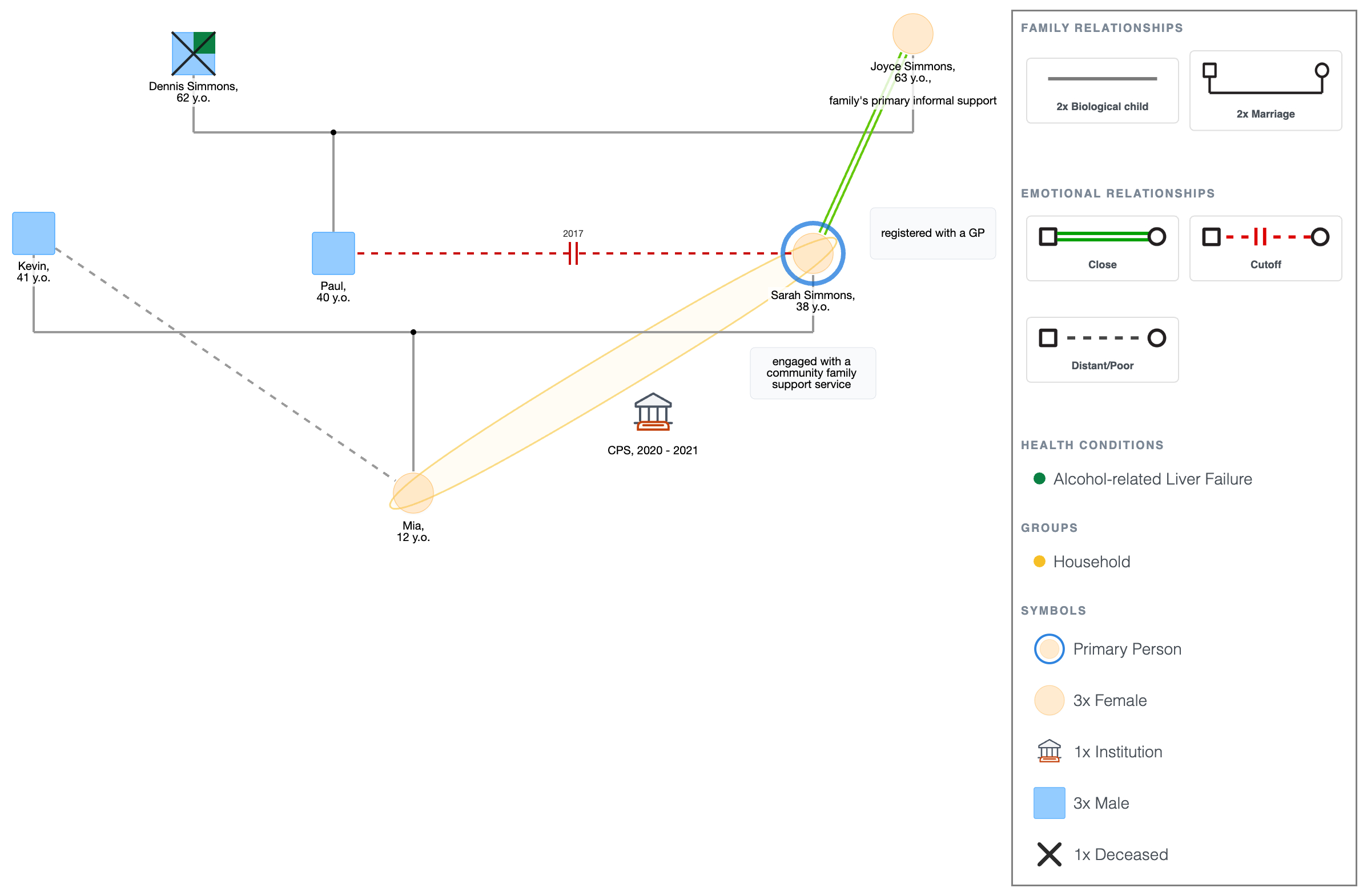
The family:
- Dennis Simmons - deceased 2019, alcohol-related liver failure, age 62. X through symbol, cause of death and age noted.
- Joyce Simmons, 63 - living. Close relationship line to Sarah.
- Paul Simmons, 40 - living. Cutoff line between Paul and Sarah, dated 2017.
- Sarah Simmons, 38 - index person, double border. Single parent.
- Kevin, 41 - Mia's biological father, outside the household. Distant relationship line between Kevin and Mia.
- Mia Simmons, 12 - Sarah's biological daughter. Household boundary drawn around Sarah and Mia. CPS notation with dates (2021–2021) beside the household circle.
- Community family support service; noted as a current formal connection.
- GP noted as registered.
What this genogram shows:
- Dennis's alcohol-related death sits one row above Sarah and Paul. The substance use annotation on his symbol is visible alongside the two adult children beneath him; one estranged, one raising a child alone. This intergenerational pattern is present in the diagram.
- Joyce is Sarah's primary support. Her close line to Sarah and her position outside the household make clear that she is a resource but not a co-parent. If Joyce's availability changes, the informal support structure shifts significantly.
- Paul's cutoff line is dated. The estrangement has a timeline and a practitioner reviewing the diagram would note that and explore what occurred around 2017.
- Kevin's distant line to Mia sits alongside Sarah's primary parenting role. He is present in the diagram because he is present in Mia's life; infrequently, but not absent. The line type records that distinction.
- The CPS notation beside the household boundary is historical but it is there. A new practitioner picking up this case file sees it immediately and knows the history.
- The community family support service and GP appear as current formal connections as they are part of the picture.
Genogram Example for Social Work
Explore this genogram and adapt it to your needs.
What Makes a Social Work Genogram Different
A social work genogram uses the same three-generation structure as any genogram but adds social work-specific layers: formal system involvement (CPS, court, services), behavioral and relational patterns across generations (substance use, estrangement, trauma), and household boundary notation.
For a full guide to what to include and how to use it in practice, see the social work genogram article.
For various examples, see the genogram for social work assessment article.
FAQ
What is a social work genogram example?
A social work genogram example is a completed three-generation family diagram that includes social work-specific information alongside the standard structure; formal system involvement such as CPS notation or service connections, behavioral patterns across generations such as substance use or domestic violence, household boundary notation, and relationship lines showing conflict, distance, and closeness.
What should a social work genogram include?
At minimum, three generations, names and ages, household composition, the index person marked with a double border, and a key. The social work context adds formal system involvement with dates, substance use or behavioral health history across generations, household boundary notation, and relationship lines including conflict, cutoff, and distant connections. Strengths and supportive connections should appear alongside risks.
What is a 3-generation genogram in social work?
A three-generation genogram maps the index client, their parents and siblings, and their grandparents on both sides. Three generations is the standard minimum in social work because it provides enough depth to show intergenerational patterns in health, substance use, relationships, and formal system involvement that would be invisible in a shallower diagram. Most social work assessments and academic assignments specify three generations as the required floor.
How do you draw a genogram in social work?
Start with the three-generation structure; grandparents at the top, parents in the middle, children at the bottom. Add names, ages, and health or cause-of-death annotations. Add relationship lines for significant connections. Then add the social work layers: household boundary, CPS or formal system notation, substance use or behavioral health annotations. Include a key listing every symbol used.
Can I use a social work genogram example for an assignment?
Yes. The Simmons family example above is designed to show the standard social work genogram structure across multiple practice contexts. Use it as a reference for format, notation, and the level of annotation expected in a clinical diagram. If your assignment requires you to map your own case or a specific scenario, adapt the structure to your family and add the layers relevant to your brief.
Sources
- Genograms: Assessment and Intervention (3rd ed.). W.W. Norton & Company.
- NASW Code of Ethics.