Appearance
Family Business Genogram
A family business genogram maps ownership stakes, management roles, and trust control alongside the standard family structure, so a succession question can be read as both a business decision and a family systems pattern.
Why a Family Business Genogram Adds Ownership and Role
A standard genogram shows who's related to whom and how those relationships function.
A family business genogram layers business information on top of that; who owns what percentage, who holds which position, who controls a trust versus who benefits from it.
None of this requires special symbols, it's added through notes on each person, but the combination is what makes the diagram useful.
An org chart shows who reports to whom. A genogram shows why that reporting structure might not survive the next transition.
The Harlow Family
Family Business Genogram Example
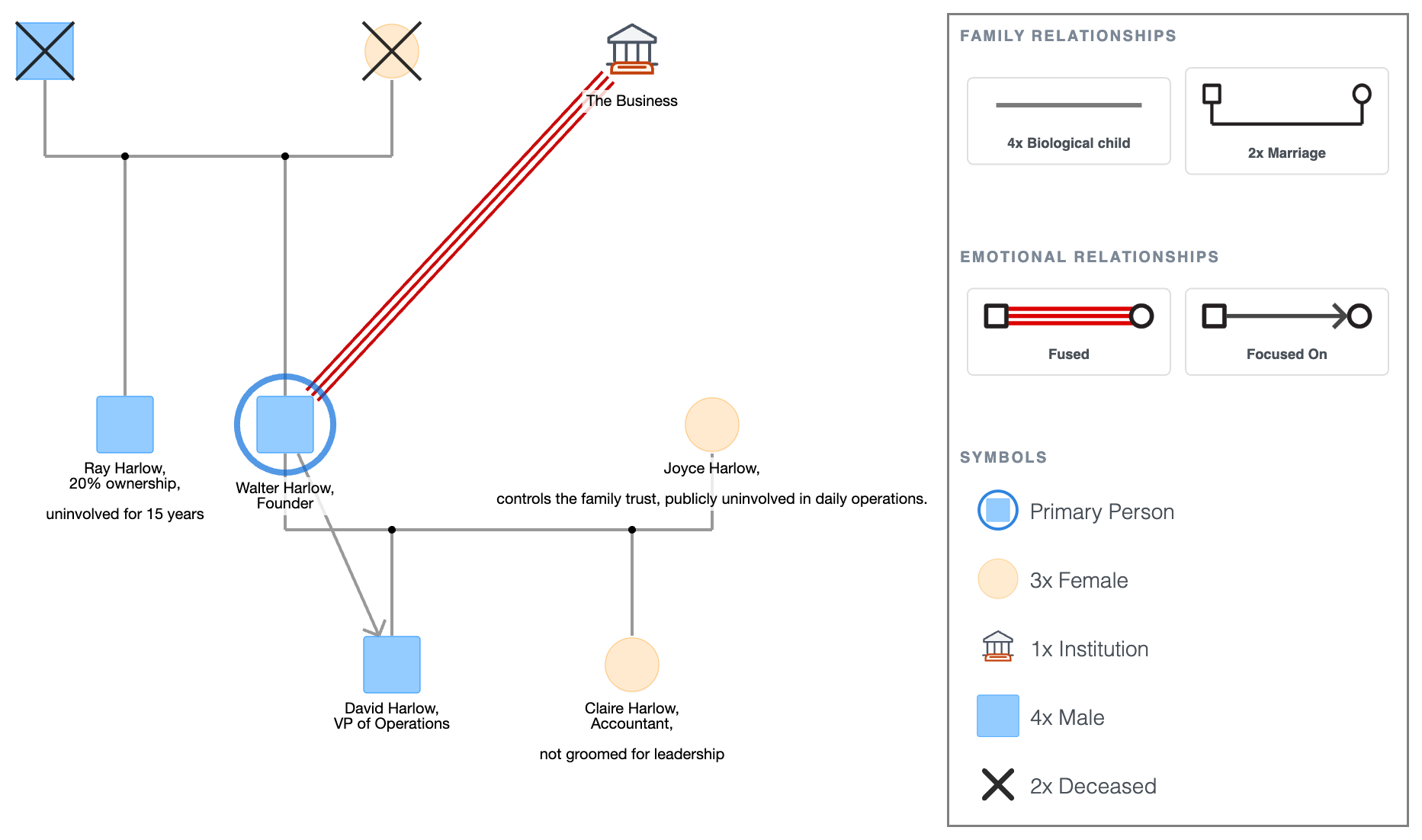
- Walter Harlow: founder, Fused line to the business itself.
- David Harlow: eldest son, VP of Operations, Focused On line from Walter (assumed successor).
- Claire Harlow: younger daughter, accountant, more qualified for CEO, not groomed for leadership.
- Ray Harlow: Walter's brother, 20% ownership, uninvolved for 15 years.
- Joyce Harlow, Walter's wife: controls the family trust, publicly uninvolved in daily operations.
Walter Harlow founded his manufacturing business decades ago and still hasn't formally named a successor.
His eldest son, David, has worked in operations for years and has always been treated as the assumed next CEO.
His younger daughter, Claire, is a trained accountant with a stronger grasp of the company's finances than anyone else in the family, but she was never brought into a leadership track the way David was.
What the Genogram Revealed
Mapping the family alongside the business showed a pattern that a qualifications review alone wouldn't have caught; Walter's expectations were fixed on David well before David's actual performance in the role was ever seriously evaluated, a Focused On line reflecting an assumption made early and never revisited.
Claire's genogram position shows the more qualified candidate sitting outside the succession conversation entirely, not because of a business decision, but because "the business goes to the son" had never been questioned as a premise.
Two other details mattered once they were on the same diagram.
Walter's brother, Ray, owns 20% of the company but hasn't worked there in fifteen years, an ownership stake with real voting weight attached to someone with no current stake in day-to-day decisions.
And Walter's wife controls the family trust that holds a significant ownership block, giving her more actual influence over any succession decision than her public role in the business would suggest.
Build One for a Succession Conversation
Start with the family structure across generations, then add notes to each person for ownership percentage, share type, and management role, distinguishing family members with formal power from those with none.
Mark relationship patterns, like Close, Conflict, Fused, Focused On, especially where a family dynamic and a business role sit on the same person.
Include in-laws and any trust structures directly, noting who serves as trustee versus who benefits, since that distinction often reveals where real decision-making power sits.
For the full guide, see How to Make a Genogram.
Family Business Genogram Example
Explore this genogram and adapt it to your needs.
FAQ
How is a family business genogram different from a regular genogram?
It adds business-specific information, ownership percentage, management role, trust control, layered onto the same family structure and relationship lines used in any genogram. The family dynamics are still the foundation; the business layer sits on top of it.
Can I show ownership percentages and share types on the diagram?
Yes, through notes on each person's symbol, you can show percentage owned, whether the shares are voting or non-voting, and whether ownership is held directly or through a trust or holding company.
Should in-laws be included in a family business genogram?
Yes. In-laws frequently hold real business roles or influence, e.g., a son-in-law running operations, a daughter-in-law excluded from key decisions, and leaving them off the diagram would miss part of the actual power structure.
How do you show a family trust that controls ownership?
Use notes to indicate who serves as trustee versus who benefits from the trust. These are often different people with very different levels of actual control, and that distinction is frequently where the real decision-making power in a family business sits.
Does mapping the family always reveal a succession problem?
Not always, but it reliably shows whether a succession plan reflects a genuine evaluation of the business's needs or an unexamined family assumption, which is usually the more useful thing to know before a transition happens rather than after.
Sources
- Developing a Business Family Genogram
- Genograms: Assessment and Intervention (4th ed.)