Appearance
Interpreting a Social Work Genogram
Interpreting a social work genogram means moving from a completed diagram to an actual assessment conclusion. That happens by reading the family in a specific order; structure, relationships, roles, then patterns across generations.
The Reasoning Steps
Work through these in order, not all at once.
- Structural: Who's actually available? Check for incarceration, hospitalization, treatment programs, or geographic distance before assuming someone is a viable option.
- Relational: Where are the close bonds, and where's the strain? A structurally available relative with a distant relationship isn't automatically a weaker option than a close one, but it's a different conversation.
- Functional: Who has demonstrated caretaking capacity, stable employment, housing, prior experience caring for the child?
- Multigenerational: What repeats? A family history of substance use, resilience, or long-term recovery all count, and an old pattern that's been stable for decades reads differently than a current one.
Reading for What's Missing
Instances like an unknown grandparent, no relationship line drawn, a gap in the family's own account are data too.
Note them and ask, don't assume they're irrelevant just because they're blank.
A Worked Example: Reasoning Through a Recommendation
Interpreting a Social Work Genogram Example
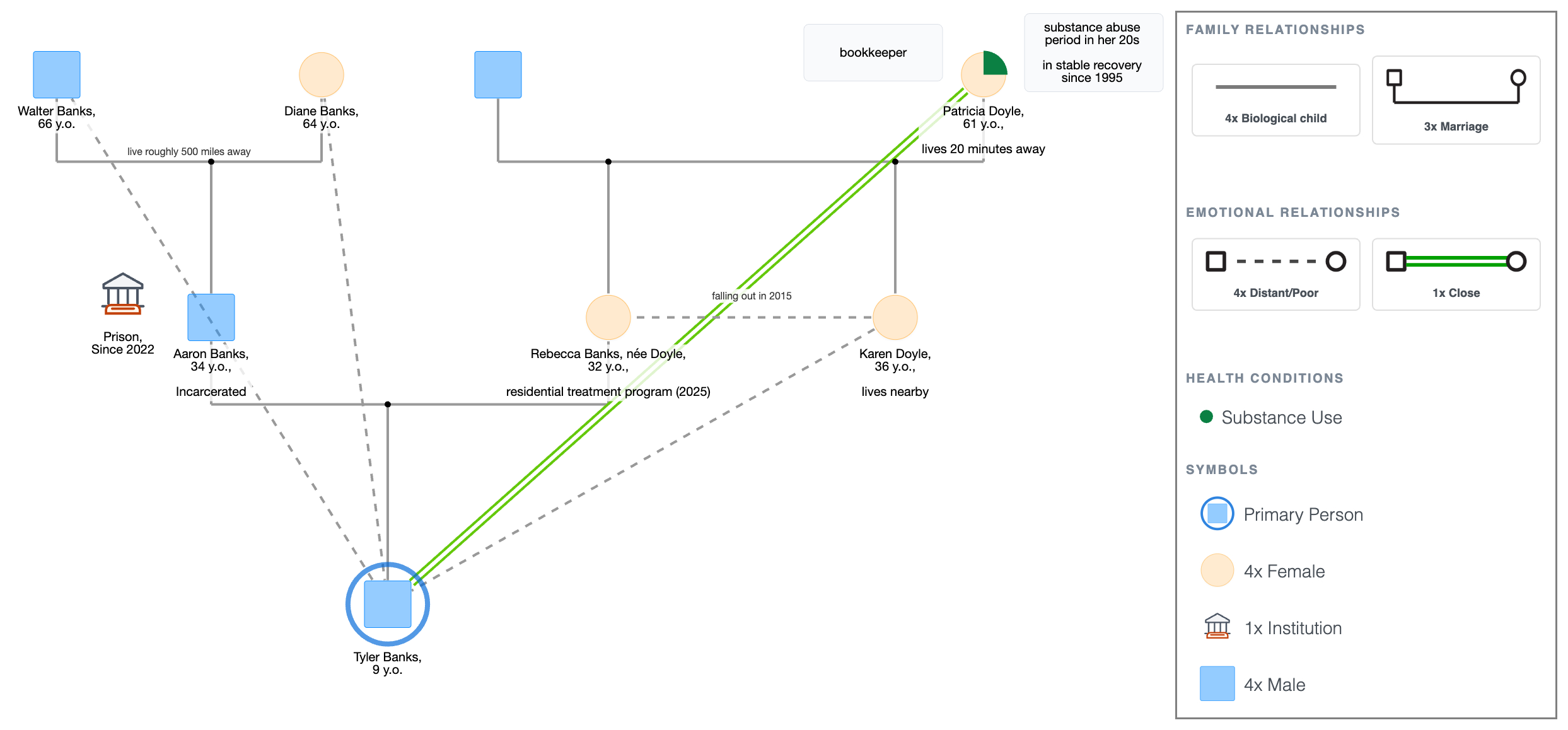
The family:
- Tyler Banks (b. 2019) is the primary person, currently 7.
- His mother, Rebecca Banks, née Doyle (b. 1994), entered a residential treatment program in 2025 and is currently unavailable.
- His father, Aaron Banks (b. 1992), has been incarcerated since 2022.
- Rebecca's mother, Patricia Doyle (b. 1965), lives 20 minutes away, works as a bookkeeper, and is close to Tyler.
- Patricia had a substance use period in her 20s and has been in stable recovery since 1995, over 30 years.
- Rebecca's sister, Karen Doyle (b. 1990), lives nearby but has been distant from Rebecca since a falling-out in 2015. Distant line to Tyler.
- Aaron's parents, Walter Banks (b. 1960) and Diane Banks (b. 1962), live roughly 500 miles away and rarely see Tyler. Distant line to Tyler.
Working through it:
- Structural: Rebecca and Aaron are both unavailable. Patricia and Karen are local and available. Walter and Diane are available but geographically distant.
- Relational: Tyler is close to Patricia, distant from both Karen and his paternal grandparents.
- Functional: Patricia has stable employment and proximity. Karen and the Bankses have no demonstrated caretaking involvement with Tyler to date.
- Multigenerational: Patricia's own recovery is 30 years stable, a resilience precedent, not a current risk, worth stating explicitly so it doesn't get misread as a red flag.
- Conclusion: Patricia is the strongest option, available, close, capable, with a family history that supports rather than undermines the recommendation.
Where Risk and Protective Factors Fit
Steps like these lean heavily on separating what's a current risk from what's a stable protective factor, Patricia's decades-old recovery being a clear example of the latter.
For the full framework on identifying and notating both, see Risk and Protective Factors in a Genogram.
Interpreting a Social Work Genogram Example
Explore this genogram and adapt it to your needs.
FAQ
What is a genogram in social work?
A genogram in social work is a visual map of a family system used for assessment, showing structure, relationships, and case-relevant detail like custody arrangements or CPS history across at least three generations.
What does harmony mean in a genogram?
Harmony marks a relationship that's stable and mutually supportive, similar to a close bond but often used specifically to note a relationship functioning well despite other stressors present in the family.
What are the key elements of a genogram?
At minimum, names and ages, structural relationship lines, at least three generations, and an index person. A social work genogram typically adds household composition, custody arrangements, and any formal system involvement.
How do you indicate an adopted person on a genogram?
Adoption is typically shown with a dashed blue line connecting the child to their adoptive parents, distinguishing it from the solid line used for a biological connection.
How is interpreting a genogram different from just reading one?
Reading identifies what the symbols and lines mean individually. Interpreting works through them in sequence, structure, relationships, roles, then patterns, to reach an actual conclusion about the family.
Sources
- Genograms: Assessment and Intervention (3rd ed.)