Appearance
EasyGenogram vs Canva: Why a Design Tool Isn't a Genogram Tool
EasyGenogram is better than Canva for clinical or coursework genograms because it includes genogram symbols, relationship-line notation, and structured case fields. Canva can help with decorative family-tree visuals, but its whiteboard templates do not function as a precise genogram tool.
The Problems With Building a Genogram in Canva
- No genogram symbols
Canva's genogram page routes to Whiteboards. Every shape comes from the generic Elements tab; the same squares, circles, and lines used for any other design, with no clinical symbol set built in.
- No relationship-line notation
Close, distant, fused, cutoff, hostile, abuse; none of these exist as line types. Every relationship has to be drawn freehand with Draw and Shape Assist, or built from a generic connector line and labeled by hand.
- Decorative templates, not clinical ones
Canva's genogram templates are styled family-tree whiteboards (Ancestral Portrait, Hourglass, Descendant Waterfall) in muted pastel palettes. They're built for looking good, not for holding up as a working case document.
- No structured case fields
Health conditions, case notes, institutional involvement, all of it has to live in sticky notes or floating text boxes with no consistent structure from one genogram to the next.
What a Genogram Tool Should Actually Do
Here's what EasyGenogram, a genogram-specific tool, does:
- Purpose-built symbols: Gender/relationship symbols plus a free-text Gender Identity field, not boxed into a fixed list; Canva's Elements tab only offers generic design shapes, with nothing built for identity nuance.
- A real relationship-line library: roughly 50 preset types across emotional, family, and children's connections, so relationship quality is visible at a glance instead of freehand lines drawn with Canva's Draw and Shape Assist tools.
- A custom connection builder: define your own line type when a preset doesn't fit; Canva has no relationship-line system at all to build from, just generic connector lines labeled by hand.
- AI drafting with manual editing: create a first draft from a plain-language description, refine it with more instructions, then edit the genogram directly; Canva's Magic Studio is general design AI (images, text, charts), not genogram-aware.
- One-click family structure: add a parent, partner, child, sibling, or connection directly from a selected person, instead of placing shapes manually on a Canva whiteboard one at a time.
- An Institution node: a dedicated symbol for CPS, court, school, or agency involvement, so a case file shows outside-system involvement instead of a sticky note with no fixed meaning.
- Structured clinical fields: Health Conditions and Sexual Communication as named fields, so details stay consistent across a caseload instead of scattered across sticky notes and floating text boxes.
Quick Comparison
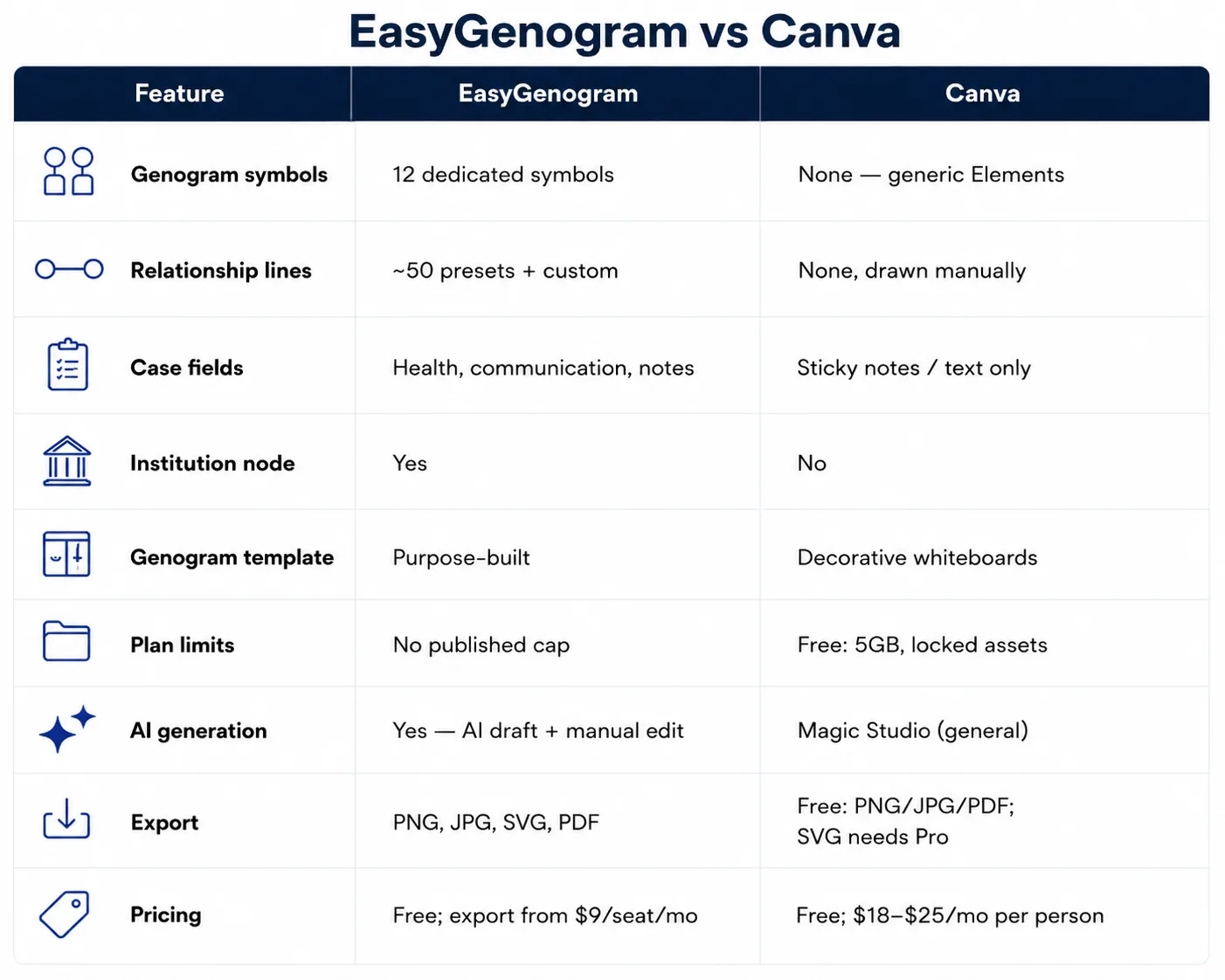
Which Should You Use; EasyGenogram or Canva?
If genograms are a regular part of your work, clinical practice, casework, or coursework, EasyGenogram is the clearer choice. It gets you to a usable diagram faster because the notation already exists.
Canva only makes sense if you want a decorative family-tree graphic for personal or social use, not something meant to function as a working clinical document, or if your team already uses Canva for other design work and just needs an occasional, non-clinical family sketch.
Build your genogram using EasyGenogram.
FAQ
Does Canva have genogram symbols?
No. Canva's genogram page routes to Whiteboards, and its genogram templates are decorative family-tree layouts built from the same generic Elements shapes used for any other design.
Can I make a clinical genogram in Canva?
You can approximate one manually, but it's a lot more difficult than using a genogram-specific tool like EasyGenogram, because there are no preset relationship lines, no clinical symbol set, and no structured per-person fields for health or case details.
Is EasyGenogram free to use?
Yes. Building and editing a genogram is free with no published cap on genogram size or number. Exporting requires the $9/seat/month Interactive Tools plan, with a 7-day free trial, but is entirely free for verified students.
Does Canva's AI generate genograms?
No. Canva's AI tools are general-purpose design and data-chart tools, not genogram-aware. EasyGenogram can generate an editable genogram from a plain-language description, then lets you refine it with instructions or manual editing.
Which is better for therapists, EasyGenogram or Canva?
EasyGenogram, for clinical or casework use specifically. It's built around the symbols, relationship lines, and structured fields genogram work requires. Canva fits better for a decorative family-tree graphic, not a working clinical genogram.