Appearance
EasyGenogram vs FamilyEcho: Family Tree vs Genogram Tool
EasyGenogram is better than FamilyEcho for clinical or coursework genograms because it adds relationship notation, case fields, and genogram-specific symbols. FamilyEcho is useful for basic lineage and GEDCOM family-tree work, but this guide explains why it stops short of a real genogram workflow.
Why a Family Tree Tool Isn't a Genogram Tool
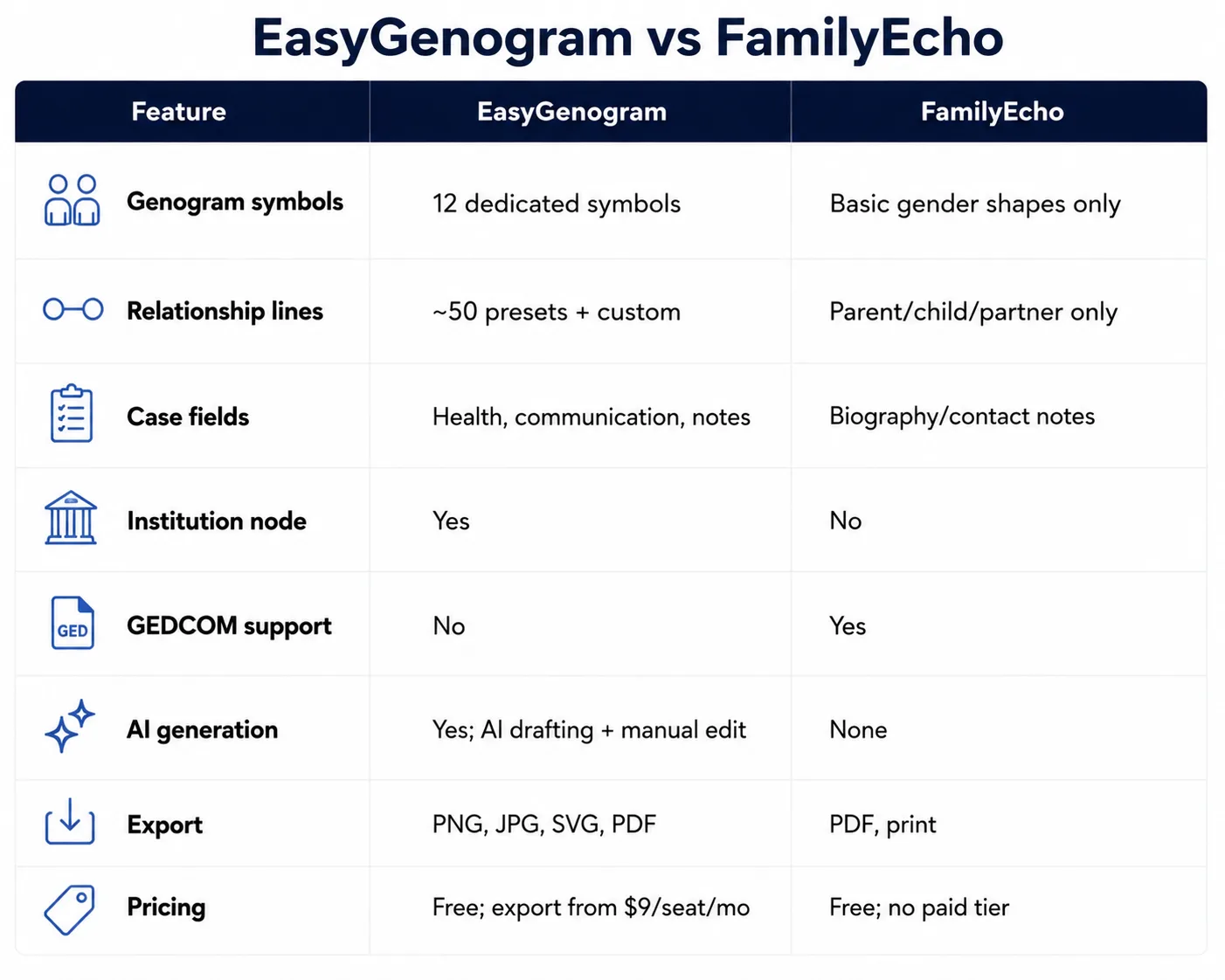
- Basic gender shapes only: Squares and circles exist for lineage, but there's no relationship-line notation layered on top.
- Parent, child, and partner lines only: No way to mark conflict, estrangement, cutoff, or closeness.
- Notes and Biography fields are free text: Useful for family history, not structured health conditions, communication patterns, or case fields.
- No Institution node: No way to represent CPS, court, school, or agency involvement.
- Built for genealogy, not case documentation: The Contact and Biography tabs suit family history research, not clinical assessment.
What a Genogram Tool Should Actually Do
Here’s what EasyGenogram, a genogram-specific tool, does:
- Purpose-built symbols: Gender and relationship symbols plus a free-text Gender Identity field, so you're never boxed into a fixed list of options.
- A real relationship-line library: roughly 50 preset types across emotional, family, and children's connections, so relationship quality is visible at a glance instead of manually labeled.
- A custom connection builder: define your own line type when a preset doesn't fit, so unusual or specific dynamics don't get flattened into a generic line.
- AI drafting with manual editing: create a first draft from a plain-language description, refine it with more instructions, then edit the genogram directly, so you're never starting from a blank canvas.
- One-click family structure: add a parent, partner, child, sibling, or connection directly from a selected person, so building out a family takes seconds instead of individual placement.
- An Institution node: a dedicated symbol for CPS, court, school, or agency involvement, so a case file shows outside-system involvement clearly.
- Structured clinical fields: Health Conditions and Sexual Communication as named fields, so details stay consistent across a caseload instead of scattered across notes.
Quick Comparison
When Should You Use FamilyEcho?
- You need to map lineage and ancestry only, not clinical or emotional dynamics.
- You want GEDCOM import/export to work with existing genealogy data.
- The family tree structure itself is the goal, with no relationship or case notation required.
When Should You Use EasyGenogram?
- You need to show relationship quality and clinical detail on top of a family structure.
- CPS, court, school, or agency involvement needs to appear as part of the record.
- The genogram itself is the deliverable, not a family tree or genealogy record.
Which Should You Use: EasyGenogram or FamilyEcho?
For casework or clinical use, EasyGenogram is the tool built for what comes next. FamilyEcho stops at being a way to map a family tree, but it can only be a reasonable structural starting point for a genogram.
Build your genogram using EasyGenogram.
FAQ
Can I build a clinical genogram in FamilyEcho?
Not accurately. FamilyEcho maps lineage well, but it has no relationship-line notation, no clinical symbol set, and no structured case fields for health conditions or institutional involvement.
Does FamilyEcho support GEDCOM?
Yes. It supports GEDCOM import and export, which EasyGenogram doesn't offer since it's built for clinical genograms rather than genealogy data.
Is EasyGenogram free to use?
Yes. Building and editing a genogram is free. Exporting requires a paid plan starting at $9/seat/month, with a 7-day free trial, but it's totally free for students.
Does FamilyEcho have any AI features?
No. FamilyEcho is a manual, form-based tool; you enter each person's details and build connections by hand. EasyGenogram can generate a first-draft genogram from a plain-language description, then let you refine it with instructions or edit it directly.
Can a family tree be a starting point for a genogram?
Yes. A family tree tool like FamilyEcho's can lay out the basic structure; who's related to whom, but a genogram tool like EasyGenogram adds relationship notation, emotional dynamics, and case-specific fields on top of it.