Skip to content

Genogram: The Complete Guide to Understanding Family Patterns

Families rarely tell their stories in a straight line.

A therapist may hear fragments in a counseling session:
a grandfather who drank heavily, a mother who stopped speaking to her sister in the 1980s, a son recently diagnosed with depression.

But when those fragments are placed onto a single diagram spanning three generations, something remarkable happens. Patterns begin to emerge.

Repeated divorces.
Clusters of illness.
Cycles of addiction or estrangement.

What once appeared to be isolated events begins to look like a system.

This is the purpose of a genogram.

A genogram is a visual tool used by therapists, social workers, medical professionals, and researchers to map family relationships and patterns across generations. By translating complex family histories into structured diagrams, genograms help professionals identify relational dynamics, inherited conditions, and behavioral patterns that may otherwise remain hidden.

Family therapist Monica McGoldrick, one of the pioneers of genogram methodology, describes the tool as a way to "see the family system unfold across time" (McGoldrick, Gerson & Petry, Genograms: Assessment and Intervention, 2008).

Today genograms are widely taught in psychology, social work, family therapy, and medical training programs, including many Marriage and Family Therapy (MFT) graduate programs and courses aligned with American Psychological Association (APA) guidelines.

Research has shown that genogram exercises can improve clinical pattern recognition during training. A study published in the Journal of Family Therapy, Hardy and Laszloffy (1995) found that counseling students who constructed genograms during case analysis were significantly more likely to identify intergenerational relationship patterns and systemic dynamics compared to students relying only on written case notes (Hardy & Laszloffy, 1995, Journal of Family Therapy).


What Is a Genogram?

A genogram is a structured diagram that represents family relationships, health history, and emotional dynamics across multiple generations.

At first glance, a genogram resembles a family tree. Both diagrams display lineage and ancestry. However, a genogram goes far beyond biological relationships.

A genogram typically records:

  • marriages, separations, and divorces
  • emotional relationships between family members
  • major life events such as deaths or migrations
  • mental health patterns
  • hereditary illnesses
  • family roles and relational dynamics

Because this information is represented visually, patterns that might remain invisible in written narratives often become immediately apparent.

A Common Misunderstanding About Genograms

INFO

Beginners often assume that the primary purpose of a genogram is to document family ancestry.

In practice, ancestry is usually the least interesting layer of the diagram.

Experienced clinicians pay far more attention to relationship patterns than to biological structure. Emotional distance, repeated conflict, caregiving roles, and alliances between family members often reveal more about family functioning than lineage alone.

Two families may have nearly identical structures - parents, children, grandparents - yet display completely different relational dynamics. A genogram becomes valuable not because it shows who belongs to the family, but because it shows how family members relate to one another across time.

For example, a therapist might discover that anxiety disorders appear across three generations of women in a family, or that periods of family estrangement tend to follow major economic crises.

These insights help professionals explore how family systems influence individual behavior and wellbeing, a core principle of Bowen family systems theory (Bowen, 1978; Kerr & Bowen, 1988).

For practical instructions on constructing one, see
How to Create a Genogram.


Historical Origins of the Genogram

The genogram emerged from family systems theory, a framework developed by psychiatrist Murray Bowen in the mid-20th century.

Bowen proposed that psychological issues cannot be fully understood by examining individuals in isolation. Instead, they must be viewed within the broader context of family relationships and intergenerational dynamics.

According to Bowen's theory, emotional patterns such as conflict, dependency, or anxiety can travel through families across generations.

In the 1970s and 1980s, researchers including Monica McGoldrick and Randy Gerson expanded Bowen's ideas by developing structured methods for mapping family systems visually.

Their work introduced the modern genogram diagram system, including standardized symbols for:

  • gender
  • relationships
  • emotional bonds
  • illness or behavioral conditions

The publication of "Genograms: Assessment and Intervention" helped establish the genogram as a core tool in family therapy education.

Today, genograms are widely used in:

  • Marriage and Family Therapy training programs
  • social work education
  • trauma-informed therapy
  • medical genetics and hereditary disease research

Why Genograms Reveal Hidden Family Patterns

Cognitive psychology research suggests that humans process visual information more efficiently than complex written descriptions (Ware, 2013, Information Visualization: Perception for Design). When relational data is arranged in diagram form, patterns such as recurring divorces or inherited conditions become easier to detect.

Empirical research in counselor education also supports the value of visual mapping tools in clinical assessment training. In one study of graduate counseling students, participants who used genograms during assessment exercises demonstrated higher accuracy in identifying family relational dynamics and transmission patterns than those using narrative family histories alone (Young, 2013).

In family therapy, genograms help reveal phenomena such as:

  • intergenerational trauma
  • repeated relational conflicts
  • emotional cutoffs between family members
  • caregiving roles passed across generations

Bowen described these repeating structures as multigenerational transmission processes.

By mapping family dynamics visually, therapists and researchers can analyze these processes more effectively.


Understanding the Structure of a Genogram

A genogram is not simply a collection of symbols. It is a structured visual language designed to encode complex family relationships in a consistent and interpretable format.

When professionals read a genogram, they are interpreting multiple layers of information simultaneously:

  • family structure
  • generational hierarchy
  • relational dynamics
  • emotional patterns
  • significant life events

The diagram is typically organized vertically by generation and horizontally by relationships, allowing viewers to trace patterns both across time and within each generation.

Understanding how to read and construct these diagrams requires familiarity with the standardized symbol system widely described in family therapy literature (McGoldrick, Gerson & Petry, 2008).


Basic Individual Symbols

Most genogram systems use simple geometric shapes to represent individuals.

SymbolMeaning
SquareMale
CircleFemale
DiamondGender unspecified or unknown
X through symbolDeceased individual

Additional annotations are often added near the symbol to represent key information such as:

  • birth year
  • death year
  • medical conditions
  • occupation or significant life events

For example, a clinician might write “Depression”, “Alcohol use disorder”, or “Breast cancer (age 42)” beside an individual symbol.


Relationship Lines

Relationships between individuals are represented by horizontal and vertical lines.

SymbolMeaning
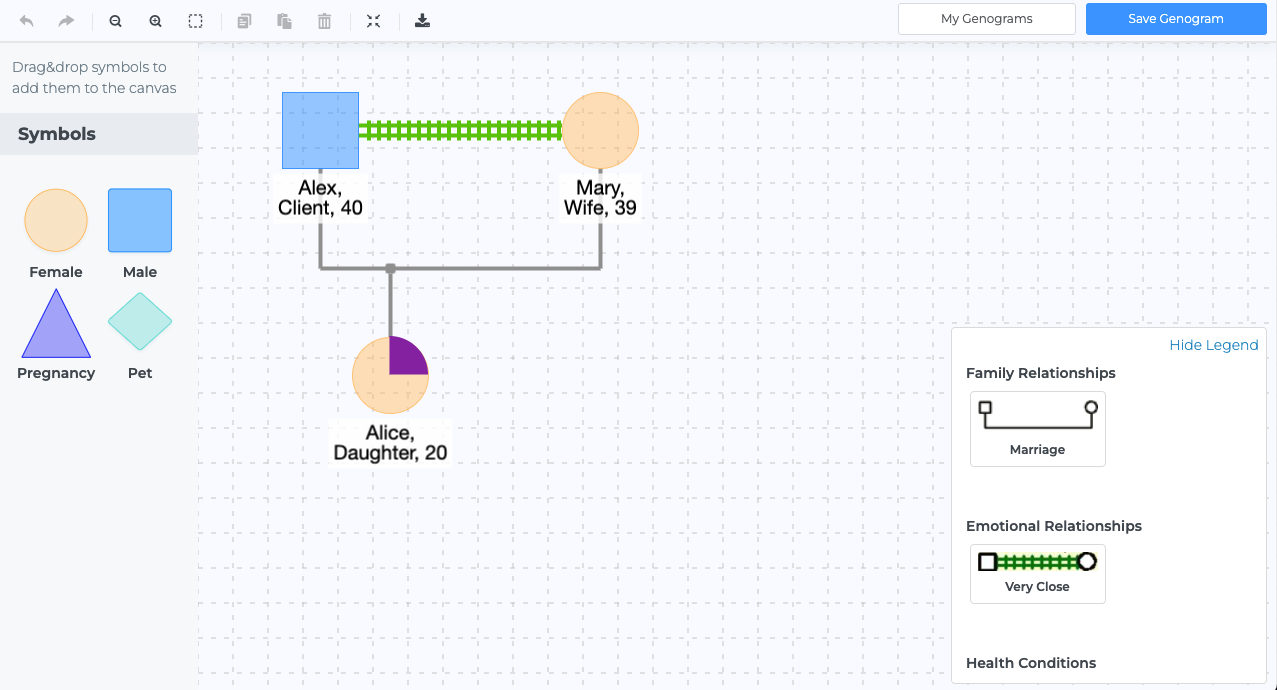
Horizontal line between two individualsMarriage or long-term partnership
Two slashes through relationship lineDivorce
Single slashSeparation
Dotted relationship lineUnmarried partnership or cohabitation

A vertical line descending from the relationship line connects the couple to their children.

Children are usually arranged from left to right in birth order, which helps readers understand sibling hierarchy within the family.


Representing Multiple Children and Sibling Order

When a couple has multiple children, their symbols are connected by a horizontal sibling line.

Example structure:

Parent ─── Parent | ────┬────┬──── Child1 Child2 Child3

Important conventions include:

  • leftmost child is the oldest
  • rightmost child is the youngest

Twins and multiple births are represented using branching diagonal lines from a single point.

SymbolMeaning
Two diagonal lines from same pointTwins
Connecting line between twin symbolsIdentical twins

Adoption and Foster Relationships

Genograms often include non-biological relationships that shape family dynamics.

SymbolMeaning
Dashed vertical lineAdopted child
Brackets around child symbolFoster child
Dotted line to parentsGuardianship relationship

In adoption cases, clinicians may also indicate both biological and adoptive parents, which helps illustrate complex family systems.

This is especially common in social work and adoption counseling.


Emotional Relationship Indicators

One of the features that distinguishes genograms from family trees is the ability to map emotional relationships.

Different line styles between individuals may represent emotional dynamics.

Line StyleMeaning
Double lineVery close relationship
Dotted lineDistant relationship
Zigzag lineConflict
Thick jagged lineHostility or abuse
No lineEmotional cutoff

These visual indicators allow therapists to identify relational patterns quickly.

For example, a genogram might reveal repeated emotional cutoffs between parents and adult children across generations, which can be clinically significant.


Emotional Cutoff and Estrangement

Emotional cutoff is a concept from Bowen Family Systems Theory referring to situations where individuals reduce or completely end emotional contact with family members to manage unresolved conflict.

In genograms this may be represented by:

  • a broken line between individuals
  • an absence of relational connection
  • explicit notation such as “no contact”

Mapping emotional cutoff can help therapists understand patterns of estrangement that recur across generations.


Representing Abuse or Trauma

In trauma-informed therapy, genograms sometimes include markers for abuse or harmful relational dynamics.

Examples may include:

  • jagged lines indicating physical conflict
  • annotated labels describing traumatic events
  • symbols marking substance abuse or psychiatric diagnoses

These notations allow practitioners to explore how trauma and behavioral patterns may be transmitted across family systems, a concept discussed in multigenerational family systems theory (Bowen, 1978).

However, clinicians must use such markings carefully because they involve sensitive personal information.


Layering Additional Information

Advanced genograms often include additional annotations that deepen the analysis.

These may include:

  • migration history
  • major illnesses
  • addiction patterns
  • religious affiliation
  • significant family events (bankruptcy, relocation, war exposure)

Because these diagrams encode so much information, they function as both:

  • clinical assessment tools
  • visual summaries of complex family narratives

In practice, genograms become living documents that evolve as therapists gather more information during interviews.

For a full symbol reference and printable guide, see
Genogram Symbols.

How Professionals Use Genograms

Genograms are used across several professional fields.

Psychotherapy

Therapists often use genograms during assessment to explore how family relationships shape emotional development.

For example, a counselor working with a client experiencing relationship anxiety may map several generations of family partnerships and discover a pattern of unstable marriages.

This insight can help both therapist and client understand how relational expectations may have been shaped by family history.

Family therapy training literature reports that constructing genograms can improve clinical interviewing and family assessment skills. When therapists construct genograms with clients, the process often encourages deeper conversations about family history, relational dynamics, and significant life events (McGoldrick, Gerson & Petry, 2008).

In training contexts, genograms are therefore used not only as analytical tools but also as structured frameworks for gathering family narratives.

Social Work

In social work practice, genograms help professionals understand family support networks, caregiving structures, and trauma histories.

They are particularly useful in:

  • adoption services
  • foster care assessments
  • child welfare cases

Medical Practice

In medicine, genograms function similarly to genetic pedigree charts. Physicians use them to track hereditary diseases and evaluate potential genetic risk factors.

Education and Training

Many psychology and counseling programs require students to create personal genograms as part of their training. This exercise helps future clinicians understand family systems theory in practice.

Many graduate programs require genogram projects because they encourage systems thinking. Family systems training literature emphasizes genograms as a tool for understanding concepts such as triangulation, differentiation, and intergenerational transmission (Kerr & Bowen, 1988). earchers have also noted l

For visual examples, see
Genogram Examples.


Case Example: Detecting Intergenerational Patterns

Consider a family where three generations of men experienced alcohol dependency.

The case began with a 34-year-old client who entered therapy for persistent relationship difficulties and anxiety. During early sessions he described a strained relationship with his father and minimal contact with extended family members. While he initially framed his struggles as personal failures, the therapist suspected that broader family patterns might be involved.

As the therapist explored the family history, additional details began to surface. The client’s father had struggled with alcohol use for many years. Further discussion revealed that the client’s grandfather had also experienced severe alcohol dependency.

When mapped onto a genogram spanning several generations, the pattern becomes clear.

The diagram may also reveal additional factors:

  • repeated emotional distance between fathers and sons
  • unresolved family conflicts
  • traumatic historical events affecting the family system

Viewed together, these elements transform scattered personal stories into a visible intergenerational pattern.

The genogram provided a structured way to discuss these themes during therapy. Rather than focusing solely on present symptoms, the therapist and client explored how expectations about masculinity, emotional expression, and coping strategies had been transmitted through the family system.

Although every family system is unique, cases like this illustrate how genograms transform scattered family memories into a structured map of relationships and events. By visualizing the family system across time, therapists and clients can identify patterns that might otherwise remain hidden within individual stories.


When Genograms May Not Be Appropriate

Despite their usefulness, genograms are not suitable in every situation.

Limitations include:

  • Incomplete information: family members may not know accurate details about previous generations
  • Crisis situations: urgent emotional needs may take priority over mapping family history
  • Confidentiality concerns: documenting sensitive information may raise ethical considerations
  • Cultural context: family structures vary widely across cultures and may not fit standardized diagrams

Family therapy literature also notes several limitations of genogram-based assessment. Because genograms rely heavily on self-reported family history, they may contain inaccuracies or incomplete information. Studies in clinical training emphasize that genograms should be interpreted as hypothesis-generating tools rather than definitive diagnostic instruments (McGoldrick, Gerson & Petry, 2008).


Genogram vs Family Tree

Although genograms resemble family trees, the two tools serve different purposes.

FeatureFamily TreeGenogram
Focusancestryrelational dynamics
Datalineageemotional + medical history
Purposegenealogyanalysis
Usershistorians, genealogiststherapists, clinicians

Genograms are therefore better suited for understanding family systems, not simply documenting lineage.


Genogram vs Ecomap

While genograms focus on relationships within a family across generations, an ecomap illustrates how a family interacts with the external environment.

Ecomaps are commonly used in social work and community health to visualize the connections between a household and the broader systems around it.

For example, an ecomap may show a family's connections to:

  • schools
  • healthcare providers
  • social services
  • religious communities
  • workplaces
  • support networks

Where a genogram asks “How do relationships function within the family system?”, an ecomap asks “How does the family interact with the outside world?”.

FeatureGenogramEcomap
FocusFamily relationships across generationsFamily connections to external systems
Time dimensionIntergenerationalPresent-focused
Used inTherapy, psychology, medicineSocial work, community health
PurposeIdentify internal relational patternsUnderstand environmental supports and stressors

In practice, social workers often use both tools together. A genogram reveals family dynamics, while an ecomap shows how the family interacts with institutions and social networks.


Genogram vs Pedigree Chart

A pedigree chart is commonly used in medical genetics to track hereditary conditions within families.

At first glance, pedigree charts look very similar to genograms because they use many of the same symbols to represent individuals and relationships.

However, pedigree charts focus primarily on genetic inheritance patterns, while genograms capture broader relational and psychological information.

For example, a pedigree chart may track:

  • hereditary diseases
  • genetic mutations
  • carrier status within a family

A genogram, by contrast, may include additional layers such as:

  • emotional relationships
  • family conflicts
  • trauma history
  • behavioral patterns
FeatureGenogramPedigree Chart
Primary useTherapy and family systems analysisMedical genetics
Information recordedEmotional, relational, medicalGenetic inheritance
Used byTherapists, counselors, social workersPhysicians, geneticists
PurposeUnderstand family dynamicsIdentify hereditary risk

Because of these differences, pedigree charts are typically used in clinical genetics, while genograms are used more broadly in behavioral health and social sciences.


When to Use Each Tool

Each of these diagram types answers a different question:

ToolKey Question
GenogramWhat patterns exist within the family system?
Family TreeWho is related to whom across generations?
EcomapHow does the family interact with the surrounding environment?
Pedigree ChartWhat hereditary conditions may run in the family?

Understanding these distinctions helps professionals choose the right tool for the specific analytical goal.


How to Create a Genogram

Creating a genogram involves more than drawing a family tree. The process combines data gathering, visual mapping, and pattern analysis. In professional practice, therapists and social workers often build genograms collaboratively with clients during interviews.

Although the level of detail can vary depending on the purpose, most genograms are constructed using a similar step-by-step approach.


Step 1: Identify Family Members Across Generations

The first step is to list family members across at least three generations. This usually includes:

  • grandparents
  • parents
  • siblings
  • children
  • extended relatives who play important roles

Each person is represented by a standard symbol such as a square (male) or circle (female).

At this stage, the goal is simply to map who belongs to the family system.

Basic information may also be recorded, such as:

  • birth and death years
  • major illnesses
  • significant life events

These details provide context for later analysis.


Step 2: Map Family Relationships

Next, relationships between family members are drawn using connecting lines.

For example:

  • a horizontal line connects partners or spouses
  • vertical lines connect parents to children
  • additional marks may indicate separation or divorce

Children are typically arranged from left to right in birth order, which helps readers quickly understand sibling structure.

This step establishes the structural framework of the family system.


Step 3: Add Emotional and Behavioral Patterns

Once the basic structure is complete, additional information is layered onto the diagram.

Professionals may annotate:

  • emotional closeness or conflict
  • estrangement or emotional cutoff
  • substance abuse or mental health conditions
  • major family transitions such as migration or loss

These annotations transform the diagram from a simple lineage chart into a functional map of family dynamics.


Step 4: Identify Patterns Across Generations

The final step involves analyzing the completed genogram to identify patterns.

Common patterns that emerge include:

  • repeated relationship conflicts
  • cycles of divorce
  • intergenerational trauma
  • hereditary medical conditions
  • recurring family roles such as caregiving or emotional distancing

This analytical phase is where genograms become most valuable. By visualizing family structures across time, therapists and researchers can explore how individual experiences may be shaped by broader family systems.

For a detailed tutorial with examples, see
How to Create a Genogram
or explore ready-made
Genogram Templates.


Research Highlights

Research across psychology and counseling education has demonstrated several benefits of genogram use:

  • Students using genograms have been shown to demonstrate improved recognition of intergenerational relationship patterns compared with narrative-only assessment methods (Hardy & Laszloffy, 1995; Young, 2013).
  • Visual mapping tools such as genograms are widely used in family therapy training to support systems-level thinking during clinical assessment (McGoldrick, Gerson & Petry, 2008).
  • Genogram construction encourages more detailed family storytelling during therapy sessions.

These findings help explain why genograms remain a standard teaching tool in Marriage and Family Therapy (MFT) and counseling programs worldwide.


Conclusion: Why Genograms Remain One of the Most Powerful Family Analysis Tools

Families carry stories across generations, but those stories are rarely organized in ways that make patterns easy to see.

A genogram transforms those scattered narratives into a structured visual system. By mapping relationships, emotional dynamics, and life events across multiple generations, the diagram allows therapists, educators, and medical professionals to observe how family systems evolve over time.

What makes genograms particularly powerful is their ability to combine several types of information in one place:

  • family structure
  • relational dynamics
  • behavioral patterns
  • medical history
  • major life transitions

When these elements are visualized together, patterns that once appeared unrelated often begin to connect.

This is why genograms remain a foundational tool in family systems therapy, social work practice, and medical family history assessment. They help professionals move beyond isolated events and instead examine how individual experiences are shaped by broader relational systems.

For students and practitioners learning about family systems theory, genograms also provide a practical way to apply theoretical concepts such as intergenerational transmission, family roles, and emotional cutoff.

If you want to deepen your understanding of genograms, the next step is to explore how they are constructed and interpreted in real practice.

You can continue with:

Together, these guides will help you move from understanding the concept of genograms to building and analyzing them in real-world situations.


FAQ

What is the difference between a genogram and a family tree?

A family tree records ancestry and lineage. A genogram expands on this by mapping emotional relationships, health history, and behavioral patterns within the family system.

How many generations should a genogram include?

Most clinical genograms include three generations, though some analyses extend further when historical information is available.

Are genograms used in medical practice?

Yes. Medical professionals use genogram-style diagrams, often called pedigree charts, to identify hereditary disease risks.

Do students create genograms in psychology programs?

Many counseling, psychology, and social work programs require students to complete genogram assignments as part of training in family systems theory.


Sources

  1. Family Therapy in Clinical PracticeMurray Bowen, 1978
  2. Genograms: Assessment and InterventionMonica McGoldrick, Randy Gerson, and Sueli Petry, 2008
  3. Family EvaluationMichael Kerr and Murray Bowen, 1988
  4. American Psychological Association training resourcesAmerican Psychological Association
  5. Marriage and Family Therapy graduate program curriculaMarriage and Family Therapy graduate programs
  6. The cultural genogram: Key to training culturally competent family therapistsKenneth V. Hardy and Tracey A. Laszloffy, 1995
  7. Learning the art of family assessment through genogramsMark E. Young, 2013